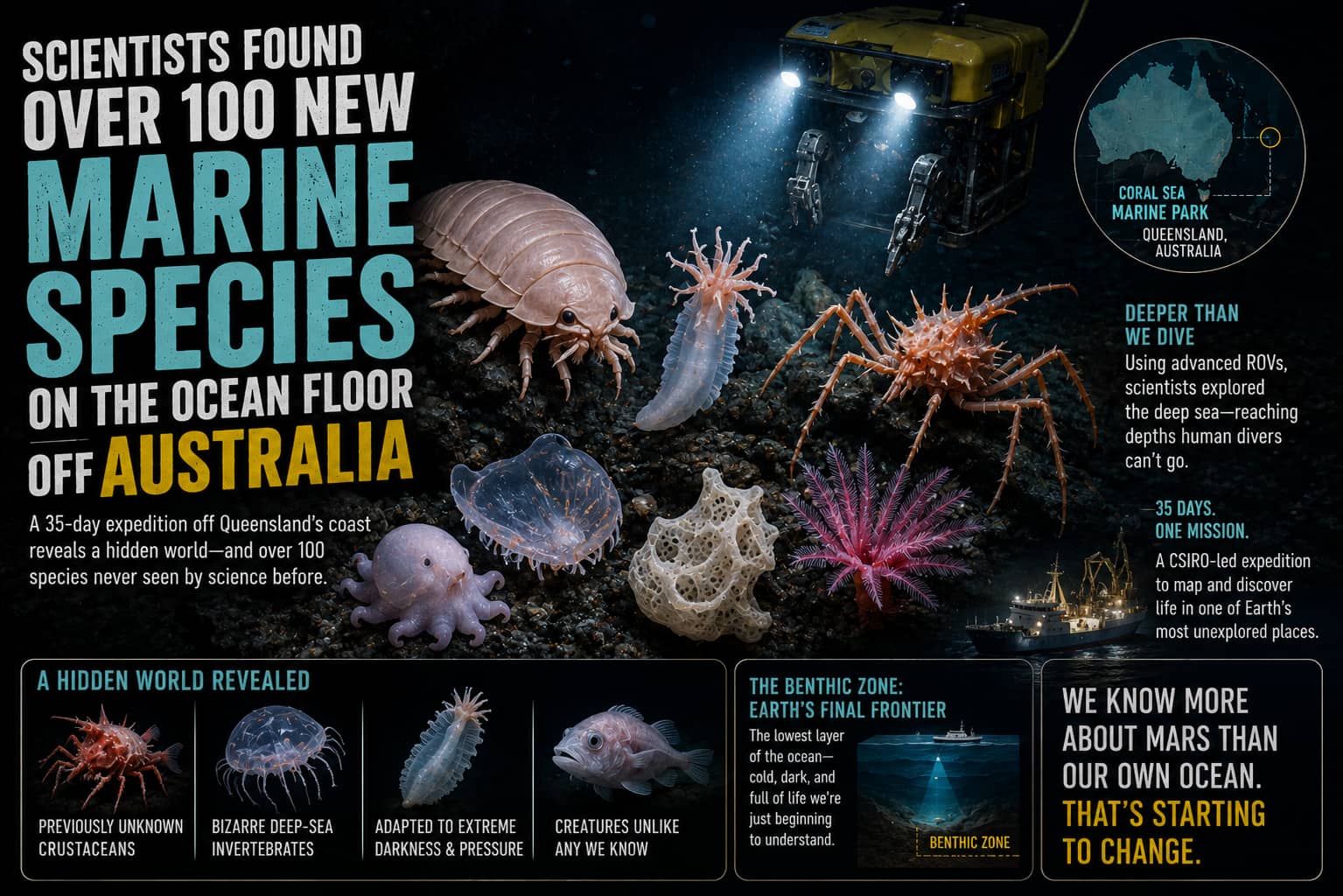
We have better maps of the surface of Mars than we do of our own ocean floor. That fact keeps getting repeated because it keeps being true. And it was proven again when a 35-day deep-sea expedition off Australia's coast came back with over 100 species that science had never documented before.
The research team explored the deep waters of the Coral Sea Marine Park off the coast of Queensland, collecting specimens from the benthic zone, the lowest area of a body of water along the sea floor. The expedition was led by the Commonwealth Scientific and Industrial Research Organisation (CSIRO), Australia's national science agency.
The discoveries included everything from previously unknown crustaceans to deep-sea invertebrates. The team used advanced remotely operated vehicles to reach depths that are nearly impossible for human divers. What they found down there was a world that looked nothing like the surface. These creatures have adapted to complete darkness, crushing pressure, and near-freezing temperatures. Many of them are bizarre even by deep-sea standards.
This expedition is part of a broader global effort. In early 2026, 24 new species of crustaceans were described as part of a separate project aiming to name 1,000 deep-sea animals by 2030. And in late 2025, the California Academy of Sciences reported 138 new species discoveries from its own scientists in a single year.
The pace of discovery is actually accelerating, not slowing down. Scientists are now identifying more than 16,000 new species each year globally. We are nowhere close to running out of things to find. Current estimates suggest we have discovered less than 10% of all species that exist on Earth. The ocean, in particular, remains overwhelmingly unexplored.
What makes these deep-sea discoveries particularly important is that they often reveal organisms with unique biological properties. Some deep-sea creatures produce compounds that have potential applications in medicine. Others help scientists understand how life adapts to extreme conditions, which has implications for everything from climate research to the search for life on other planets.
The timing matters too. Marine biodiversity is under increasing threat from warming oceans, deep-sea mining proposals, and plastic pollution that reaches even the most remote depths. Discovering what lives down there is not just about satisfying scientific curiosity. It is about knowing what we stand to lose before it disappears. You cannot protect what you do not know exists, and right now, we do not know what exists across roughly 80% of our own ocean.
Have you ever thought about what might be living at the bottom of the ocean right now that we have zero knowledge of? Because the answer is: a lot.
Ronny M (ronny76netstuff@gmail.com) is a content creator under the Newswav Creator programme, where you get to express yourself, be a citizen journalist, and at the same time monetize your content & reach millions of users on Newswav. Log in to creator.newswav.com and become a Newswav Creator now!
The User Content (as defined on Newswav Terms of Use) above including the views expressed and media (pictures, videos, citations etc) were submitted & posted by the author. Newswav is solely an aggregation platform that hosts the User Content. If you have any questions about the content, copyright or other issues of the work, please contact creator@newswav.com.