
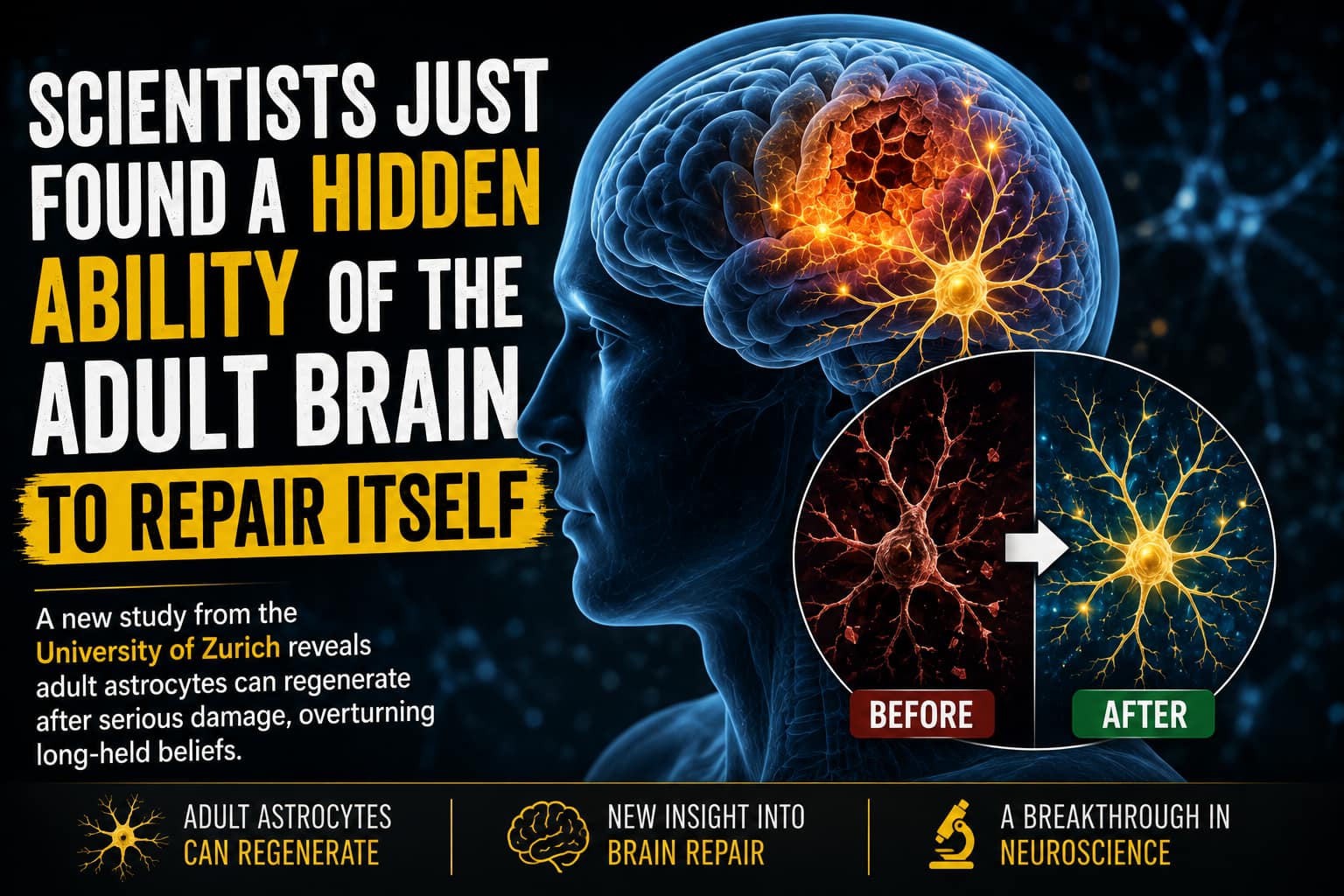
For a long time, the working assumption in neuroscience was that adult astrocytes, the support cells that keep neurons functioning, could not meaningfully regenerate after serious damage. A study out of the University of Zurich just upended that.
The research, published in Nature Neuroscience, identified a specialised population of what the team calls regenerative astrocytes that respond to injury by growing long cellular extensions into the damaged area and physically transporting new cell nuclei through them to rebuild tissue. Lead researchers Marina Herwerth and Matthias Wyss, working under principal investigator Bruno Weber, used two photon microscopy to watch this process unfold in real time inside living mouse brains over several weeks.
How They Actually Caught It Happening
Technology Networks broke down the mechanism in more detail, describing how the team tracked gene activation patterns across different brain regions to pinpoint exactly which cells were responsible for the repair process, rather than relying on static after the fact tissue samples that would have missed the mechanism entirely.
Why This Matters Beyond the Lab
The University of Zurich's release, also carried on EurekAlert, quoted Weber directly: "The findings of our study reveal a previously unknown ability of the adult brain to repair itself. They point toward new ways of supporting recovery from ailments involving the loss of astrocytes." That includes conditions like neuromyelitis optica spectrum disorder, an autoimmune condition where the body specifically attacks and destroys astrocytes, leaving patients with exactly the kind of damage this newly discovered repair mechanism might one day be coaxed into fixing.
The Bigger Shift Here
Brain injuries have long been treated as largely one directional, damage happens, and the brain compensates around it rather than genuinely repairing the lost tissue. A confirmed, mapped repair mechanism changes that framing considerably, opening the door to therapies that actively support or amplify a process the brain was already capable of, just not one anyone knew to look for.
What Comes Next in the Research
The team's next step is identifying what triggers a given astrocyte to become one of these regenerative cells rather than staying dormant, since understanding that switch is what would eventually let researchers encourage more of the brain's own tissue to take part in repair after an injury, rather than simply observing that some of it already does.
My Opinion
Every few years neuroscience quietly overturns something we treated as settled fact, and this is one of those moments. The adult brain has apparently been repairing itself in ways nobody documented until someone finally pointed a microscope at the right cells for long enough. Makes you wonder what else is happening in there that we have simply never watched closely enough to notice.
Ronny M (ronny76netstuff@gmail.com) is a content creator under the Newswav Creator programme, where you get to express yourself, be a citizen journalist, and at the same time monetize your content & reach millions of users on Newswav. Log in to creator.newswav.com and become a Newswav Creator now!
The User Content (as defined on Newswav Terms of Use) above including the views expressed and media (pictures, videos, citations etc) were submitted & posted by the author. Newswav is solely an aggregation platform that hosts the User Content. If you have any questions about the content, copyright or other issues of the work, please contact creator@newswav.com.