
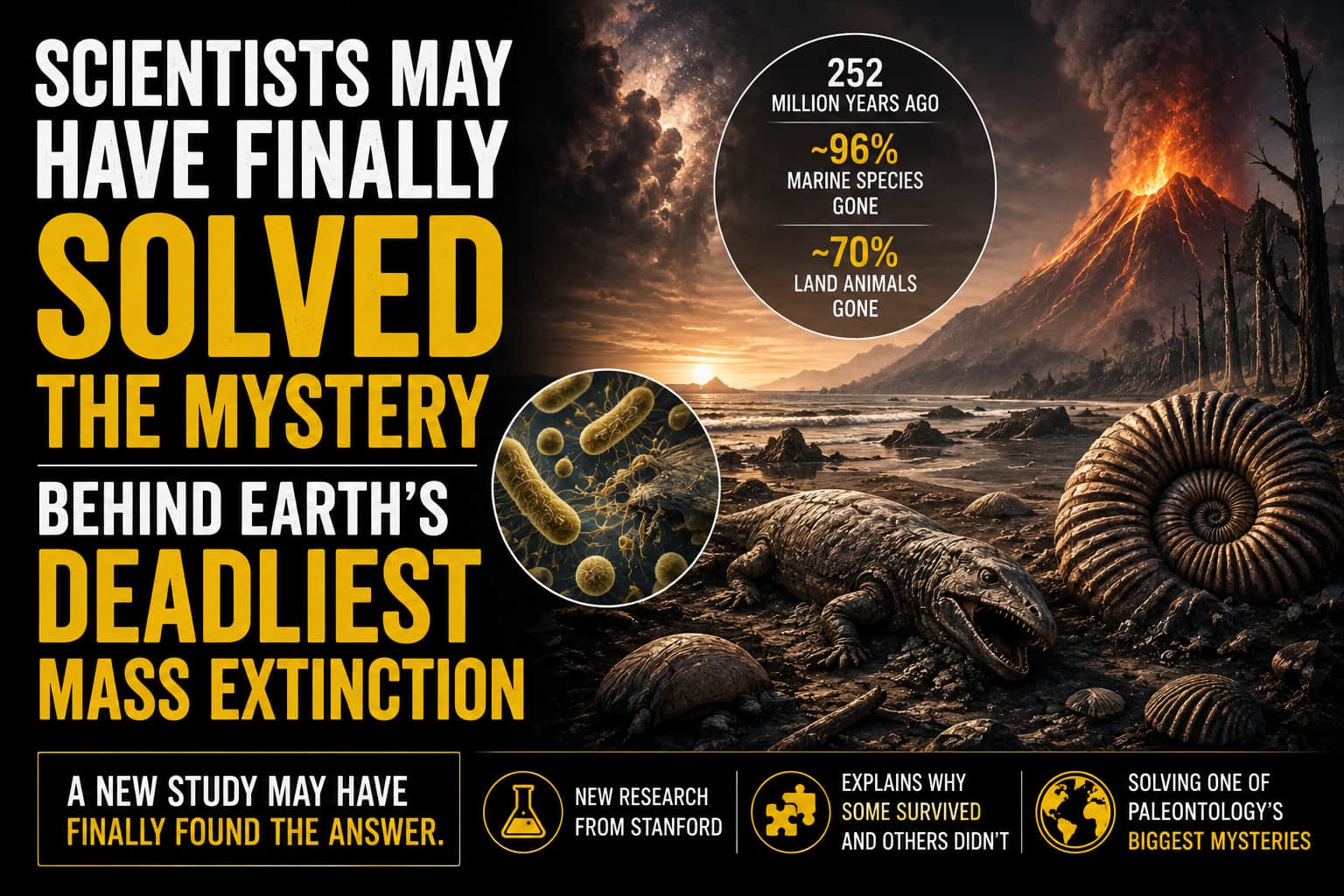
252 million years ago, something wiped out roughly 96 percent of marine species and 70 percent of land animals on Earth. It is known as the Permian-Triassic extinction, or more bluntly, the Great Dying, and it has remained one of the most debated mysteries in paleontology for decades. A new study out of Stanford may have finally nailed down why some species survived and others simply vanished.
The research, published in the Proceedings of the National Academy of Sciences and covered by ScienceDaily, found that survival came down largely to metabolism. Massive volcanic eruptions released enormous quantities of CO2 and methane, warming the oceans and depleting their oxygen. Species that needed faster metabolic rates and higher oxygen intake to function, like fast moving fish and mobile snails, were hit hardest as the water around them lost the oxygen they depended on, while slower, less metabolically demanding creatures like brachiopods that had previously dominated the ocean floor were effectively replaced.
Who Did the Work
Stanford's own report on the findings credited former PhD student Jose Andres Marquez as lead researcher, working under professor Erik Anders Sperling. Marquez explained the core finding directly: "Our findings show that, across different organism groups, extinctions happened at much higher rates for those more vulnerable to increases in water temperature."
Why This Is Not Just Ancient History
Sperling did not shy away from drawing a line to the present, saying "understanding how Earth and Earth's biota responded back then could inform us of what's to come," before adding a note that reads less like scientific detachment and more like a warning: "We're still at the point where we can change things and do something about it."
What Makes This Different From Previous Theories
Earlier explanations for the Great Dying focused heavily on the volcanic activity itself as the direct killer, through toxicity or immediate environmental collapse. This study reframes the mechanism as more specific and more measurable, tying survival directly to metabolic demand under oxygen stress, a pattern that gives researchers something concrete to compare against today's warming, oxygen depleting oceans rather than a vague historical parallel.
A Warning Dressed as History
Gizmodo's coverage of the findings framed it bluntly as bad news for the present, not just an answer to an ancient puzzle, given that the same oxygen depleting, warming ocean conditions that doomed so many species 252 million years ago are already measurably underway again today, just on a vastly different timescale than the volcanic upheaval that triggered the original event.
Ronny M (ronny76netstuff@gmail.com) is a content creator under the Newswav Creator programme, where you get to express yourself, be a citizen journalist, and at the same time monetize your content & reach millions of users on Newswav. Log in to creator.newswav.com and become a Newswav Creator now!
The User Content (as defined on Newswav Terms of Use) above including the views expressed and media (pictures, videos, citations etc) were submitted & posted by the author. Newswav is solely an aggregation platform that hosts the User Content. If you have any questions about the content, copyright or other issues of the work, please contact creator@newswav.com.