
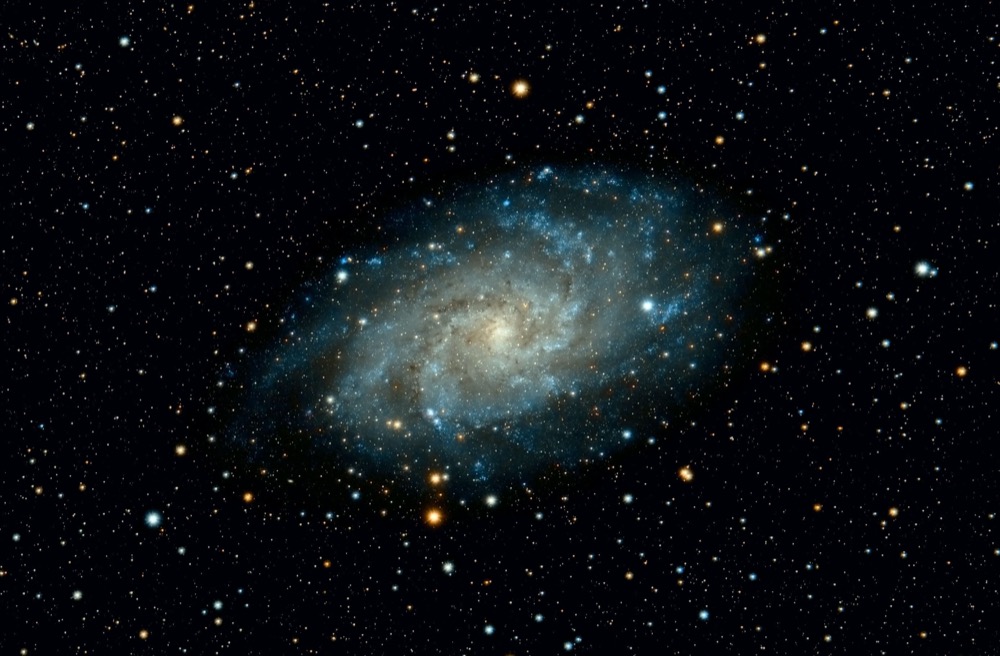
Astronomers may have uncovered a rare pair of galaxies that appear to contain almost no dark matter, challenging conventional understanding of how galaxies form. The findings, reported on the arXiv preprint server, focus on FCC 224 and FCC 240, two ultra-diffuse galaxies on the outskirts of the Fornax Cluster. Their unusual properties suggest a violent and unusual origin, providing a new window into the mysterious behavior of galaxies in the cosmos.
Ultra-Diffuse Ghost Galaxies Defy Expectations
Ultra-diffuse galaxies (UDGs) are faint and sprawling, roughly the size of the Milky Way but containing far fewer stars. While many UDGs are rich in dark matter, forming “failed galaxies” that never accumulated much stellar mass, a small subset appears almost completely devoid of it. FCC 224 and FCC 240 fall into this latter, enigmatic category. Observations with the MUSE instrument on the Very Large Telescope revealed that stars and globular clusters in both galaxies move sluggishly, suggesting the galaxies’ inner gravitational pull comes mainly from their visible stars. Their dynamical masses within the half-light radius closely match their stellar masses, far below what is expected for ordinary dwarf galaxies. This low velocity dispersion places them among the rarest cosmic phenomena ever observed.
Evidence For a Violent Origin
The pair also hosts abnormally bright globular clusters whose luminosity patterns mirror the previously known dark-matter-deficient galaxies DF2 and DF4. FCC 224 and FCC 240 are nearly identical in age, around ten billion years old, with clusters sharing the same metallicity and formation history as the surrounding stars. Researchers propose that these properties align closely with the bullet-dwarf collision scenario, where two dwarf galaxies collide at high speed, separating stars from their dark matter. The process triggers a rapid, intense burst of star formation, producing both the diffuse galaxy bodies and unusually massive clusters at the same time.
“Taken together, these results suggest that FCC 224 and FCC 240 may have formed in a high-velocity collision similar to the event proposed for DF2 and DF4,” the researchers conclude.
Comparing The New Twins With DF2 And DF4
Unlike DF2 and DF4, which are separated by 240 kiloparsecs and form part of an extended chain of debris, FCC 224 and FCC 240 are only 75 kiloparsecs apart and moving toward each other at a mere 16 kilometers per second. This compact pairing implies a long-lived gravitational bond rather than a dispersed stream of fragments. Despite the difference in separation, astronomers suggest that both systems may have experienced a high-energy collision with only minor variations in orbital geometry, creating either an extended chain or a tightly bound pair. This raises the possibility that dark-matter-deficient galaxies are not unique anomalies but part of a broader phenomenon in galactic evolution.
Searching For Dark Matter Remnants
The team estimates that any dark matter remnants from the original collision could lie roughly three megaparsecs away along the projected axis. These potential remnants offer a natural target for future observations, which may reveal additional fragments or ejected halos. Deeper and more comprehensive studies will be needed to determine whether FCC 224 and FCC 240 formed independently or as part of a shared violent event. The current data, shared through the arXiv preprint server, provide some of the clearest evidence yet that extreme high-speed collisions may shape galaxies in unexpected ways.