
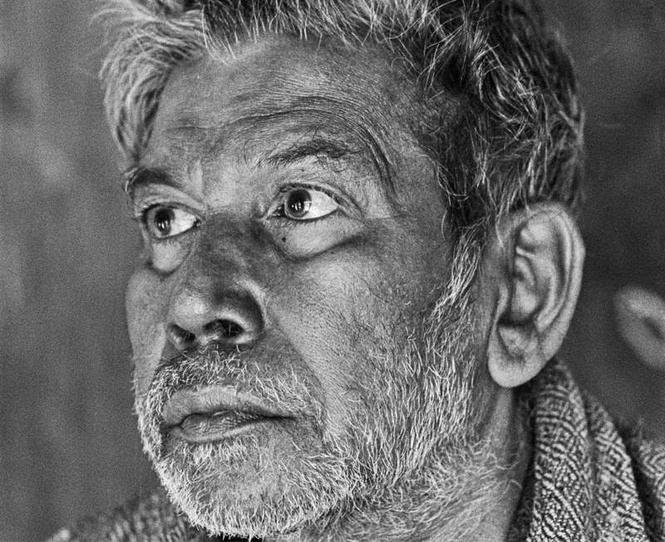
Imagine the red soil of Birbhum district in West Bengal, and its termite mounds. Think of a passionate rustic with a curly mop of hair fashioning his sculptures with rudimentary materials like concrete and his bare bronze skin hands. This was the guru of Santiniketan, India’s first modernist sculptor Ramkinkar Baij. It was Rajeev Lochan, director, National Gallery of Modern Art (NGMA), and Akar Prakar’s Reena Lath who unravelled a brilliant retrospective curated by sculptor KS Radhakrishnan many moons ago to shine the light on this great master.
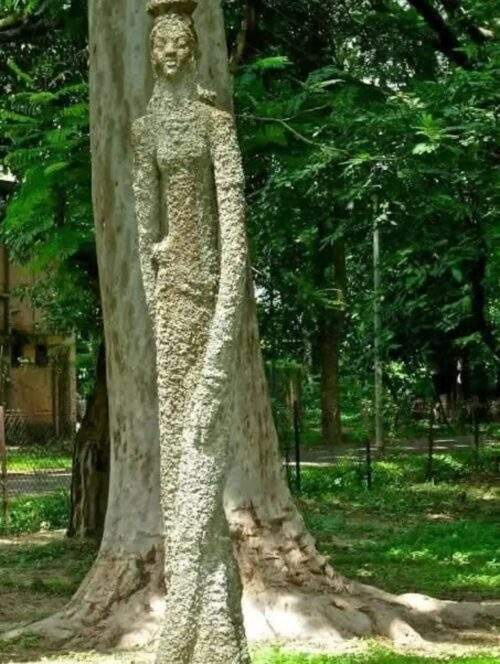
Sujata, c 1935, at Kala Bhavana in Santiniketan. Photo by Uma Nair
Historic cement heads
Baij’s outdoor sculptures rise out of the ground, and he holds the foundation of the modern Indian sculpture. At the NGMA as well as Lalit Kala Akademi in Delhi stand his historic cement heads of Gurudev Rabindranath Tagore. In the NGMA’s treasure trove is an abstract head of Tagore that makes us gauge how deep his understanding of Cubism was and how the abstraction of form just flowed through his compositional clarity and philosophy of modernism.
One recalls the NGMA exhibition presented by the Ministry of Culture and Prof Rajeev Lochan stating clearly that Baij (1906-80) was the vanguard of modern Indian sculpture.
Dotting different parts of India are his larger-than-life outdoor concrete statues, and his life-size Yaksha and Yakshi at the Reserve Bank of India in Delhi that reflect how in the creation of his own sensibilities, Baij broke the shackles of the British colonial curriculum taught in Indian art colleges. His works were born of personal experience.
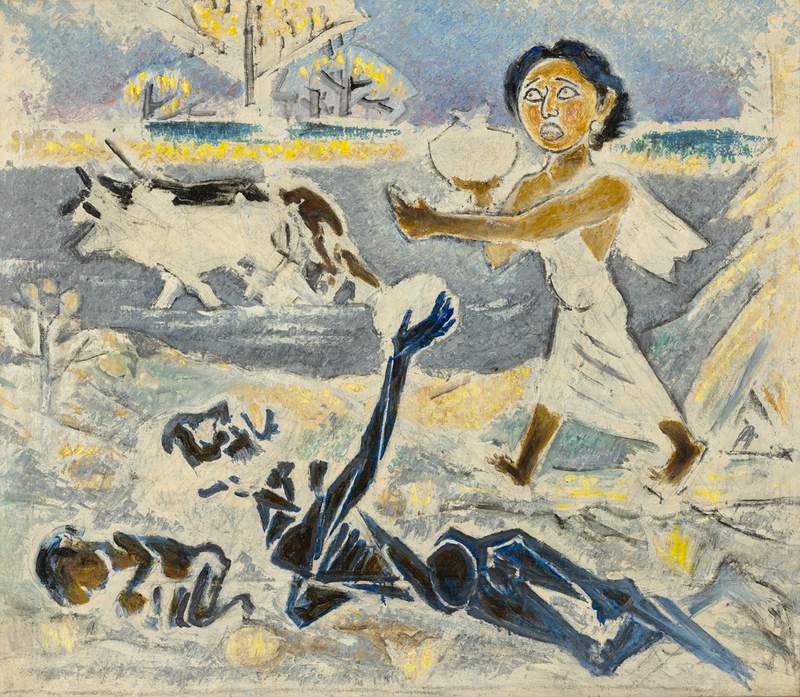
Untitled (Famine Series), c 1976. Oil on canvas. Photo courtesy: DAG
Life and nature
Shruti Das, curator of NGMA at Mumbai, says it was Baij’s choice of material and his subjects that set him apart. She elaborates: “Concrete was combined with laterite pebbles from the Khoai (formation native to Bengal) and this action rooted his entire evolution to Santiniketan.”
Yaksha and Yakshi
Das says the RBI commissioned Baij to make dvarapala (protective figures placed outside the doors of temples) sculptures for its New Delhi offices in the 1950s. For the Yaksha and Yakshi sculptures, the stone was specially obtained from Baijnath in Himachal Pradesh. Baij’s thought and sensibility shine through in this pair of sculptures; the Yaksha holds a pinion and a bag of money, while the Yakshi stands with flowers, agricultural produce and a rudder in her hands.
According to the late artist A Ramachandran, who was Baij’s student, “This was an example of a pre-modern iconic pairing of the Yaksha and Yakshi. The composition was a conversation staged between modern and contemporary art. The sculpture was a rethought of nationalist ideologies at the time of Independence and in the context of globalisation.”
Among his sculptures, his tall and slender ‘Sujata’ (1935) and the seated Buddha are both stupendous creations. ‘Sujata’ was made from laterite granules, gravel mixed with cement. The result was a uniquely textured surface on his figures. ‘Sujata’, the earliest cement sculpture, was modelled on artist Jaya Appasamy. Among such works, ‘Santhal Family’ (1938) and ‘Mill Call’ (1956) stood out as iconic sculptures, made as a celebration of the working class and the Santhals. Another outdoor work, ‘Lamp Stand’ (1940), is arguably the earliest abstract sculpture by an Indian artist.
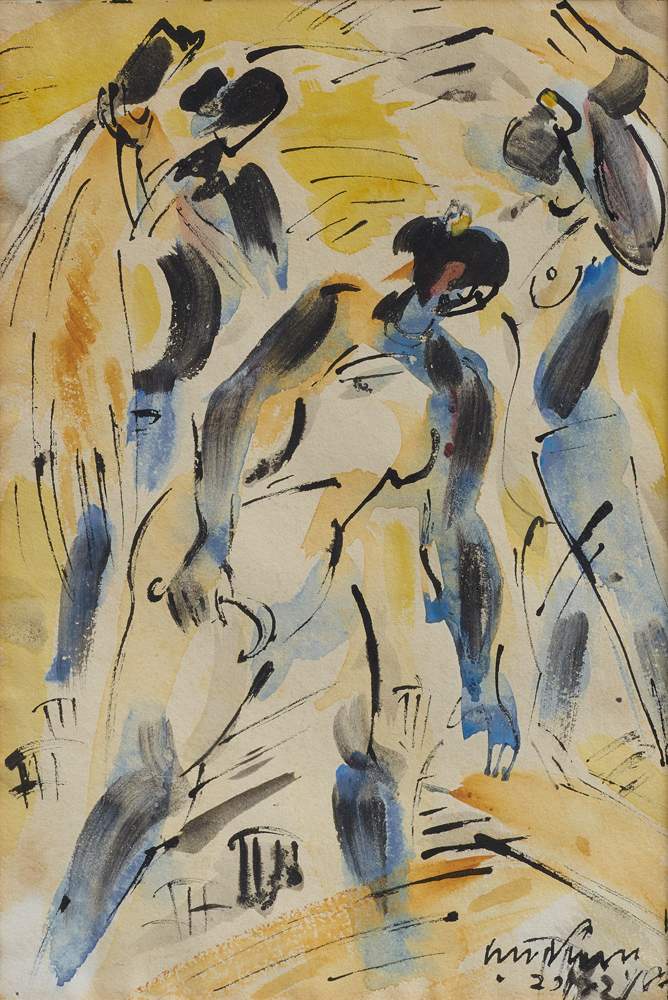
Untitled (Women Threshing) — 1951. Watercolour and ink on paper. Photo courtesy: DAG
Expressionist paintings
Baij’s works on paper and canvas too are a delight to behold. His paintings in watercolours, gouache and in oils were about nature and life. His Expressionist strokes were candid and charismatic. ‘Famine’, ‘Harvesters’ and ‘Santhals’ were all his pet subjects, as were forests and flowers bathed in sunlight.
Paintings were his immediate response to the rural environment around Santiniketan. The restless bold strokes, executed with great speed, capture fleeting moments of light and form of the ever-changing Indian landscape.
KG Subramanyam, the artist and critic, described how Baij depicted the bare landscape around Santiniketan — “Each little detail came to throbbing life. The modest trees bristled up with a primitive vigour and the foliage took on a new sheen and vivacity. The sky played hide and seek with the barren earth… the seasonal nuances came out with great authenticity. In his company, we saw nature in a new light,” he wrote in ‘Ramkinkar: The Man and his Work’ (Lalit Kala Contemporary 30, September 1980).
Amongst portraits on paper and canvas, his ‘Binodini’ was a head-turner. She was his student and a watercolour of her smoking a cigarette demurely clad in a saree is unforgettable.
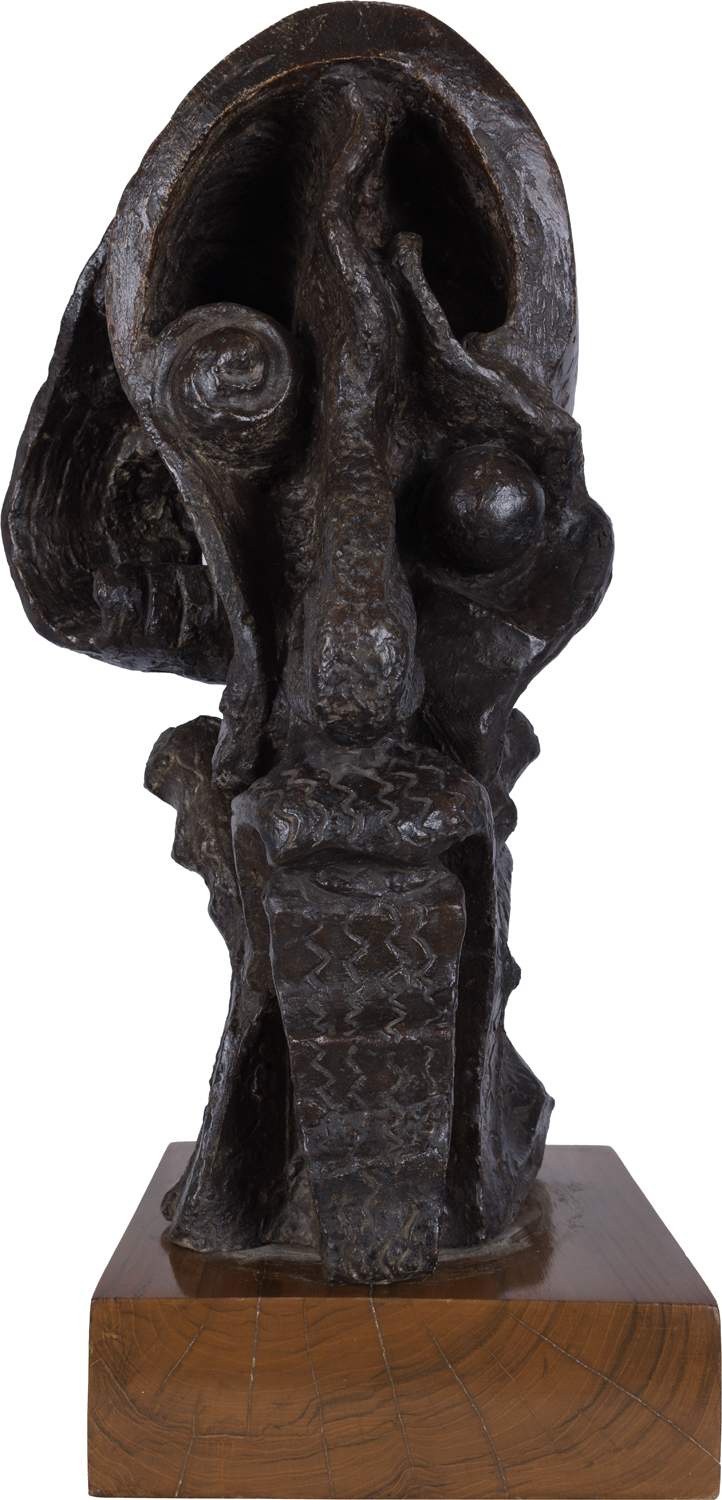
The Poet (Head of Rabindranath Tagore), c 1938. Painted cement with wooden pedestal. Photo courtesy: DAG
Through Ghatak’s lens
The best film on him, though incomplete, was by the famed Ritwik Ghatak. In ‘Ramkinkar Baij — A Personality Study’, Baij speaks about the problems that he faces in his life. He narrates how he has shielded his dripping roof with his oil paintings. An astonished Ghatak asks him what he is going to do for the show that is coming soon.
To this question, Baij answers: “As the paintings are made by oil on canvas, water will not do any damage to them. I can pull them out for the show. But my worry is what I will replace them with to stop the rainwater. It costs a hundred rupees to buy grass for thatching. It is very expensive.”
— The writer is a critic and curator