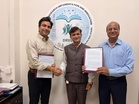
ALABANG — The Southeast Asian Regional Center for Graduate Study and Research in Agriculture (Searca) helped organize a conference on how to measure whether science and technology projects are working.
The 2nd Science and Technology Impact Assessment Conference (IACon) 2026 was held May 25-26, 2026, at the Acacia Hotel here. It was led by the University of the Philippines Los Baños College of Public Affairs and Development, together with the Department of Science and Technology through the Philippine Council for Industry, Energy and Emerging Technology Research and Development (PCIEERD) and the Philippine Council for Agriculture, Aquatic and Natural Resources Research and Development (PCAARRD). The theme was “Evaluating What Works in STI-led Pathways to Development.”
IACon 2026 brought together local and international researchers, government officials and practitioners. They shared methods, real examples and ideas on how to build impact assessment into regular monitoring and evaluation. Impact assessment (IA) is the process of checking whether a project delivers long-term benefits for people, the economy and technology. Sessions focused on improving tools used to track these results.
Searca Center Director Mercedita Sombilla said IA helps answer three questions: which programs work, which need to be fixed, and which should be expanded.
“The goal is simple. Make sure science and technology give real, measurable benefits: better incomes, stronger food systems, a cleaner environment, and better opportunities for people,” she said.
In a roundtable on putting IA into decision-making, Searca’s Rowell Dikitanan said IA should not be treated as just a requirement for donors.
“It must be a main part of how institutions plan and decide,” he said.
Dikitanan, head of Searca’s Project Development and Technical Services Unit, spoke for Sombilla as a panelist.
He explained that Searca builds IA directly into its 12th Five-Year Plan called Sustain Southeast Asia. The plan aims for four outcomes: higher farmer incomes or “Pocket,” better food security or “Plate,” stronger farms and resources or “Place,” and more skilled farmers and leaders or “People.”
Dikitanan also led a session on how IA provides data for major investments such as space technology, mapping and geospatial systems, and industry plans that support long-term national goals.
He said these investments matter more when backed by strong institutions, steady partnerships and practical ways to use them. IA also helps make policy decisions clearer and holds agencies accountable.
Dikitanan gave two examples of Searca’s IA work. For the Technical Education and Skills Development Authority’s farm school program, Searca worked with all groups involved to agree on goals and design the survey.
This showed where there were gaps, duplicated work, unclear roles and areas where strategies needed to be strengthened. It also showed that good assessment starts when everyone understands and owns the goals.
For large programs, Searca adjusts its methods. In the nationwide review of the Rice Competitiveness Enhancement Fund-Rice Extension Services Program, or RCEF-RESP, which reached more than 300,000 farmers, trainers and extension workers in 57 provinces. Searca used surveys, group discussions, interviews and government data to provide a comprehensive picture of results.
Dikitanan said there is no single way to do IA. He told leaders to focus on learning from results, accept findings even if they are negative, and make sure IA results are discussed during budget planning and used in the next cycle of projects.
Searca has supported IACon since the first conference in 2023, led by UPLB’s School of Environmental Science and Management. The next conference will be held in 2028.
As Searca works to be a policy center for Southeast Asia, it promotes careful impact assessment in science and technology to help guide decisions with evidence.
Guided by its mission of linking science, policy and practice, Sombilla said Searca supports IA so investments in areas such as biotechnology, renewable energy and digital farming translate into practical benefits that improve the lives of farming communities.