
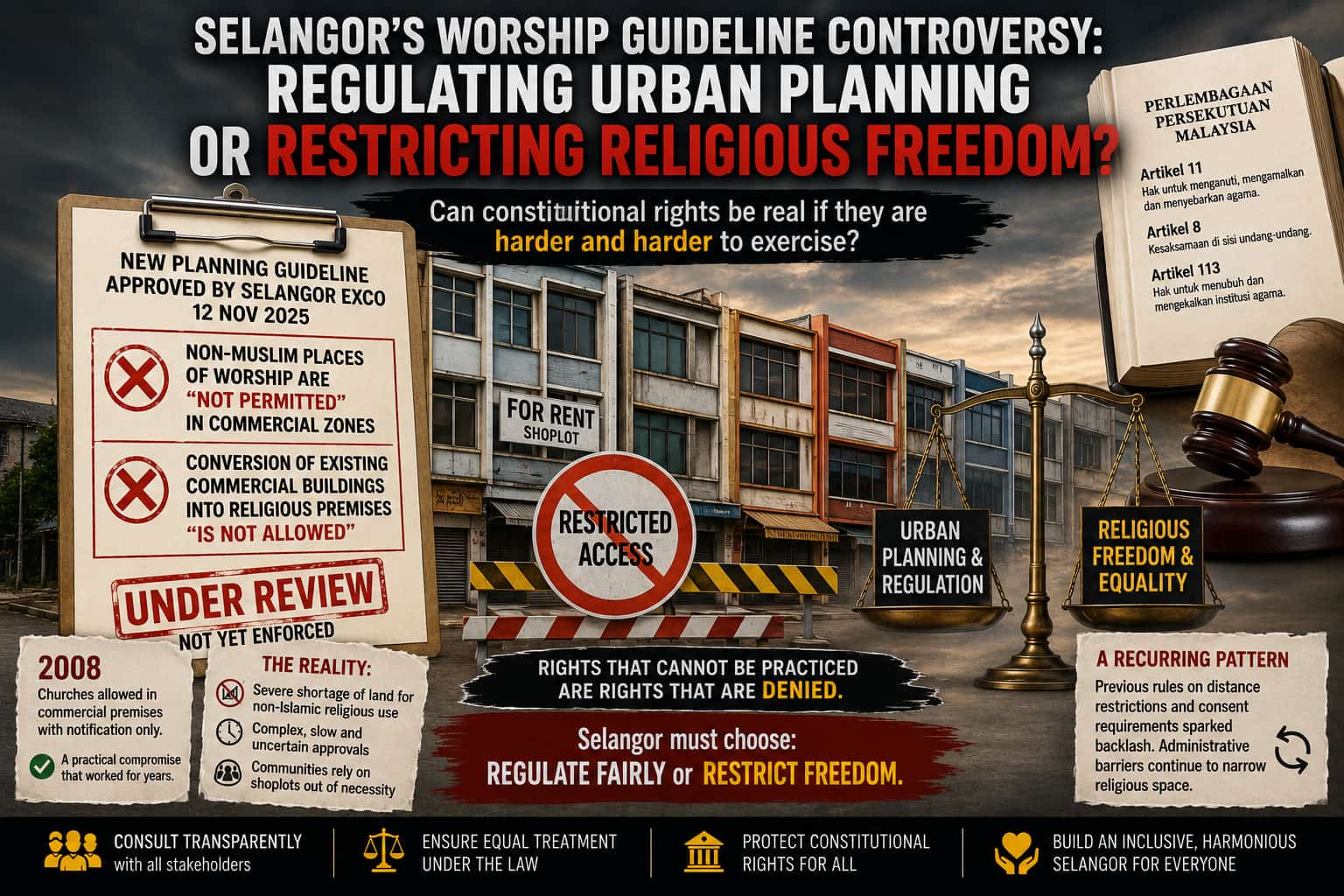
The Selangor government now faces a growing constitutional and moral dilemma: is it genuinely regulating urban planning, or is it indirectly restricting the religious freedom of non-Muslims under the guise of administrative policy?
The controversy erupted after the state’s newly approved planning guidelines revealed restrictions on non-Muslim places of worship operating in commercial shoplots. Although Selangor later attempted to ease concerns by clarifying that the guidelines are still under review and not yet enforced, the issue has already triggered strong reactions from civil society, lawmakers, lawyers, and religious communities.
At the heart of the debate lies a simple but critical question - can a government claim to uphold constitutional freedoms while simultaneously making those freedoms increasingly difficult to exercise?
The guideline, approved by the Selangor State Executive Council (EXCO) on Nov 12, 2025, states that non-Muslim places of worship are “not permitted” in commercial zones and that conversion of existing commercial buildings into religious premises “is not allowed.”
While state leaders have attempted to frame the matter as a technical planning and administrative issue, critics argue that the implications go far beyond zoning regulations.
Petaling Jaya MP Lee Chean Chung described the move as deeply problematic because it disproportionately affects non-Muslim communities who have long relied on commercial shoplots as places of worship due to the severe shortage of land gazetted for non-Islamic religious use.
For decades, churches, temples, and prayer centres across Selangor have operated from shoplots not out of preference, but necessity. Many communities simply cannot obtain suitable land or secure approvals through conventional channels due to lengthy bureaucratic procedures, political sensitivities, and inconsistent local council requirements.
Historically, Selangor itself had acknowledged this reality. Since 2008, churches were reportedly allowed to operate in commercial premises with notification rather than strict permit requirements. That arrangement was widely seen as a practical compromise balancing urban planning needs with constitutional rights.
The sudden shift toward restrictive guidelines therefore appears regressive to many observers.
Lawyer and activist Siti Kasim contends that the guideline places a disproportionate burden on non-Muslim communities, effectively restricting the exercise of their constitutionally protected religious freedoms. Approved by the state executive council, the policy also highlights deeper structural inequalities and ongoing political sensitivities surrounding religious rights, emphasizing the need for greater transparency, fair governance, and genuine inclusivity.
The Malaysian Federal Constitution clearly guarantees religious freedom, including:
• Article 11 - the right to profess, practise, and propagate one’s religion.
• Article 113 - the right to establish and maintain religious institutions.
• Article 8 - equality before the law.
These protections are constitutional rights, not merely administrative concessions subject to discretionary approval.
Although the state government possesses authority over land use, urban planning, and zoning matters, regulation must not become a tool for suppression. A broad restriction on non-Muslim places of worship in commercial areas raises several serious constitutional and legal concerns:
• Indirect Discrimination - While the policy may appear neutral on the surface, it disproportionately impacts non-Muslim communities, many of whom rely on shoplots for worship due to the longstanding shortage of designated religious land.
• Potential Violation of Constitutional Equality - The restriction may conflict with Article 8, which guarantees equality before the law, as well as Article 11, which protects freedom of religion.
• Disproportionate and Unreasonable Limitation - Courts may ultimately examine whether the restriction is necessary, proportionate, and fairly applied. If the policy fails to satisfy these legal standards, it could be deemed unconstitutional.
If non-Muslim communities are denied practical alternatives while commercial shoplots are simultaneously prohibited, the right to establish and maintain places of worship risks becoming merely symbolic.
Rights that cannot realistically be exercised are ultimately reduced to political slogans rather than constitutional guarantees.
The backlash against the guideline also exposes the fragile balancing act faced by the Selangor government. On one hand, there are pressures from conservative quarters demanding tighter control over religious expansion. On the other, Selangor’s urban and diverse voter base expects the state administration to remain progressive, inclusive, and constitutionally grounded.
The government’s rapid clarification that the policy is “not yet enforced” appears less like reassurance and more like damage control following public outrage.
This latest dispute is merely another chapter in a series of recurring controversies. Previous disputes involving distance restrictions and consent requirements for non-Muslim places of worship similarly sparked accusations that the state was slowly narrowing religious space through administrative mechanisms rather than outright prohibition.
Such recurring episodes contribute to a growing perception that non-Muslim religious rights remain structurally unequal despite constitutional protections.
The deeper issue is therefore not merely about shoplots.
It is about whether Malaysia’s governance model genuinely accommodates religious diversity in practice, or merely tolerates it within politically acceptable limits.
Selangor now has an opportunity to correct course responsibly. The state government’s decision to review the guideline with religious associations in June 2026 is a positive first step, but consultation alone will not be enough if the final outcome still leaves non-Muslim communities without realistic pathways to establish places of worship.
True inclusivity requires more than carefully worded statements after public backlash.
It requires transparent policymaking, equal treatment under the law, and the political courage to ensure that constitutional rights apply meaningfully to all communities regardless of religion.
The Selangor government must ultimately decide whether it wishes to be remembered as an administration that regulated fairly - or one that restricted religious freedom through policy ambiguity and bureaucratic barriers.
Because in a multiracial and multireligious society like Malaysia, peaceful coexistence cannot survive on constitutional promises alone. It depends on whether those promises are genuinely protected when politically inconvenient.
By: Kpost
Information Source:
YouTube/SitiKasim , RakyatPost , Nst
Kpost (ckhorsk@gmail.com) is a content creator under the Newswav Creator programme, where you get to express yourself, be a citizen journalist, and at the same time monetize your content & reach millions of users on Newswav. Log in to creator.newswav.com and become a Newswav Creator now!
The User Content (as defined on Newswav Terms of Use) above including the views expressed and media (pictures, videos, citations etc) were submitted & posted by the author. Newswav is solely an aggregation platform that hosts the User Content. If you have any questions about the content, copyright or other issues of the work, please contact creator@newswav.com.
