
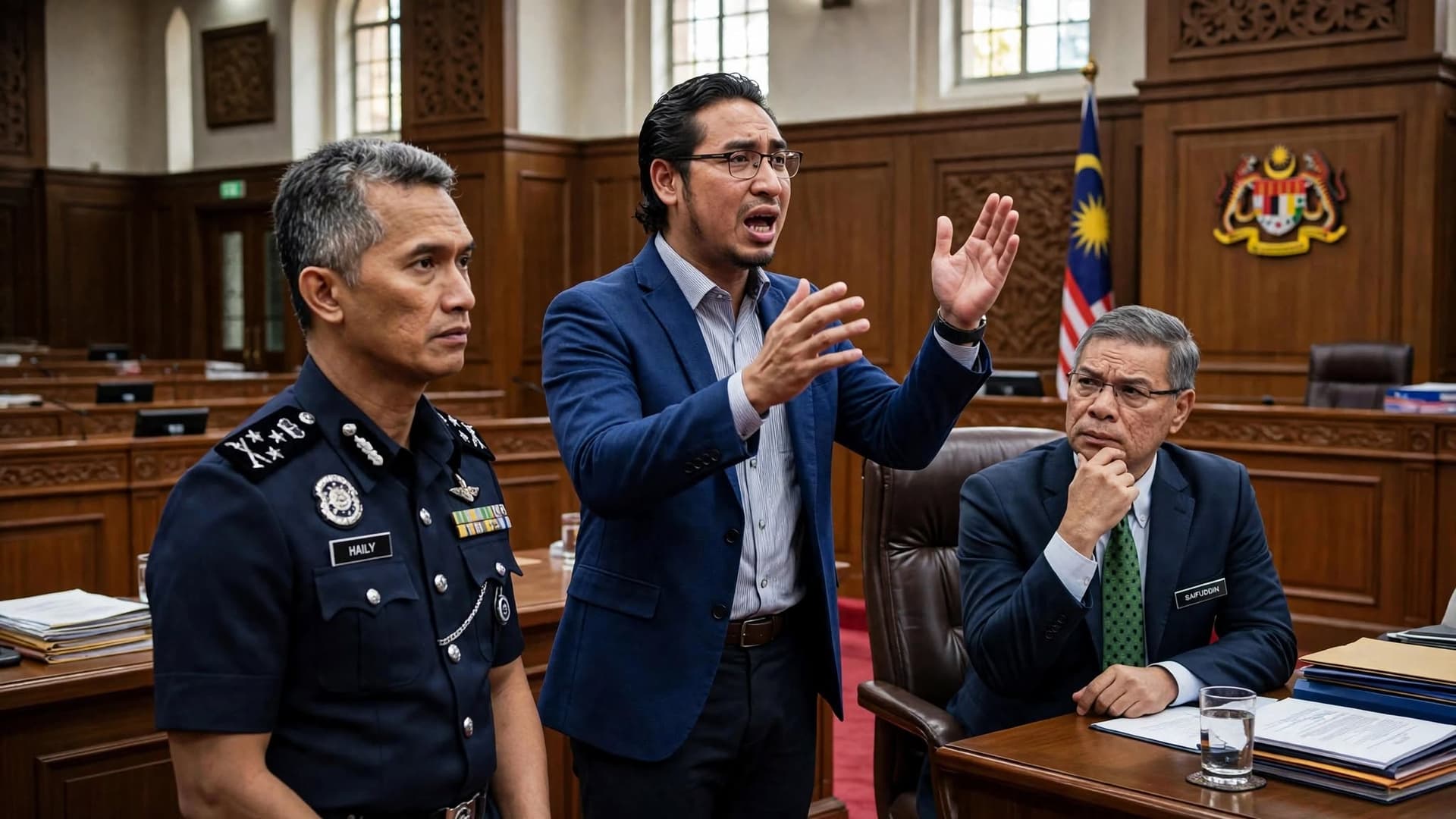
In parliamentary governance, the ministerial mandate rests on a simple premise: leadership is defined not by the routine administration of orderly files, but by active oversight when systems fracture. When institutional rifts spill into public view or international scandals tarnish statutory credibility, a minister’s primary function is to step into the breach, mediate, and take ownership.
Yet, a persistent operational pattern has emerged from the Ministry of Home Affairs. When high-stakes institutional failures occur, the preferred stance is technical detachment. Complex accountability questions are routinely compartmentalized, reframed as isolated administrative missteps, or delegated entirely to peripheral bodies.
This operational pattern reveals a stark asymmetry in how the state chooses to exercise its authority. On one end of the spectrum lies high-level administrative and institutional affairs exemplified by the FAM-FIFA lineage fraud, the AKPS-PDRM inter-agency airport clash, and ongoing statutory compliance disputes involving political coalitions. In these high-stakes institutional arenas, the ministry's default posture is one of procedural distance, routinely hiding behind strict jurisdictional boundaries and leaving matters to the court. Conversely, when dealing with local civil friction, public speech, 3R issues, or unauthorized religious structures (kuil haram), the ministry pivots instantly to immediate, proactive state power and rapid preventive security.
Consider the global embarrassment surrounding the Football Association of Malaysia (FAM) and FIFA’s sanctions over falsified lineage documents for foreign-born "heritage" players. The official defense centered on a strict separation of powers: the ministry and the National Registration Department (JPN) merely verified constitutional citizenship criteria; any subsequent submission of fraudulent ancestral documentation to international governing bodies was strictly FAM's internal affair. While technically accurate under statutory provisions, this posture ignores the political reality. Fast-tracked naturalization processes carry the imprimatur of the state. When national representation is compromised on an international stage, technical disclaimers fail to preserve public confidence.
A similar dynamic unfolded in the Dewan Rakyat during debates over the public confrontation between Datuk Seri Mohd Shuhaily Mohd Zain heading the newly established Malaysian Border Control and Protection Agency (AKPS) and officers from the Royal Malaysia Police (PDRM). Opposition MPs, led by Machang’s Wan Ahmad Fayhsal, questioned why the Home Minister failed to step in as a mediator before an inter-agency altercation at KLIA Terminal 1 escalated into criminal assault charges under Section 323 of the Penal Code.
When newly formed enforcement entities are carved out to secure borders, operational friction with legacy policing structures is predictable. Shuhaily’s aggressive, hands-on approach on the ground naturally disrupted entrenched domain boundaries. Managing those structural overlaps requires proactive political mediation from the top. Leaving two crucial enforcement arms directly under the ministry’s purview to settle institutional turf wars through open court trials does not represent equal application of the law; it represents a failure of internal administrative leadership.
This administrative hands-off approach stands in sharp contrast to the ministry’s posture on local civil friction, public gatherings, and socio-religious issues such as unauthorized places of worship (kuil haram) or sensitive public rhetoric. On these fronts, the state machinery demonstrates remarkable agility, deploying preventive measures and swift enforcement. This sharp contrast creates a perception of selective strictness: ironclad intervention for the public, but technical deferral and jurisdictional shields for institutional missteps.
However, the opposition's critique carries its own inherent limitations. Pointing out ministerial blind spots is standard parliamentary practice, but doing so while Perikatan Nasional and Bersatu navigate severe constitutional and administrative challenges such as recent Registrar of Societies (RoS) compliance actions reveals a broader systemic weakness. Political critiques that highlight executive incompetence lose their bite if the opposition itself struggles with internal party compliance and governance standards.
True ministerial accountability cannot be turned on and off depending on the convenience of the domain. Hiding behind procedural boundaries when statutory bodies misstep while wielding full state power against minor civil friction creates an unsustainable deficit in public trust. Leadership requires managing the machinery of state before it fractures, not merely observing the damage from behind a desk.
“True authority is proved not by how swiftly a government polices its citizens, but by how courageously it polices its own institutions.” - Annan Vaithegi
Annan Vaithegi (annanvaithegi@icloud.com) is a content creator under the Newswav Creator programme, where you get to express yourself, be a citizen journalist, and at the same time monetize your content & reach millions of users on Newswav. Log in to creator.newswav.com and become a Newswav Creator now!
The User Content (as defined on Newswav Terms of Use) above including the views expressed and media (pictures, videos, citations etc) were submitted & posted by the author. Newswav is solely an aggregation platform that hosts the User Content. If you have any questions about the content, copyright or other issues of the work, please contact creator@newswav.com.