.jpeg)
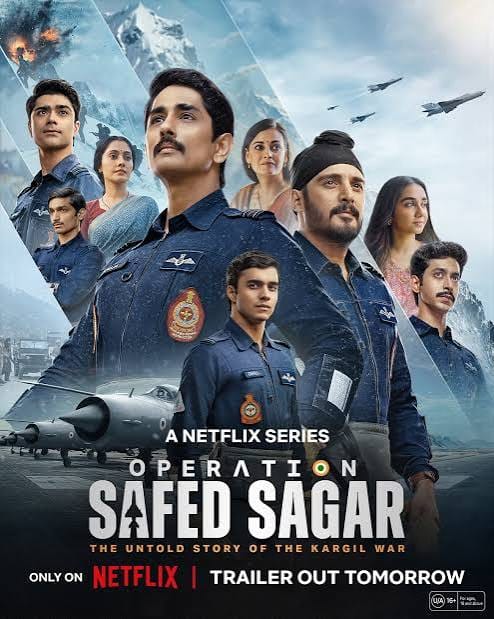
Operation Safed Sagar (Operation White Ocean; 2026)
Miniseries (E1-6)
US Ambassador to India Sergio Gor's first visit to Jammu and Kashmir has triggered a diplomatic uproar in Pakistan because, in his speech, he mentioned that Jammu and Kashmir was an important part of India. Pakistan's stance, since 1947, has been that Maharajah Hari Singh's accession of the princely state to India is illegal. Being a Muslim-majority state, Pakistan asserts that it should be governed by Pakistan. As far as the UN and many countries that support it are concerned, its people are yet to determine, through a plebiscite, where they want to be. That is why, during the Pahalgam attack, the world heard the Prime Minister of Malaysia, Anwar Ibrahim, refer to Kashmir as 'India-occupied Kashmir'. Turkiye and many Islamic nations do not recognise the Line of Control (LoC) as the demarcation that separates the Indian union territories of Jammu and Kashmir and Ladakh from Pakistan-administered regions like Azad Kashmir and Gilgit-Baltistan.
The modus operandi has always been the same. Be it 1947, when Pakistani soldiers masqueraded as Kashmiri tribal shepherds, starting a skirmish or 1999, when their soldiers infiltrated the no-man's-land dressed as Mujahideen, all the Pakistani government did was deny, deny and deny. They asserted that Pakistani intelligence had no activities at the disputed border and that India was weaving a fiction. The irony of it all was that all of this was happening while India and Pakistan were engaged in cross-border diplomacy. Atal Vajpayee, the then PM of India, went on the inaugural New Delhi-Lahore bus service through the Wagah border into Pakistan to sign the Lahore Declaration with Pakistani PM Nawaz Sharif.
As the saying goes, 'all countries have their armies. In Pakistan, the Army has a country'. From 1958, after General Muhammad Ayub Khan became the first military dictator following a coup d'état, the Army has always held the reins over the democratically elected civilian PM. The sudden ouster of Imran Khan after he began criticising the Pakistani Army is a testament to this.
This miniseries is a highly engaging, big-budget TV production that successfully evokes Indian nationalism in its viewers, whilst painting a rather 'lesser than human' kind of persona upon their arch rivals, the Pakistanis.
While Sharif was holding peace talks with Vajpayee, the Army, led by General Parvez Musharraf (who later ousted Sharif as PM), was not having any of those. In their mind, Kashmir is Muslim land, and per the agreement before Partition, it should be given to Pakistan. Period. It did not matter if Kashmiris wanted to remain with India. Cladestinely, Pakistani soldiers crossed over to the LoC, spilt over into Kargil district and occupied strategic checkpoints.
That is where the Indian Air Force Squadron #17 comes in. The story is centred around them. While engaged in one of their aerial reconnaissance drills, one of their fighter jets is hit by a Pakistani missile. To rescue his comrade, another fighter pilot rushed to his rescue. Both jets crashed. The second pilot was, however, apprehended by the Pakistanis, interrogated, tortured and subsequently killed mercilessly. India soon realised that the Pakistanis had infiltrated deep into the LoC.
This started an international scare. Two nuclear nations at loggerheads did augur well for regional stability, the big powers, especially the US, were heard saying. The trouble is that the US were in the precarious position of arming both parties, with preferential treatment to Pakistan, of course.
The Indians were using the Russian-made MiG planes with American-made GPS systems. That is when the Indians realised that the US-made systems were compromised, perhaps intentionally so, to ensure India's failure. Embodying the Indian spirit of jugaad, the Indian Air Force successfully executed critical, unprecedented high-altitude aerial operations to overcome its enemy.
Throughout the whole imbroglio, the Pakistani PM Nawaz Sharif was kept in the dark about his Army's operations. Even its Air Force was not brought in. By the time the Kargil War reached its zenith and the Pakistani side was losing, there were mounting pressures to call for a truce. It was a soul-crushing defeat for the Pakistani forces, yet again. Pakistan faced diplomatic isolation. Soon afterwards, Musharaff executed a military takeover and became the supreme leader of Pakistan. For India, the Kargil War was a wake-up call to develop its own expertise. It became evident that their technological know-how jumped by leaps and bounds. Proof of this was seen later in the subsequent space missions.
P.S. 'There's a difference between them and us!*' is a line from the miniseries. Just because the other side acted barbarically, it does not justify doing the same. That makes the difference!
Farouk Gulsara (asokansham@gmail.com) is a content creator under the Newswav Creator programme, where you get to express yourself, be a citizen journalist, and at the same time monetize your content & reach millions of users on Newswav. Log in to creator.newswav.com and become a Newswav Creator now!
The User Content (as defined on Newswav Terms of Use) above including the views expressed and media (pictures, videos, citations etc) were submitted & posted by the author. Newswav is solely an aggregation platform that hosts the User Content. If you have any questions about the content, copyright or other issues of the work, please contact creator@newswav.com.