

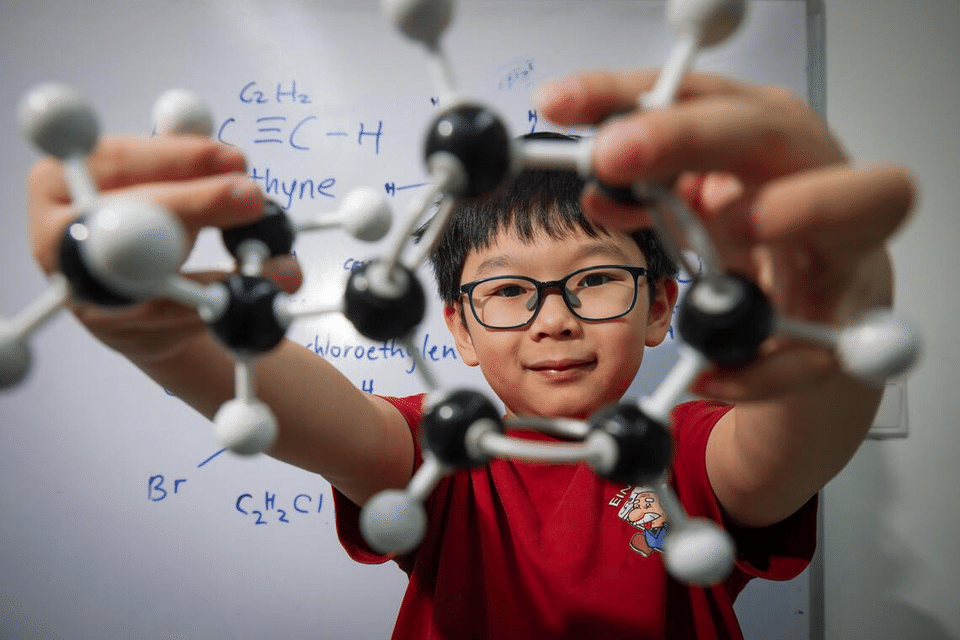
From the moment he sat in the front row of a freshman chemistry lecture at Nanyang Technological University (NTU), the quiet buzz of a typical Thursday afternoon shifted. The under‑graduates glanced at the bespectacled boy with a tablet in one hand, a printed sheet of notes in the other, and a small bottle of water by his side. He was accompanied by his mother, a PhD student at the same university. He wasn’t a registered student. He wasn’t there for assignments or labs. Yet at age seven, he was attending university‑level lectures on topics like molecular orbital theory. According to NTU, the boy is Theodore Kwan. (Corporate NTU)
He is only seven years old, yet he has become a sensation in academic circles in Singapore. Why has Theodore become not just a curiosity, but a symbol of the possibilities and pitfalls of nurturing early talent in the 21st century?
Early Brilliance and Records
Theodore’s academic journey is already studded with unusual milestones. In early 2025, while he was six years and ten months old, he took the International General Certificate of Secondary Education (IGCSE) Chemistry paper the equivalent of an O‑Level exam and earned an A. That reportedly made him the youngest person in Singapore to achieve that grade in that exam. (The Straits Times)
He also holds several Singapore records: among them, identifying him as the first and youngest to score full marks in a national science Olympiad. (The Straits Times) His IQ is reported at 154, according to his parents and local media reports. (FTNews)
At home, he is homeschooled by his mother, Crystal Tang, who is a PhD student at NTU’s medical school, and his father, Kwan Jung Hong, runs a small business. (The New Paper)
The image of a seven‑year‑old sitting among university students is visually striking. It forces questions: What does excellence mean at that age? What is the role of educational institutions when extraordinary talent appears?
Entering the University Lecture Hall
In August 2025 Theodore began attending NTU’s foundational chemistry lectures roughly three times a week, as a guest of senior lecturer Sumod Pullarkat. (AsiaOne)
Dr Pullarkat says he initially hesitated, asking whether a child so young could follow the concepts such as “a method that uses quantum mechanics to explain electron behaviour.” (The Straits Times) Ultimately he invited Theodore as a guest purely for the sake of exploration not for exams or credit. “As a university, NTU is open to all talent,” said the Deputy President and Provost, Prof Christian Wolfrum. “Although Theodore isn’t enrolled as a student, we are thrilled to ignite his passion in chemistry.” (AsiaOne)
In the lecture theatre Theodore sits with usual first‑year undergraduates in a hall of around 400 students. One told The Straits Times that she initially thought he was just a child accompanying his mother. Then she saw him quietly ask questions after lecture and realised he could speak about “lone pairs of electrons” and why they take up more space. (The Straits Times)
For Theodore it seems less about being extraordinary and more about simply wanting to learn. After his first lecture he asked his mother: “Can I attend lectures every day? Can I live in NTU?” (AsiaOne)
Motivation, Curiosity, and the Home Setting
What drives a child of seven to attend lectures meant for 18‑year‑olds? Theodore’s mother says he has asked questions about what his toys are made of and when told “plastic”, he would follow up with “what is plastic made of?” Soon the conversation would be about molecules and atoms. (The New Paper)
His homeschooling enables him to move at his own pace, and attending lectures gives him the structure of a class, the peer environment, and exposure to higher‑level ideas. It is not a standard path, but it appears to work for him for now.
His parents say they are grateful for the opportunity but also cautious: “We are okay for now, but not sure how we are going to continue doing this in the future.” (The New Paper)
Opportunities and Risks
Theodore’s case raises both opportunity and risk. On the one hand, it challenges the traditional age‑based milestones of education. If a child at age seven can engage meaningfully with advanced chemistry, what does that mean for how we structure learning? The NTU leadership emphasises that talent does not recognise age brackets. (AsiaOne)
On the other hand, several child‑prodigy stories from history caution us. There is the risk of social isolation, burnout, or pressuring the child into trajectories they may not choose themselves. In Singapore’s r/singapore subreddit one commenter noted:
“The cousin that your parents always compared you to … at 7, you should be playing like any other kid.” (Reddit)
Balancing a child’s intelligence with emotional development, social normalcy, and personal choice is complex. In Theodore’s case, the faculty emphasised that he is not taking tests or labs; his attendance is voluntary and interest‑driven. (The Straits Times)
Broader Implications for Singapore’s Education System
In response to an earlier question in Parliament, Singapore’s Ministry of Education Singapore stated that exceptionally gifted students who apply for early admission to local autonomous universities will be assessed on a case‑by‑case basis. In the past five years before 2025 only one exceptionally gifted student gained early admission. (The Straits Times)
Theodore’s attendance at university lectures but not his formal admission illustrates a middle option: access without accreditation. It suggests new models for educating exceptional talent guest auditing, mentor‑guided lectures, and flexible arrangements.
For Singapore, a nation that emphasises meritocracy and education, Theodore becomes a visible symbol of how the system might adapt to edge‑case talents. The parents emphasise the cost: as they say, “At the moment, most local students like Theodore head overseas universities, but that is expensive.” (The Straits Times)
What Comes Next
For now, Theodore is content with his lectures. “I can’t wait to go back to lectures so that I can learn more chemistry and meet my jie jie and kor kor,” he said, referring to his university classmates. (The Straits Times)
Looking ahead, the questions multiply: Will Theodore continue with university‑level chemistry and then pursue degrees early? Will he switch direction according to his evolving interests? How will his social and emotional development proceed alongside his intellectual acceleration?
His parents remain supportive but cautious. The key phrase: “for now.” They recognise that childhood is broader than academic achievement alone.
In the quiet halls of NTU, a seven‑year‑old boy asks questions not because he must, but because he wants to. He sits among undergraduates, shoulder to shoulder, his presence reminding us that curiosity does not wait for age.
But the story of Theodore Kwan is more than a novelty. It asks us to reflect on how we nurture talent in a fast‑changing world. It reminds us that behind the remarkable metrics IQ scores, exam records, university lectures there is a child who deserves both challenge and protection, intellectual stimulation and the space to be simply seven years old.
If education is about opening doors, then for Theodore one door has already swung wide. The bigger question is whether we can build the rest of the hall, the corridors, the supports, so that when he walks through them, he steps into freedom not obligation; joy not pressure; possibility not expectation.
AM World (tameer.work88@gmail.com) is a content creator under the Newswav Creator programme, where you get to express yourself, be a citizen journalist, and at the same time monetize your content & reach millions of users on Newswav. Log in to creator.newswav.com and become a Newswav Creator now!
The User Content (as defined on Newswav Terms of Use) above including the views expressed and media (pictures, videos, citations etc) were submitted & posted by the author. Newswav is solely an aggregation platform that hosts the User Content. If you have any questions about the content, copyright or other issues of the work, please contact creator@newswav.com.