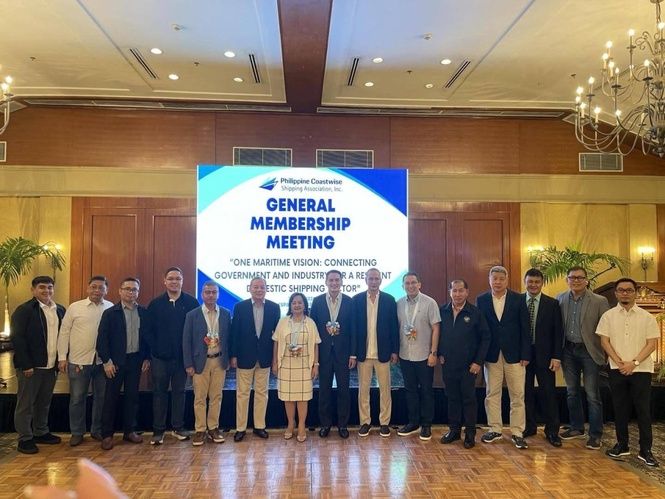
CEBU CITY, Philippines — The cost of moving goods between Philippine islands could be reduced by scrapping roll-on, roll-off (RoRo) terminal fees and expanding transport infrastructure, the Philippine Coastwise Shipping Association (PCSA), which is seeking reforms to improve connectivity and ease inflationary pressures, said.
PCSA Chairman Lucio Lim Jr. said RoRo terminal fees account for 5% to 10% of the total freight cost for a 10-wheeler truck and can reach 15% on some short-haul routes, adding to the expense of transporting food, construction materials and other commodities.
“When logistical costs rise, food prices rise. When logistical costs increase, businesses become less competitive. When connectivity is slow and inefficient, economic opportunities become limited,” Lim said during the association’s general membership meeting at NUSTAR Resort and Casino in Cebu City.
Held under the theme “One Nation, One Network: Lower Logistical Costs, Lower Inflation,” the meeting came nearly a year after Typhoon Tino devastated parts of the Visayas.
The association has been pushing for the removal of RoRo terminal fees for nearly two decades, arguing that the charges increase expenses for truckers, shippers and producers, which are eventually passed on to consumers through higher prices.
The PCSA wants the government to recognize RoRo vessels as extensions of the country’s road network and their terminals as part of the national highway system, rather than treating them primarily as revenue-generating facilities.
It also proposed transferring the management and maintenance of RoRo ports outside the base ports of the Philippine Ports Authority (PPA) and Cebu Port Authority (CPA) to the Department of Public Works and Highways.
Lim cited Japan and Norway as examples of countries that integrate RoRo facilities into their highway networks.
He estimated that a standard RoRo port would cost about P200 million ($3.5 million) to build, with relatively low maintenance expenses.
The group welcomed the CPA’s temporary suspension of passenger terminal fees amid rising fuel costs but said the PPA had not granted a similar request despite the association’s appeal.
Beyond reducing port charges, the PCSA is proposing feasibility studies for eight expressway corridors intended to link production centers, ports and major markets across the Visayas and Mindanao.
The proposed routes are Calapan City to Roxas in Oriental Mindoro; Caticlan in Aklan to Iloilo City; Bacolod City to Dumaguete City; Dapitan City to Zamboanga City; Bogo City to Santander in Cebu; Aroroy to Esperanza in Masbate; Allen in Samar to Liloan in Southern Leyte; and Surigao City to Davao City.
The proposed corridors range from 121 to 406 kilometers, including the 230-kilometer Bogo City-Santander route in Cebu.
Lim said the projects could be financed through public-private partnerships or long-term congressional appropriations.
He pointed to the planned 420-kilometer South Luzon Expressway Toll Road 5, which will connect Lucena City in Quezon province to Matnog in Sorsogon, as an example of how expressways could improve connectivity and shorten travel times.
The PCSA also cited the concentration of manufacturing hubs in Metro Manila and Calabarzon region as a factor contributing to higher transport costs and longer delivery times for goods shipped to the Visayas and Mindanao.
Meanwhile, the association is exploring the development of a maritime industrial park in Northern Cebu to address the shortage of shipyards and ship repair facilities.
PCSA President Paul Rodriguez said that the group was discussing the proposal with Cebu Gov. Pamela Baricuatro.
Lim said the shortage of shipyards was a nationwide concern, particularly in Cebu, which serves as a key hub for domestic shipping.
Passenger and cargo vessels must undergo dry-docking every two years for mandatory inspections of their underwater structures, propulsion systems and propellers.
However, shipyard development has not kept pace with the number of vessels requiring maintenance and inspection, he said.