
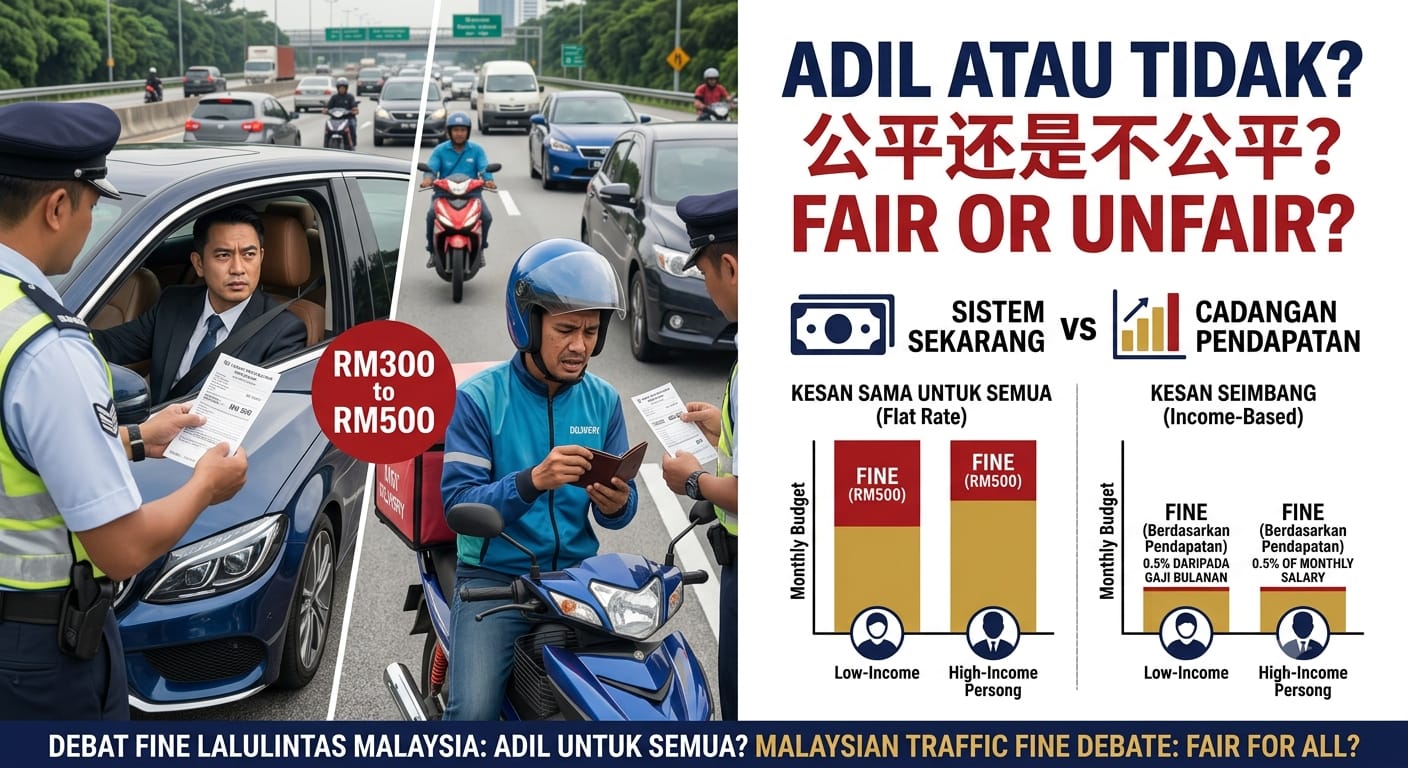
Malaysia's move to strengthen traffic laws and increase the maximum compound rate for traffic offences from RM300 to RM500 has sparked a wider debate about fairness, deterrence, and road safety.
While the government insists that the revised penalties are designed to improve compliance rather than generate revenue, social activist Tan Sri Lee Lam Thye has raised an important question: should traffic fines be linked to an offender's income level?
Lee, who chairs the Alliance for a Safe Community, believes the current flat-rate fine system does not affect all offenders equally. A RM500 fine may be a painful financial setback for a lower-income worker, but it may be little more than a minor inconvenience for a wealthy individual.
His argument makes sense: if the purpose of a traffic fine is to deter dangerous behaviour, then the penalty must be significant enough for the offender to feel its impact.
"For a person with substantial financial means, a fine of RM500 or even RM1,000 may have little impact. Conversely, the same amount could impose a significant burden on a low-income individual," Lee said.
Equal Punishment or Equal Impact?
The proposal touches on a principle that several countries have already adopted. Nations such as Finland, Sweden and Switzerland have experimented with income-based or "day-fine" systems, where certain serious offences carry penalties calculated according to the offender's earnings.
Under such systems, the objective is not to punish the wealthy more harshly but to ensure that every offender experiences a similar level of financial consequence.
Supporters argue that this creates a more equitable justice system. A millionaire speeding through a school zone would face a penalty that genuinely hurts financially, while lower-income motorists would not be disproportionately burdened by fines that could jeopardise their household finances.
Lee believes Malaysia should study these international models carefully and explore whether a similar approach could be adapted for local conditions.
Government Focuses on Compliance
Meanwhile, Transport Minister Anthony Loke has clarified that the proposed RM500 compound rate is merely a maximum limit and will not automatically apply to all offences.
According to Loke, the actual amount imposed will depend on several factors, including the type and severity of the offence, the payment period, and enforcement policies.
The increase, scheduled to take effect on Jan 1, 2029, follows the passage of the Road Transport (Amendment) Bill 2026 in the Dewan Rakyat.
Among the offences subject to the revised compound framework are speeding, driving without a valid licence, operating vehicles without valid motor vehicle licences, failure to comply with traffic signals, and other road compliance violations.
More significantly, the amendments introduce a new Section 42A, which specifically targets illegal street racing and speed testing activities. First-time offenders may face fines ranging from RM2,000 to RM10,000, imprisonment of up to two years, or both. Repeat offenders face even tougher penalties.
Loke stressed that the government's objective is behavioural change rather than revenue collection.
"If we do not violate traffic laws, we do not need to worry about the maximum fine imposed," he said.
More Than Just Fines
While supporting tougher enforcement, Lee cautioned that any move towards an income-based fine structure must be transparent, practical and protected against abuse.
He also emphasised that financial penalties alone cannot solve Malaysia's road safety challenges.
Among the complementary measures he proposed are stronger demerit point enforcement through the KEJARA system, mandatory road safety education programmes, temporary licence suspensions for repeat offenders, and compulsory community service related to road safety awareness.
These measures, he argued, would help address habitual offenders who repeatedly break traffic laws and simply treat fines as a cost of convenience.
A Question Worth Discussing
The debate highlights a broader issue facing modern societies: should punishment focus on treating everyone exactly the same, or should it be designed to create the same impact regardless of economic status?
As Malaysia prepares for stricter traffic enforcement in the coming years, the discussion on income-based penalties is likely to gain momentum. Whether the government ultimately adopts such a system remains uncertain, but Lee's proposal has opened an important conversation about balancing deterrence, fairness and public safety.
After all, the ultimate goal of any traffic law is not merely to collect fines, but to save lives and make Malaysian roads safer for everyone.
By: Kpost
Information Source:
Kpost (ckhorsk@gmail.com) is a content creator under the Newswav Creator programme, where you get to express yourself, be a citizen journalist, and at the same time monetize your content & reach millions of users on Newswav. Log in to creator.newswav.com and become a Newswav Creator now!
The User Content (as defined on Newswav Terms of Use) above including the views expressed and media (pictures, videos, citations etc) were submitted & posted by the author. Newswav is solely an aggregation platform that hosts the User Content. If you have any questions about the content, copyright or other issues of the work, please contact creator@newswav.com.
