
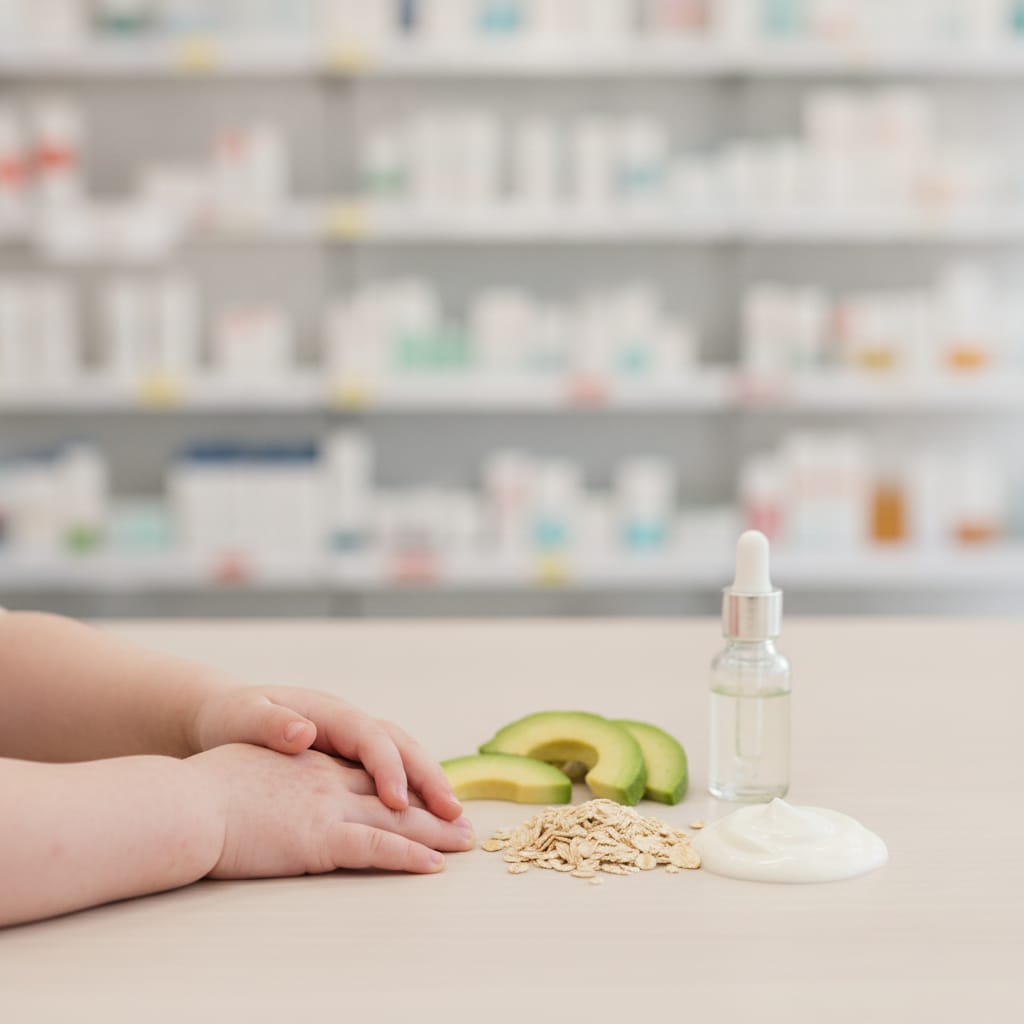
Picture this.
You're standing along the pharmacy aisle looking at dozens of baby moisturizers. Lotions, cream, ointments. Your baby’s eczema is flaring, and you want something gentle and safe for your baby.
One bottle says “natural”, another says "organic", and one contains oats, while another advertises ingredients derived from milk, wheat or plant oils such as lavender.
It does sound soothing. After all, if something is safe enough to eat, surely it should be safe for the skin, nay?
Well, not necessarily.
For babies with eczema, there is an interesting question that allude allergy researchers for years:
Could exposing damaged inflamed skin to food proteins increase the chance of becoming allergic to that food?
The answer is not a simple yes or no.
Moisturizers remain one of the most essential part of eczema care. But repeatedly applying intact food proteins onto inflamed or broken skin deserves some caution, particularly in young infants who have not yet eaten that particular food.
And here is why.
The Dual-Allergen Exposure Hypothesis: Gut vs Skin
A baby’s immune system respond to food differently depending on how it encounters that food. A skin exposure and the mouth exposure may brings different outcome.
This forms the basis of the dual-allergen exposure hypothesis.
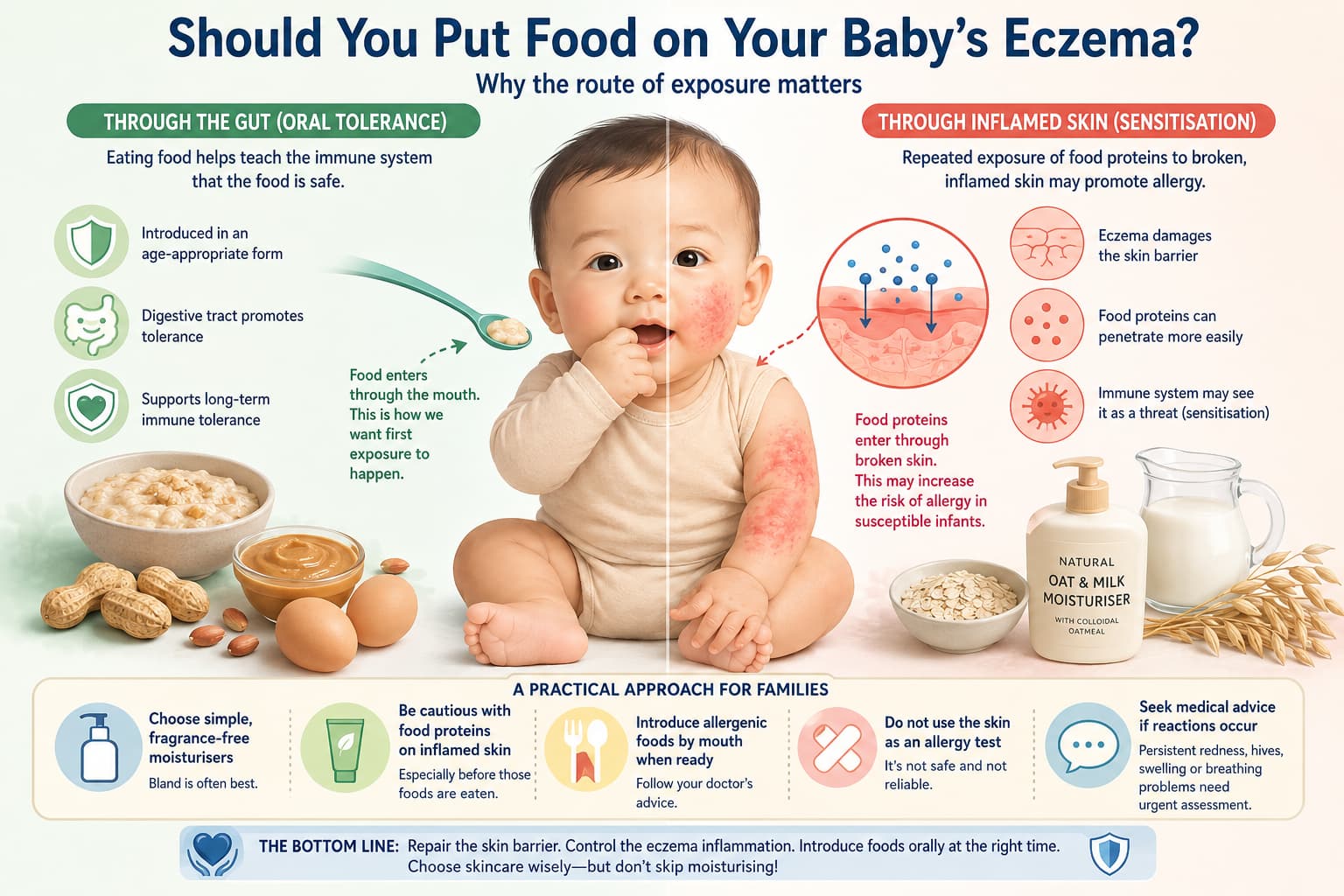
(1) Through the mouth and gut: PROMOTING TOLERANCE
When an infant eats an age-appropriate food, proteins are introduced through the gastrointestinal tract.
This helps to promote oral tolerance, and this teaches the immune system to recognize and accept the food protein rather than attack.
That advice is outdated. Earlier guidance in the 1990s and 2000s often recommended delaying foods such as egg and peanut, but current evidence supports introducing age-appropriate peanut and well-cooked egg once babies are ready for complementary foods, rather than postponing them unnecessarily.[1]
(2) Through damaged inflamed skin: POSSIBLE SENSITIZATION/ALLERGY
Eczema is different.
The skin barrier is broken and inflamed. Food proteins from the environment or from products repeatedly applied to the skin, may penetrate this damaged barrier and interact with the immune system.
In some children, this may favor allergic sensitization rather than tolerance.
A simple way to remember it:
The gut is designed to encounter food. Inflamed skin is designed to defend against things entering it.
That doesn't mean every food protein touching an eczematous skin will cause an allergy. But it explain why allergists are cautious in what we put onto damaged infant skin.
Why Did Researchers Become Concerned?
This idea did not appear out of nowhere.
Several studies have provided interesting signals.
(1) Peanut oil and peanut allergy
In 2003, a landmark UK study published in the New England Journal of Medicine found an association between childhood peanut allergy and the use of skin preparations containing peanut oil.[2]
One proposed explanation was that peanut protein exposure through inflamed skin might contribute to sensitisation.
But there is an important limitation:
Association does not prove causation.
The study could not demonstrate that applying the product directly caused peanut allergy.
(2) Oat creams and oat sensitization
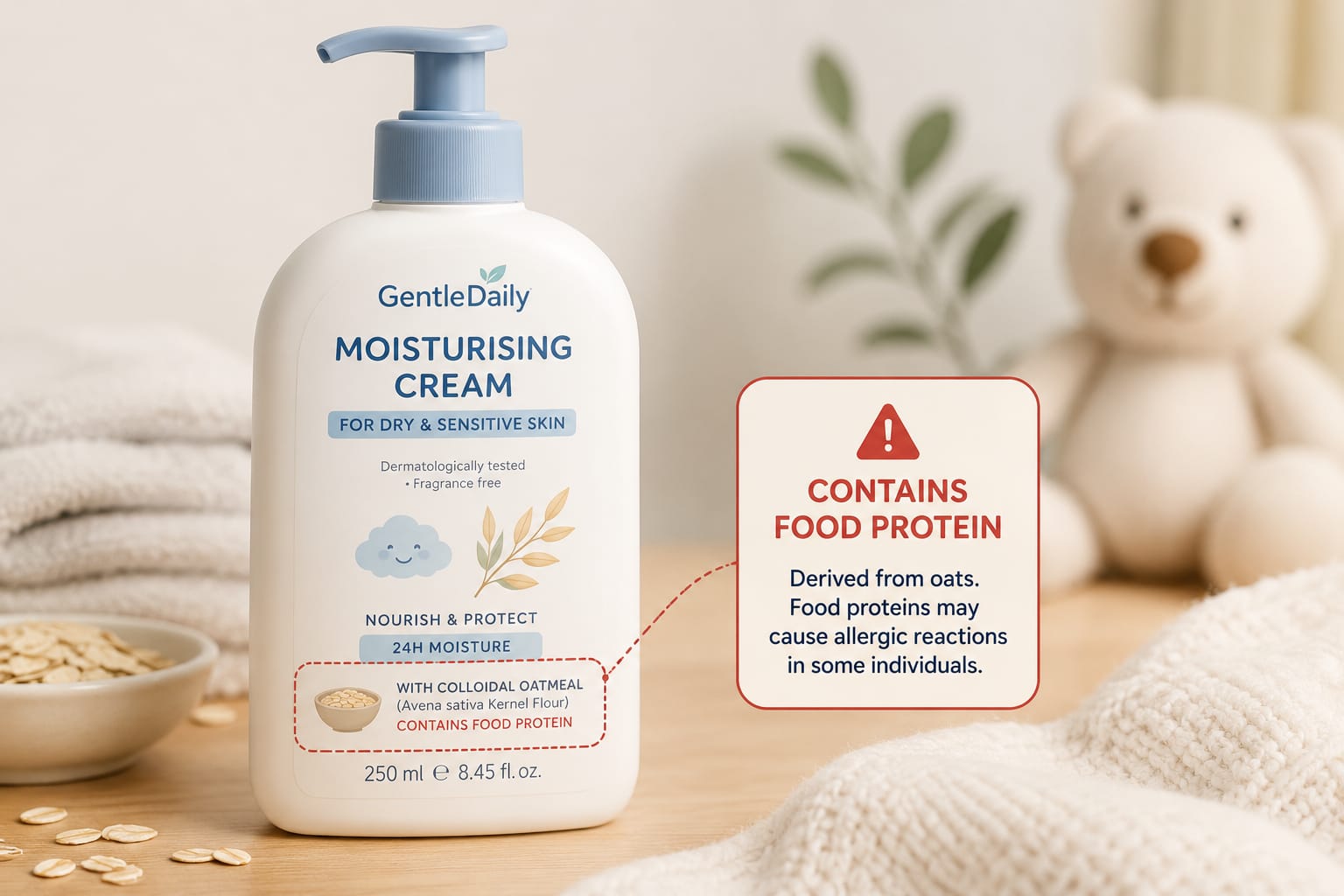
Oats are particularly interesting because colloidal oatmeal is widely used in eczema products.
A French study involving children with atopic dermatitis found relatively frequent oat sensitisation within this selected population. Previous use of oat-containing creams was associated with positive oat patch testing, while a smaller number of sensitised children reacted during oral food challenges or topical application tests.[3]
Again, this does not mean oat moisturizers routinely cause oat allergy.
These were children attending a specialist service for atopic dermatitis, not healthy children from the general population.
But it was enough to raise an important question about repeated exposure to food proteins through damaged skin.
What about moisturizers in general?
A secondary analysis of the a study on early allergenic food introduction (EAT) study published in 2021 found that more frequent moisturizer use during early infancy was associated with a higher subsequent risk of food allergy.[4]
At first glance, that sounds alarming.
But this is a major chicken-and-egg problem.
Babies who needed moisturizer more frequently may simply have had drier, more damaged or more inflamed skin in the first place.
And an impaired skin barrier itself is associated with food sensitisation.
Different families also used different moisturizers containing different ingredients.
So the study does not prove that moisturisers cause food allergy.
The sensible conclusion is not:
“Stop moisturising your baby.”
It is:
“Perhaps we should think about what we are putting onto an impaired skin barrier.”
The Oatmeal Paradox: Helpful or Harmful?
This is where the discussion becomes genuinely interesting, as colloidal oatmeal is not a “bad” ingredient.
It can help improve hydration, reduce skin itch and support the skin barrier. There are clinical studies that found oat-containing eczema products effective and well tolerated.
Millions of children use them without developing oat allergy.
At the same time, oat sensitization and occasional allergic reactions have been reported, particularly among children with atopic dermatitis and repeated topical exposure.
Both things can be true.
An ingredient can benefit the skin while still containing a food protein capable of sensitizing a susceptible individual.
Therefore, for a young infant with active, broken eczema who has never eaten oats, perhaps an oat-containing moisturizer should not be the first choice if an equally suitable bland alternative is available.
If a child already eats oats regularly without any problem, this concern becomes less compelling, although skin irritation and contact reactions can still occur.
So this is not a blanket ban on oatmeal skincare.
It is about choosing products according to context.
What Should Parents Actually Do?
Here is a practical approach.
1. Keep skincare boring
For infants with eczema, boring is good. A simple, fragrance-free moisturizer such as a petrolatum/paraffin-based ointment or an appropriately formulated ceramide moisturizer is often a reasonable starting point. Your baby’s moisturizer doesn't have to be a full breakfast menu.
2. Be cautious with food proteins on broken eczema
Careful on repeatedly applying products containing recognizable food proteins or extracts, particularly nut, milk, wheat, sesame or oat-derived proteins, especially onto significantly inflamed or broken skin before that food has been introduced orally.
This is a precautionary approach, not proof that these products cause food allergy.
3. Don’t stop moisturizing
This is perhaps the most important message. The solution to concerns about moisturizer ingredients is not untreated eczema. Maintain the skin barrier and treat active inflammation appropriately.
4. Food belongs in the mouth, not on eczematous skin
When your baby is developmentally ready, allergenic foods should generally be introduced orally in an age-appropriate form. For example, current evidence supports timely introduction of peanut and well-cooked egg rather than unnecessarily delaying them. Infants with severe eczema or an existing food allergy may need an individualized plan.
5. Please don’t use the skin as an allergy test
Rubbing peanut butter, egg, milk or another food onto your baby’s skin is not a safe home allergy test. Local redness can simply be irritation and tells us little about whether the food can safely be eaten. If there is concern about food allergy, discuss appropriate testing or supervised introduction with your doctor.
The Bottom Line
You do not need to throw away every moisturizer containing oats or plant-derived ingredients.
And you certainly should not stop treating eczema.
But when a baby’s skin barrier is already inflamed and permeable, it makes sense to think carefully about what is repeatedly applied to it. For young infants with active eczema, I generally favor a simple, fragrance-free moisturizer without unnecessary intact food proteins, particularly before those foods have been introduced orally. It is a precautionary approach based on our evolving understanding of how food allergy develops, not a claim that moisturizers or food-derived ingredients inevitably cause allergy.
The principles are actually quite simple:
Repair the skin barrier.
Control the inflammation.
Introduce foods through the mouth at the appropriate time.
And don’t deliberately introduce food through broken skin.
References
- Halken S, Muraro A, de Silva D, et al. EAACI guideline: Preventing the development of food allergy in infants and young children (2020 update). Pediatric Allergy and Immunology. 2021;32:843–858. doi:10.1111/pai.13496
- Lack G, Fox D, Northstone K, Golding J; Avon Longitudinal Study of Parents and Children Study Team. Factors associated with the development of peanut allergy in childhood. New England Journal of Medicine. 2003;348(11):977–985. doi:10.1056/NEJMoa013536.
- Boussault P, Léauté-Labrèze C, Saubusse E, et al. Oat sensitization in children with atopic dermatitis: prevalence, risks and associated factors. Allergy. 2007;62(11):1251–1256. doi:10.1111/j.1398-9995.2007.01527.x.
- Perkin MR, Logan K, Marrs T, et al. Association of frequent moisturizer use in early infancy with the development of food allergy. Journal of Allergy and Clinical Immunology. 2021;147(3):967–976.e1. doi:10.1016/j.jaci.2020.10.044.
Disclaimer: This article is intended for educational purposes and should not replace individual medical assessment, diagnosis, or treatment. Please consult your healthcare professional for personalised advice.
Dr Wong Yee Ming (allergy@drwongyeeming.com) is a content creator under the Newswav Creator programme, where you get to express yourself, be a citizen journalist, and at the same time monetize your content & reach millions of users on Newswav. Log in to creator.newswav.com and become a Newswav Creator now!
The User Content (as defined on Newswav Terms of Use) above including the views expressed and media (pictures, videos, citations etc) were submitted & posted by the author. Newswav is solely an aggregation platform that hosts the User Content. If you have any questions about the content, copyright or other issues of the work, please contact creator@newswav.com.
