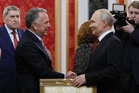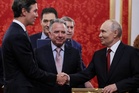
THE emissaries of United States President Donald Trump met with Russian President Vladimir Putin in Moscow over the weekend to discuss a proposal to end the more than four years of war in Ukraine.
Steve Witkoff and Jared Kushner spent three hours with the Kremlin strongman. The closed-door talks ended with what was described as “cordial rhetoric.” Putin said there was a “high level of trust” and that he felt “comfortable” working with Trump’s envoys.
That’s about it.
Witkoff and Kushner have left Moscow for Kyiv for a meeting with Ukraine President Volodymyr Zelenskyy. They have nothing to present to Zelenskyy that would be substantial enough to be considered as a game changer.
With their discussions with Putin ending up a dud, many see Witkoff and Kushner’s meeting with Zelenskyy as a mere ceremonial exercise.
What exactly is Trump’s plan for ending the war in Ukraine? The White House has declined to release it in full to the public, but based on details that have leaked out, it is anchored on four points:
1. A comprehensive ceasefire while negotiations are being carried out.
2. Substantial international commitments to defend Ukraine against future Russian aggression.
3. A 20-point formula for the postwar rebuilding of Ukraine’s infrastructure.
4. Lifting long-standing economic sanctions against Russia.
Executing the plan will be next to impossible without Moscow and Kyiv agreeing to come to terms on territorial concerns involving Donetsk and Crimea.
Russia has taken a nonnegotiable stance in demanding that Ukraine cede areas of Donetsk that remain under its control. The region also holds another strategic value, being part of the land corridor that links Crimea to the Russian mainland.
Ukraine, meanwhile, is drawing the line on keeping the heavily fortified 50-kilometer stretch of Donetsk that makes up its main defense perimeter against any Russian thrust into the Ukrainian heartland.
Russia also wants to get its hands on Donetsk’s vast reserves of rare earth metals and lithium. Ukraine needs the same minerals to rebuild its war-ravaged economy.
For Putin, annexing Donetsk projects a “narrative of total victory” that he can present to a domestic audience that is growing weary of a war that has raged on with no clear resolution in sight.
Since Russian forces smashed across the border into Ukraine in 2022, more than 2 million people have been killed, according to the United Nations Office of the High Commissioner for Human Rights. That includes civilian fatalities, which in July alone numbered close to 15,400.
Some 3.7 million Ukrainians have been driven from their homes, and 372,000 people remain internally displaced, the UN agency said.
Russia has launched more than 1,000 drone and missile attacks on Ukraine’s infrastructure, destroying half of the country’s electricity capacity and inflicting $14.6 billion in damage.
Ukraine countered by targeting Russian refineries, oil depots and industrial sites, knocking out about 10 percent of Russian refining capacity.
United Nations Secretary-General António Guterres looks at the war in Ukraine as a “stain on our collective consciousness, and remains a threat to regional and international peace and security.”
“The longer the war continues, the deadlier it becomes,” Guterres said, stressing that “civilians bear the brunt of this conflict.”
A political analyst has described the war as “a seismic evolution to the world — to the nature of warfare, the balance of global powers and to European security.”
Past peace plans have fallen by wayside, as Putin continues to deftly dodge Trump’s efforts to squeeze concessions out of him.
“I thought that would have been one of the easy ones,” Trump is said to have told Canadian Prime Minister Mark Carney, referring to his struggles to broker peace in Ukraine. “I get along very well with Putin, and I thought that would have been ... I’m very disappointed in him because I thought this would have been an easy one to settle, but it turned out to be maybe tougher than the Middle East.”
Last week, the White House announced it will make a formal announcement on the US’ “next steps” following Witkoff and Kushner’s talks with Zelenskyy.
The way things are going, it is difficult to expect any breakthrough in moving the Ukraine peace deal forward.