
THE SME Association of Malaysia (SMEAM) has called for any further increase in the minimum wage to be deferred, saying businesses need more time to improve productivity and cope with the cumulative cost of doing business.
The call followed SMEAM’s Quick Business Survey: Minimum Wage Review 2026, which received 333 responses from businesses across manufacturing, services, wholesale and trading, retail, professional services, food and beverage, technology and other sectors.
The association said 73.3% of respondents employed 50 people or fewer, providing an indication of the concerns faced by smaller businesses.
According to the survey, 61.6% of respondents said their business conditions were worse or much worse than 12 months ago.
When asked about a possible increase in the minimum wage from RM1,700 to around RM2,000, 45.9% disagreed or strongly disagreed, while 21.3% agreed in principle with higher wages but believed the increase should be deferred until business and economic conditions improve.
Another 15.3% said wages should be determined primarily by market conditions, skills and productivity, while 9.6% supported an increase if it was linked to productivity and business or economic performance.
Only 6.6% directly supported increasing the minimum wage to around RM2,000 at this stage.
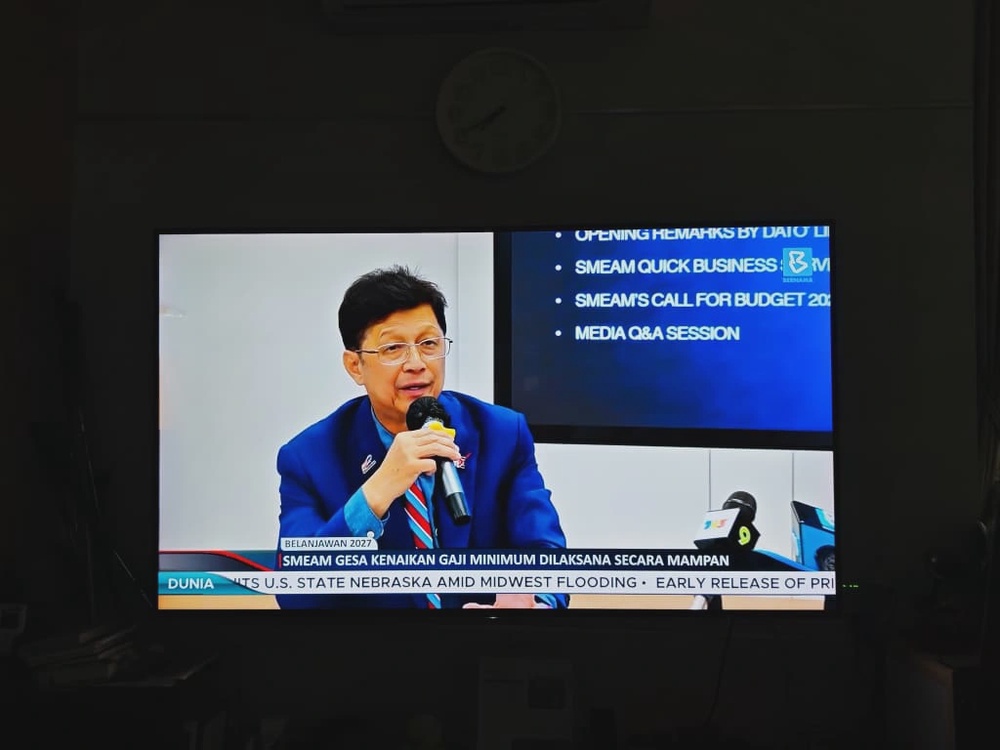
SMEAM national president Dr Chin Chee Seong said the findings should not be interpreted as businesses being opposed to higher wages.
“SMEAM fully recognises the importance of improving the income and standard of living of Malaysian workers. But better wages must ultimately come from better productivity and stronger businesses,” he said.
The association said a minimum wage increase from RM1,700 to RM2,000 could also have a wider impact on salary structures, with 92.8% of respondents expecting at least some pressure to adjust the salaries of employees already earning above the new minimum wage.
It said 76.9% of respondents expected significantly higher operating costs, while 59.5% anticipated lower profit margins.
Meanwhile, 57.4% said they might increase prices, 44.1% might reduce or slow recruitment, and 42.9% might reduce their workforce.
SMEAM stressed that these figures represented concerns and anticipated responses among survey participants, rather than predictions of what would definitely happen.
On factors that should determine future minimum wage adjustments, employee productivity was the top response at 63.7%, followed by overall economic conditions at 56.2% and a company’s ability to pay at 54.4%.
The association said the findings should be considered alongside its Budget 2027 proposal, which calls for measures to strengthen SME competitiveness and develop more Malaysian companies capable of expanding regionally and globally.
Among its proposals is a Cumulative SME Cost and Regulatory Impact Assessment to assess the combined impact of policies affecting labour costs, utilities, financing, the Sales and Service Tax (SST), e-Invoicing, licensing and compliance requirements.
SMEAM said major policy changes should be properly sequenced, with meaningful consultation with SMEs and reasonable transition periods.
It also called for an SME Life-Cycle Financing and Investment Framework covering areas such as working capital, machinery and automation, digitalisation, artificial intelligence, environmental, social and governance (ESG) transformation, commercialisation, exports and international expansion.
The association proposed that financing support combine grants, guarantees, debt, equity, co-investment and private capital according to the needs and growth stage of individual businesses.
SMEAM also urged the Government to strengthen support for automation, robotics, AI, cloud technology, data analytics, cybersecurity and smart manufacturing.
It said assistance should extend beyond equipment purchases to include software, systems integration, implementation, technical skills and workforce training.
Another proposal is a Supplier Development, Localisation and Procurement Programme aimed at connecting Malaysian SMEs with multinational corporations (MNCs), government-linked companies (GLCs) and government procurement opportunities.
SMEAM said the objective should be to move beyond business matching towards actual procurement and sustainable participation in supply chains.
The association also called for stronger domestic direct investment, including appropriate financing, guarantees, equity and co-investment to encourage Malaysian-owned companies to reinvest, automate, innovate, expand and internationalise.
To simplify access to government assistance, SMEAM proposed an integrated SME Development Gateway that would connect existing financing, technology, ESG, skills, certification, supplier development and export programmes.
It said the system should provide SMEs with a clearer development pathway rather than creating another government agency.
SMEAM also called for a shift in the way government assistance is measured, with greater emphasis on outcomes such as productivity gains, automation, higher-skilled employment, exports, intellectual property development and business growth.
“SMEAM appreciates that the Government has recognised MSMEs as an important priority in the preparation of Budget 2027. Our appeal is that Budget 2027 should be a transformational Budget for Malaysian SMEs,” Chin said.
“We are not asking Government simply to protect SMEs from competition or permanently subsidise businesses. We are asking Government to create the conditions that allow SMEs to become stronger, more productive and more competitive.”
Chin said stronger businesses would ultimately benefit workers by creating the conditions for better jobs and more sustainable wage growth.
He said Malaysia’s ambition should extend beyond attracting global companies to invest in the country and include developing Malaysian companies capable of becoming regional and global players.