KUALA LUMPUR, MALAYSIA — The Philippines, along with Malaysia, is now becoming a central destination of distribution channels for transnational illicit tobacco trade made possible through the exploitation of the country’s geographic vulnerabilities.
According to Japan Tobacco International (JTI), a leading global tobacco and nicotine product manufacturer, illegal tobacco trade matters because it weakens public revenue causing an estimated annual government loss of $50 billion, which accounts for 11 percent of global cigarette consumption and about 23.6 percent regionally across Southeast Asia.
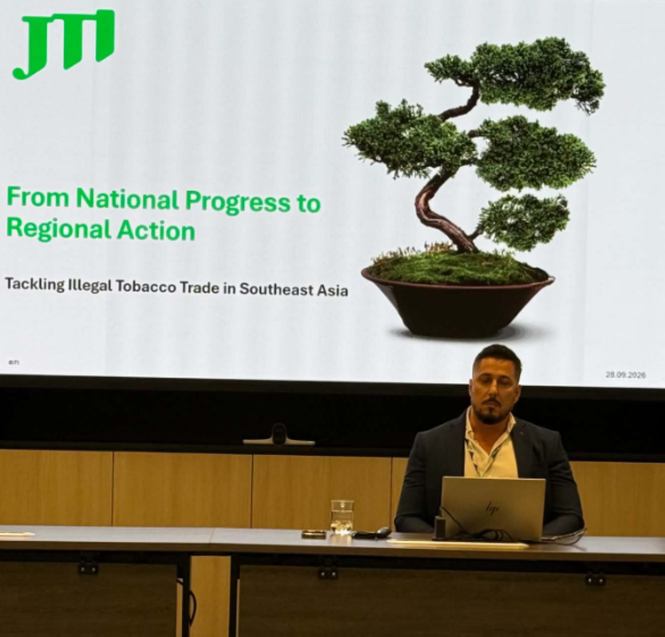
“Illegal tobacco trade is usually discussed or referenced as a tobacco industry problem. But in fact, it's much wider than that. It drives governments out of revenue, undercuts legitimate retailers, obviously undermines our legitimate business, but more importantly, it creates a space for criminal networks to thrive,” JTI Anti-Illicit Trade Operations regional director Valentin Dinca told reporters in a briefing.
The two countries, Dinca said, are top recipients for illicit tobacco sourced from China, the United Arab Emirates, Vietnam, Indonesia and Cambodia with transit hubs in Malaysia, Singapore and Thailand.
With over 7,600 islands and a coastline spanning roughly 36,000 kilometers, the country has an extraordinary amount of unmonitored shoreline. Hence, regulatory gaps, weak enforcement and porous maritime borders are what tobacco smugglers exploit to divert products into illegal markets, using smaller vessels and less visible distribution channels to evade detection, said Shaiful Mahpar, JTI Philippines corporate affairs and communications director.
This is because the Philippines, Dinca said, sits within a regional illicit supply chain which makes a national response practically ineffective as the problem requires a regional approach to address illegal tobacco trade.
Despite being mentioned as the sources of illegal tobacco products, the countries mentioned, Dinca said, are resolute in fighting the multi-billion illegal trade.
Smuggling trend
According to Dinca, trade flows can be diverted before reaching the declared destination. By process, the shipment is first declared for export and documented for a specific destination.
A compliance gap then sets in as products fail to meet destination-market registration or tax requirements.
Diversion then happens when cargo is transferred to smaller vessels before entering the domestic market.
“The risk is not the declared route. It is what happens after the shipment leaves the formal supply chain and moves through less visible channels,” Dinca said.
$145 billion sticks of illicit cigarettes
Across the ASEAN-6 markets of Indonesia, Malaysia, the Philippines, Singapore, Thailand and Vietnam, industry data showed about 145 billion sticks of illicit cigarettes and e-vapes were sold last year.
In the past two years alone, governments lost a combined $13.1 billion in revenues. The Philippine government in particular lost at least $2.5 billion or about P141 billion, according to a study cited by JTI from the EU-ASEAN Business Council and Euromonitor International.
“One thing is clear: no single agency owns the full enforcement chain. Different institutions control borders that affect not only the Philippines but all the other countries worldwide,” Dinca said.
Mindanao a critical convergence point
Throughout the entire Philippines, Mindanao was found to be a critical convergence point for illicit tobacco shipped from Malaysia and Indonesia by sea before products are redistributed to other Philippine markets.
From the two countries serving as the last visible points, routes then connect to Tawi-Tawi, Saranggani and Zamaboanga and from there, products are moved to regional and urban distribution areas.
“Smuggling networks do not operate within the boundaries of a single country. They take advantage of gaps between jurisdictions, moving products through different markets and shifting routes to avoid detection. This is why stronger regional cooperation is essential,” Dinca said.
Historically, Mindanao, specifically the Southwestern Mindanao region comprising the Sulu Archipelago (Tawi-Tawi, Sulu, Basilan), Zamboanga Peninsula, and parts of Palawan is frequently referred to as the Philippines' "southern backdoor".
Criminals, high-profile fugitives, and organized syndicates exploit this area to escape the country due to several reasons, including its extreme geographical proximity to other countries, overlapping maritime borders, limited maritime surveillance and centuries-old informal and maritime barter trades.
In addition, southern Mindanao contains hundreds of informal, privately owned piers and fish ports where no immigration officers are present and established human-smuggling syndicates operate along these routes.