Kota Kinabalu: All State Government-owned buildings in Sabah will be offered installation of solar energy technology to help reduce electricity consumption, with implementation expected to begin early next year.
Sabah Education, Science, Technology and Innovation Minister Datuk James Ratib said his Ministry is ready to provide solar installation services to any state ministry or department that agrees to participate. Implementation is not compulsory.
He said such initiative was among the State Government’s efforts via his Ministry to expand use of green technology in the management of government buildings, while also forming part of the public service digitalisation and reform agenda.
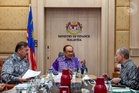
“The use of solar energy is expected to reduce electricity consumption by about 10 per cent, thus helping to lower the operation costs of government buildings,” he told reporters after a symbolic handover of 25 Smart TVs to Sabah Local Government and Housing Minister Datuk Dr Mohd Arifin Mohd Arif at Wisma Bandaraya, here, Wednesday.
As an initial step, James said 24 libraries under his Ministry have been identified to be equipped with the solar system.
“Solar panels will be installed at the 24 libraries, which could save about 10 per cent in costs. In addition, the State Government will receive a 32 per cent return,” he said.
James also said his Ministry had proposed a collaboration with the Local Government and Housing Ministry (KKTP) to provide digital billboards at strategic locations throughout Sabah.
He said the locations for the billboards would be identified and discussed with KKTP, while their management and content would be decided through collaboration between the two ministries.
According to him, the facilities would not only serve as a faster and more effective medium for disseminating information, but also have the potential to increase local authorities’ revenue through advertising.
“These are fully electronic digital billboards that do not use paper. With this approach, we will no longer need to install advertisements manually, where sometimes old advertisements are not replaced and remain displayed until now.
“Digital billboards are fully electronic and easier to manage. We will work with local authorities and KKTP to identify strategic locations for their installation.
“Besides increasing local authorities’ revenue, we also want to provide training for the people, particularly asnaf and B40 groups, so that they have employment opportunities, including in the management and maintenance of the billboards,” James said.
Asked about the costs of the solar and digital billboard projects, James said they would be funded under his Ministry’s allocation.
He added that the respective permanent secretaries of KPSTI and KKTP would further discuss both projects before being finalised.
On the handover of 25 Smart TVs to be distributed among 25 local authorities (PBTs) throughout Sabah, he said the initiative was part of State Government’s efforts to digitalise local government services that would provide direct benefits to the public.
The Smart TVs would also facilitate work processes, speed up information dissemination and improve the effectiveness of service delivery at the local authority level, he added.
James said all three initiatives would be implemented in stages, with preparations and further discussions beginning October, this year before broader implementation next year.
He said the efforts were in line with the Sabah Maju Jaya (SMJ 2.0) agenda under the leadership of Chief Minister Datuk Seri Hajiji Noor, particularly in strengthening the use of technology and improving the efficiency of government service delivery.
Meanwhile, Dr Mohd Arifin welcomed KPSTI’s initiatives, which he said have the potential to benefit local authorities and the public.
He said his Ministry would hold further discussions with KPSTI before making any decisions on implementation.