Food prices became one of the biggest talking points during the recent Formula 1 weekend at Sepang.
From RM50 meals to drinks costing more than RM20, many Malaysians were shocked by how much they had to spend just to eat inside the circuit.
However, why did some spectators at G Hillstand pay only RM3 for mineral water and RM10 to RM15 for a meal?

One possible reason lies in something spectators rarely see: how much vendors actually had to pay to operate inside the F1 venue.
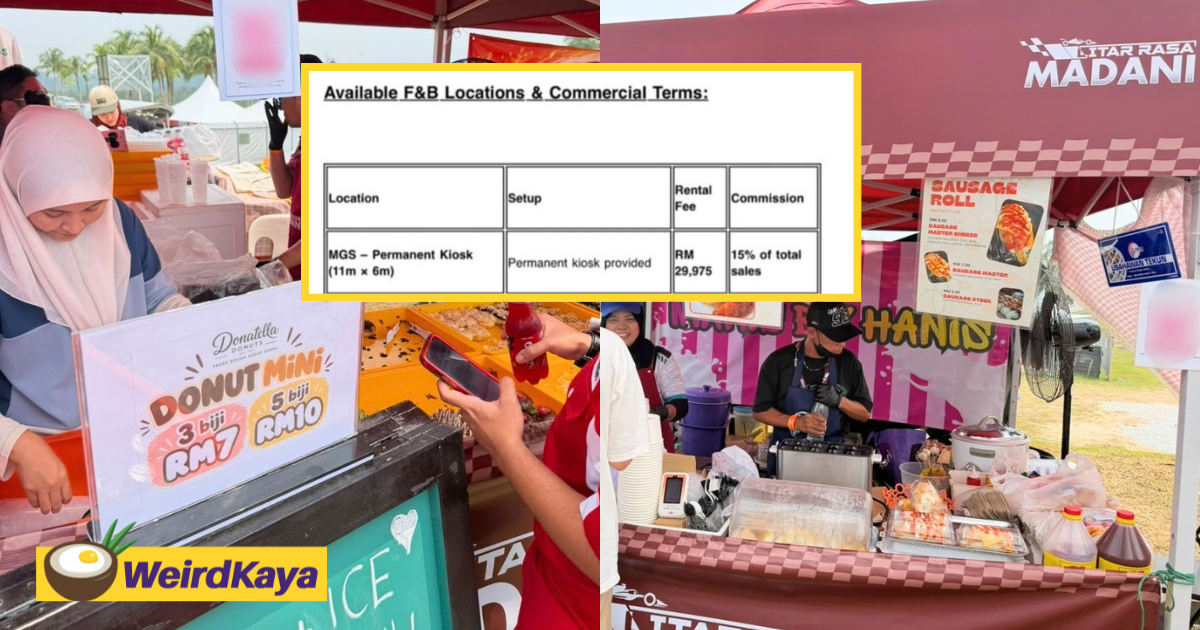
Some F&B vendors faced nearly RM30,000 in rental
Commercial terms for the event showed that F&B vendors could be charged anywhere from RM6,250 to almost RM30,000 in rental for the three-day event, depending on their location.
This was before SST was included. On top of that, vendors were also subject to a 15% commission on their gross sales.
Even at G Hillstand, the standard commercial rental was RM6,250, together with the same 15% sales commission.
Of course, these costs do not automatically explain every menu price seen during the event.
However, they do show how much some commercial vendors had to recover before they could even start making a profit.


But 40 small businesses at G Hillstand only paid RM180
Here is where things were different.
Around 40 micro businesses operating at G Hillstand were brought in under a separate arrangement by the Ministry of Entrepreneur and Cooperatives Development (KUSKOP), led by Minister Steven Sim.
Instead of paying RM6,250 in rent and giving up 15% of their sales, these businesses only had to pay RM180 for a Sepang business licence.
Their rental? RM0.
Sales commission? 0%.

This special arrangement only applied to the 40 selected micro businesses and not to all food vendors operating throughout the circuit.
KUSKOP also provided basic infrastructure such as booths, tables, chairs, chillers, fans and other set-up necessities.

For spectators, dining areas and water dispensers were also provided, while toilets and surau facilities were located nearby.


With much lower operating costs, these small businesses had more room to keep their food prices affordable.
Spectators noticed the difference
Several spectators who visited G Hillstand later shared their experience online.
One Threads user said the area had “a lot of food choices at affordable prices”, pointing out RM3 cold mineral water and a RM10 hotdog-and-drink combo.

Another described the area as having plenty of affordable food booths, along with refillable water fountains.

But if the food was cheaper there, why didn’t everyone simply head to G Hillstand to eat?
G Hillstand was for Malaysians only
The reason is that G Hillstand was not an open food area accessible to everyone inside the circuit.
It was a dedicated ticketed section linked to the special RM200 Tiket MADANI allocation.
For Malaysian spectators, ticket prices differed significantly depending on the zone:
- G Hillstand — RM200
- B Hillstand — RM809.60
- C Hillstand — RM809.60
- F Grandstand — RM1,291.40
- K1 Grandstand — RM1,386
- Main Grandstand — RM2,083.40
G Hillstand tickets were also not offered to international spectators.
This meant someone watching the race from another section of the circuit could have had a completely different food experience and may never have come across the affordable stalls available at G Hillstand.

The RM200 ticket was also a special arrangement
The RM200 G Hillstand ticket was not simply part of the event’s usual commercial ticket structure.
Prime Minister Anwar Ibrahim previously said the special Tiket MADANI was introduced following discussions and an agreement with Bahrain, with the aim of allowing more Malaysians to experience Formula 1 live.

Only 10,000 RM200 tickets were allocated, all for the G Hillstand zone and all the tickets were fully sold out around a month before the race.
It was also within this same zone that KUSKOP brought in 40 local micro businesses and allowed them to operate under the much lower-cost set-up.
Two very different F1 experiences
So when Malaysians compared food prices after the race, they may not actually have been comparing the same experience.

While some commercial vendors were operating with thousands of ringgit in rental and additional sales commissions, 40 micro businesses at G Hillstand only needed to pay RM180 for a business licence.
The difference was not just about food prices. G Hillstand itself was designed as a more accessible F1 experience for Malaysians, from the RM200 ticket introduced under the Tiket MADANI initiative to KUSKOP’s lower-cost arrangement for small local businesses.

And that may explain why two spectators attending the same F1 weekend could walk away with very different opinions about how expensive it was to eat there.
Read more:
F1 Bahrain GP Turns Into A ‘Wet Race’ As Heavy Rain Hits Sepang