
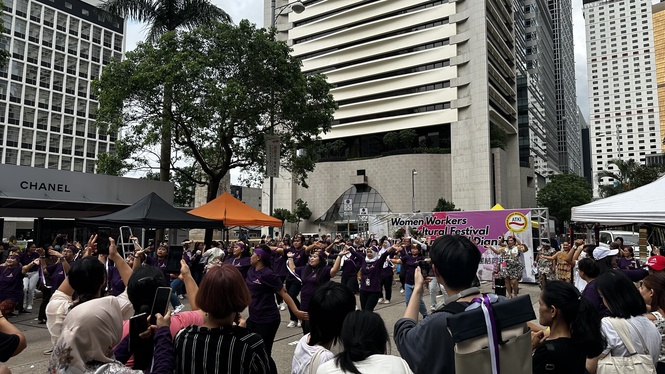
Ate Ling*, a petite and bubbly mid-30s Filipina domestic helper in Hong Kong SAR (China), left the Philippines bringing only a medium luggage, a small backpack, and an ingrained expectation to embody the bagong bayani (new heroes) ideal. What seemed like a harmless expectation soon began to negatively affect her health, more specifically her mental well-being.
I first met Ate Ling on a clammy September Sunday under the ‘Exit B’ signage at MTR Central Station. She was one of the 32 Filipino domestic workers who agreed to share their stories for an ethnographic study about mental health.
Ate Ling’s labor migration journey mirrors that of countless Filipinos who leave the country in search of better opportunities. Her departure was less a leap of ambition and more a quiet surrender. With local wages for high school graduates like herself barely covering the daily costs of her family’s growing needs, boarding that one-way flight was a matter of survival.
Her sacrifices abroad do not go unnoticed. She is one of the millions of Filipino migrant workers being recognized as bagong bayani for bolstering the country’s economy.
Yet, this recognition is not always as glorious as how it is painted. It comes with a mental health cost, and Filipina domestic helpers are among those who carry the weight of this burden.
Expected to be a model citizen
Before departing, Filipino domestic workers are required to undergo the Comprehensive Pre-departure Education Program (CPDEP), a more comprehensive version of the Pre-departure Orientation Seminar (PDOS) co-delivered by the Overseas Workers Welfare Association (OWWA), non-governmental organizations, and private recruitment agencies.
CPDEP lectures center heavily on constructing the bagong bayani: one who is resilient and self-sacrificing. Framed consistently as both an honor and a civic duty, its place in mandatory training makes it clear that heroism is no longer optional, but an active obligation Ate Ling is compelled to perform abroad.
“We are reminded to always be the best version of ourselves because we represent the country,” Ate Ling said in Filipino. “No room for mistakes as we do not want to bring shame to our family and the Philippines.”
Expected to be always present
Closely tied to the bagong bayani ideal is the demand to remain endlessly available to her family back home. For ten years, Ate Ling has stretched herself thin, juggling her roles as a mother, daughter, and wife through a small phone screen.
“After I left the Philippines, my salary increased, and so did my obligations. Because I am working abroad, I need to make them feel that I am still around. Aside from providing their material needs, I need to maintain connection with my daughter, I need to manage my family’s crises, and I need to maintain my intimacy with my husband. I need to show to everyone that I care from afar.”
She remains convinced that this constant availability is tied to the bagong bayani ideal she has internalized. When reflecting on what the heroic label meant to her, Ate Ling anchored her worth in the monthly remittances she sends home and her capacity to endure.
“You need to be self-sacrificing. You need to be ready to surrender your own personal happiness for your family. It is the least that I can do since I am far from them.”
Expected to be efficient
Inside her employer’s household, the bagong bayani ideal takes on a harsher edge. Employers directly benefit from workers like Ate Ling, whose work ethic is framed as a matter of national pride, and whose family obligations back home make holding onto a contract a non-negotiable priority.
With the Philippine government professionalizing domestic work through mandatory certifications provided by the Technical Education and Skills Development Authority (TESDA), Hong Kong employers have come to expect hyper-efficiency as the baseline standard.
“I am the first to wake up, and the last to sleep. I am expected to work more than 16 hours a day. I need to be strong every day, otherwise they will find ways to terminate my contract and find a new helper. I cannot afford to lose my job. I have a family to feed in the Philippines.”
The mental health cost
Simultaneously meeting these expectations takes a quiet, invisible toll on Ate Ling’s mental health.
“There were times when I had to worry about everything all at once,” she recalls. “I had misunderstandings with my mother, needed to send extra money to my child, and had to handle my husband’s suspicion whenever I went out on my rest day. On top of that, I had to keep my employers satisfied so they wouldn’t find fault with my work.”
The distress did not come all at once. Rather, it accumulated until her body began to give out.
“It started when I noticed I was losing weight and my hair was falling out. Too much worrying became too heavy. I had heavy, restless nights, and even bleeding that doctors couldn’t explain.”
Nevertheless, Ate Ling always chooses to keep going. For her, acknowledging physical or mental breakdown and informing her employers about it risks job termination. Returning to the Philippines is also not an option.
“When I decided to migrate, I told myself I needed to be ready for anything. This is the same for many domestic helpers here. When it comes to our mental health, we are always on our own.”
After all, according to Ate Ling, they were constantly reminded during their pre-departure training to be as resilient as possible and to always rely on themselves
A nation dependent on heroes
Although international labor migration is not a new phenomenon in the Philippines, the institutionalization of the labor export policy in the 1970s firmly positioned the country as a primary global labor exporter. Based on the most recent Survey on Overseas Filipino Workers, an estimated 2.19 million Filipinos work abroad. Their economic contributions serve as a permanent feature of the Philippine state’s development strategy.
In Hong Kong SAR, Filipino nationals continue to make-up the majority of foreign domestic helper population. In recent years, mental health concerns among these workers have risen sharply, particularly during and after the COVID-19 pandemic.
This is not to say that the Philippine government is doing nothing to address the issue.
At the policy level, it has established several legal frameworks to protect the mental health of migrant workers, including Republic Act No. 11036 (Mental Health Act) that mandates the Department of Migrant Workers to develop mental health programs. Additionally, the Overseas Workers Welfare Administration is mandated to formulate and implement welfare programs for migrant workers, while the Migrant Workers Offices in host nations are mandated to provide psychosocial services to distressed workers. However, official mental health programs and interventions primarily target those with severe cases, leaving many domestic workers—whose distress builds gradually—without support.
It is high time for the Philippine government to address the structural causes of Filipino domestic helpers’ distress. We can begin by deconstructing and challenging the bagong bayani ideal, while simultaneously raising awareness of and expanding access to both informal and formal mental health services for our migrant workers.
Until labor migration policies offer genuine protection instead of empty heroic praise, Ate Ling and millions like her will continue to quietly trade their mental well-being for survival.
**Ate* is a Filipino term for an older sister. A pseudonym is used to protect the participant’s identity and privacy.