
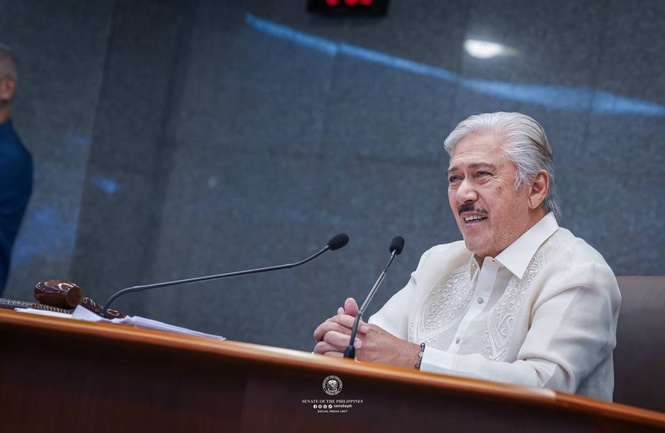
MANILA, Philippines — Senate President Pro Tempore Vicente “Tito” Sotto III is pushing for the creation of a central government agency that would represent Filipino families in policymaking and assess how laws and government programs affect them.
In a privilege speech Tuesday marking National Family Week, Sotto said his proposed Filipino Family Act would institutionalize “Family Mainstreaming” and “Family Impact Assessment” in government policies, legislation, budgets, programs and projects.
“I filed Senate Bill No. 2306, or the Filipino Family Act. This bill seeks to create a central agency that represents the Filipino family in policymaking to ensure that the sanctity of family life is recognized, protected, and strengthened,” he said.
Sotto said the Constitution recognizes the right of families and family associations to participate in the planning and implementation of policies and programs that affect them.
However, he said that no single government agency is tasked with overseeing family-related concerns.
“The basic aspects of family life are scattered among various agencies whose mandates may have an impact on specific facets of family life. This often leaves the Filipino family on the sidelines of legislation and policymaking, with no one specifically championing its interests,” he said.
Sotto said the government should consider the impact of policies and legislation on Filipino families before they are adopted.
The senator noted that the National Committee on Filipino Family currently operates under the Department of Social Welfare and Development, but said the department is already handling a broad range of social welfare and development concerns.
Sotto also linked the need for stronger family policies to recent incidents of violence involving children and young people.
“With all these tragedies and violence happening in our schools and among our children, it bears stressing: Where have we failed our young people?” Sotto said.
“When a young person commits an offense, three institutions have failed — the school, the government and the family,” he added.
Sotto also raised concerns about children’s exposure to online content, noting that technology and social media have expanded access to information while making supervision more difficult.
He said lawmakers should consider the views of Filipino families when crafting legislation affecting children and family relations.
“However, we have to ask this question: What do Filipino families have to say? Or did we even ask them?” he said.
Under Sotto’s proposed measure, Family Impact Assessments would be conducted for government policies, legislative measures, budgets, programs and projects to ensure that their effects on families are considered.
Sotto also cited his previous legislative work, including Republic Act 8369, or the Family Courts Act of 1997, which established specialized courts for cases involving children and family relations.
He said strengthening families should also form part of government efforts to address illegal drugs and drug abuse, which he described as separate but related problems.
“We have to put into action the words we often say: We have to empower and strengthen the Filipino family in order to nurture outstanding Filipino people,” Sotto said.