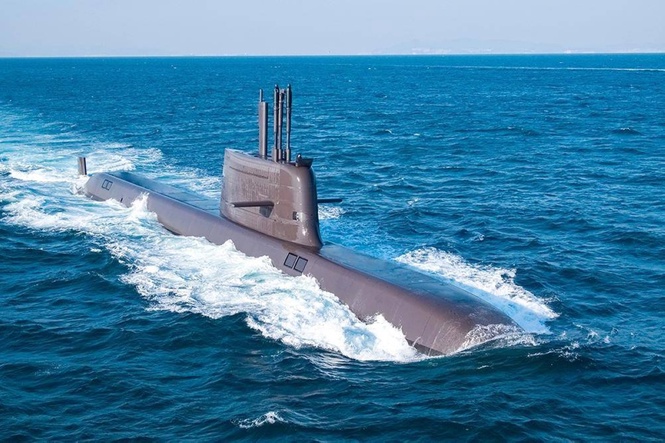
MANILA, Philippines — South Korean shipbuilder Hanwha Ocean has upgraded its submarine proposal for the Philippine Navy, offering a specific variant of the KSS-III as it competes with European shipbuilders for the country's planned submarine acquisition.
Hanwha is offering the Jangbogo-III PN, a variant of the submarine developed for the Republic of Korea Navy. Other companies involved in the Philippine project include France's Naval Group, which offers the Scorpene; Spain's Navantia, with the S-80 Plus; and Italy's Fincantieri.
The Jangbogo-III PN replaces Hanwha's earlier Ocean 1400, formerly known as the DSME 1400, in its proposal to the Philippine Navy.
The proposed submarine is about 77 meters long, 9.7 meters wide and has a surface displacement of about 2,800 tons, according to specifications provided by Hanwha to defense publication Janes.
The design also uses lithium-ion batteries. Hanwha has highlighted the battery system as a feature of its proposal for the Philippine Navy.
Hanwha said the Jangbogo-III PN is based on the KSS-III submarines operated by South Korea.
The company is also offering training, base facilities and logistics support as part of its proposal. In a 2024 statement, Hanwha said its package included “crew training, essential base facilities, and equipment and logistics support.”
The Philippine-specific proposal follows Hanwha's offer of the Ocean 1400 and reflects changes to the design being presented for the Philippine requirement.
The KSS-III is part of South Korea's indigenous submarine development program. Hanwha Ocean inherited the submarine-building business of Daewoo Shipbuilding & Marine Engineering after Hanwha Group acquired the company in 2023.
Hanwha also has an existing defense connection with the Philippine Navy through Hanwha Systems, which supplied the Naval Shield integrated combat management system used on the Navy's Jose Rizal-class frigates.
The Philippine Navy currently has no submarines. Its planned acquisition would therefore require not only the vessels but also the establishment of supporting infrastructure, training and maintenance capabilities.
The competing proposals differ in submarine designs and associated support packages, making training, basing, maintenance and long-term logistics part of the procurement considerations alongside the specifications of the vessels themselves.