.png)

The way traders respond to macro shocks is changing, and Bitget thinks it has the data to prove it. The exchange, which positions itself as a Universal Exchange, or UEX, has released a new report co-authored with quantitative analytics firm Block Scholes that examines trading behavior during the first quarter of 2026.
The central finding is straightforward: as global macro events increasingly spill across asset classes simultaneously, traders are abandoning fragmented platforms in favour of environments that let them move across markets in real time, without waiting for any single exchange to open.
The report, titled "Tokenised Markets on Bitget UEX: How Traders Are Utilising 24/7 Real-World Assets For Real-Time Macro Hedging," documents what Bitget describes as a structural shift in how active traders approach portfolio management. Rather than treating crypto, equities, and commodities as separate strategies managed through separate systems, a growing cohort of users is approaching them as a single, continuous trading surface.
Southeast Asia sits at the centre of this shift. The region accounts for 26.2% of active traders on the platform, which currently serves over 125 million users globally and operates across 150 regions. This followed by South Asia at 20.5% and the Middle East and Africa at 18.4%. The Commonwealth of Independent States accounts for 6.9%, Latin America for 5.2%, and the UK for 4.9%. That geographic distribution helps explain why 24/7 market access matters: when geopolitical events break across time zones, a significant portion of Bitget's user base is active regardless of where traditional markets sit in their session schedule.
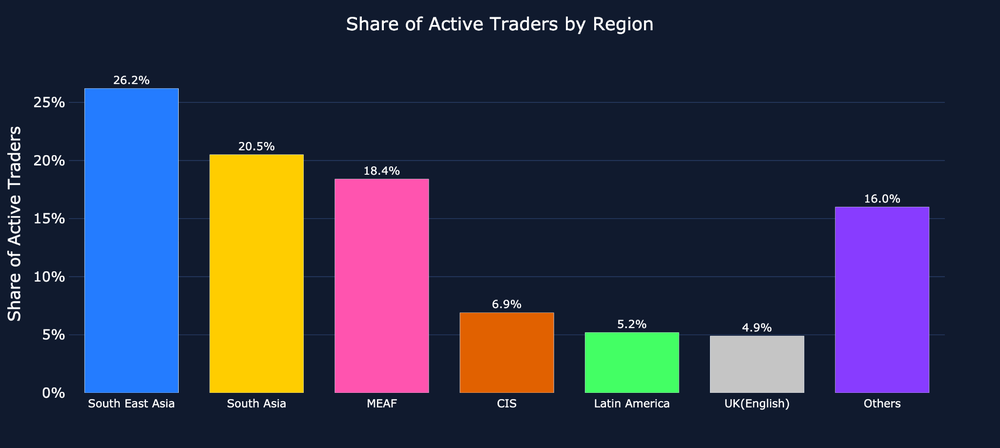
The concentration is even more pronounced when looking specifically at tokenized real-world asset trading. Southeast Asia accounts for 81.9% of total RWA trade volume on Bitget — a figure that positions the region not just as the platform's largest user base, but as the clear centre of gravity for onchain traditional asset activity on the exchange.
The numbers behind Bitget's TradFi offering appear to bear out the broader trend. The platform's tokenized traditional finance products reached $2 billion in daily trading volume within days of launch, doubled to $4 billion shortly after, and surpassed $6 billion during periods of elevated volatility in Q1. Bitget attributes the growth to a combination of macro sensitivity and infrastructure convenience — when a geopolitical event breaks over a weekend, traders no longer have to wait until Monday.
"Modern traders don't wait for markets to open anymore — they know it never closes," Gracy Chen, CEO of Bitget, said in a statement. "There weren't many avenues to explore this earlier, but with tokenization, stocks, gold, silver, commodities and any traditional financial asset can now be traded 24/7."
The report highlights one specific episode that illustrates the thesis. As Middle East tensions sustained safe haven demand for the dollar and briefly stalled what had otherwise been an imperious equity rally toward 7,000 points, gold-linked contract volumes on Bitget spiked sharply. Traders moved to hedge positions and participate in price discovery in real time, outside of any traditional market session. The ability to do so, the report argues, is no longer a niche advantage but a core operational requirement for traders managing risk across multiple asset classes.
Supporting that view is a notable shift in Bitcoin's market behaviour. The report finds that Bitcoin's correlation with major equity indices has reached its highest level since late 2025, which it links to emerging markets responding to shared macro drivers. As Bitcoin increasingly trades in step with equities, the logic of managing both under the same roof becomes harder to dismiss.
Block Scholes provides the quantitative backbone of the report, analysing order flow, volume distribution across time zones, and cross-asset correlation patterns during the period. The collaboration is part of a broader effort by Bitget to substantiate its Universal Exchange positioning with third-party research rather than internal data alone.
The framing arrives at a moment when the tokenized real-world asset sector is gathering institutional momentum. Competitors and traditional financial institutions alike are racing to offer on-chain access to assets that were historically siloed in separate custodial and trading systems. Bitget's argument is that the exchange model itself needs to reflect this convergence – that the platform infrastructure, not just the asset list, is the differentiator.
The report stops short of making specific forecasts on volume growth or market share, but its directional conclusion is clear: unified trading environments are gaining traction, and platforms that integrate crypto, tokenized RWAs, and traditional instruments into a single system are increasingly becoming the default for active traders rather than a specialist offering.
➢ Stay ahead of the curve. Join Blockhead on Telegram today for all the latest in crypto.+ Follow Blockhead on Google News