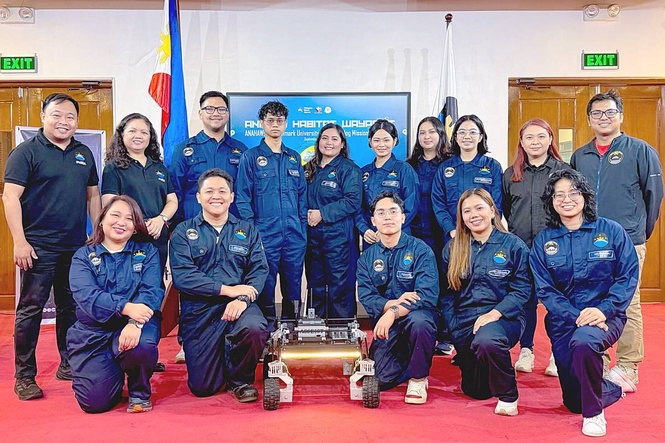
BATANGAS CITY — The 11-crew members at the Analog Habitat Waypoint (Anahaw) have successfully completed a 24-hour simulation at a facility in Batangas State University (BatStateU) practicing as astronauts under severe isolation, communication lag, and physical limits of a lunar base.
The completed simulation forms part of a broader push by the Philippine Space Agency (PhilSA) to build a regional hub for analog astronaut missions. Ahead of the deployment, four experienced Filipino analog astronauts met with President Ferdinand Marcos Jr. at Malacañan Palace to outline future spaceflight initiatives.
The primary crew members lived and worked inside the simulated environment, navigating operational isolation and resource limitations. Five additional team members staffed mission control under the Space Infrastructure Management and Deployment Division, monitoring operations, managing procurement and training protocols, and responding to simulated emergency scenarios.
Anahaw followed a six-part preparatory lecture series held from April to June 2026, designed to train personnel in analog habitat architecture, extravehicular suits, life support infrastructure, and flight-readiness protocols.
Kristine Jane Atienza, the first Filipina analog astronaut, served as a key resource person and lead lecturer for the series. Drawing from her background as a nutrition specialist and medical officer at the Hawaiʻi Space Exploration Analog and Simulation habitat on Mauna Loa, she prepared the Batangas habitat for the operational realities of off-world life while putting a spotlight on a critical discipline: space food engineering.
Atienza has spent years demonstrating that survival rations in isolated, confined environments must be treated simultaneously as medicine, logistics, and psychology.
“Feeding an astronaut is far more complex than stowing freeze-dried camping rations in a locker,” Atienza told The Manila Times. “Beyond Earth’s atmosphere, extreme environments disrupt human physiology. Microgravity drives bodily fluids upward toward the head, causing chronic nasal congestion similar to a severe head cold.” The fluid shift blunts olfactory and taste receptors, causing standard meals to taste like damp cardboard. Simultaneously, cosmic radiation, accelerated muscle atrophy, and rapid bone calcium loss require precise formulas packed with potassium and bioavailable protein, while keeping sodium and iron strictly controlled.
These insights helped shape how crew health is viewed inside the Batangas habitat, where preparation routines faced rigid mass and energy constraints. Boiling water draws heavily on microgrid power reserves, requiring recipes optimized for passive rehydration.
“Crumbly dry goods are strictly out of the question because loose specks foul sensitive environmental air scrubbers and irritate crew eyes,” Atienza stressed. “Waste is equally uncompromising; packaging cannot simply be tossed into a dustbin when every cubic centimeter of discarded plastic consumes vital habitat volume.” To combat menu fatigue—a major cause of declining cognitive clarity and crew morale during longduration confinement—Atienza champions using Southeast Asian food chemistry. Rather than adding excess salt, sour bases from calamansi and tamarind, garlic-heavy aromatics, and the naturally protective vinegar reductions of traditional adobo offer strong flavors that pierce sensory dullness.
Her ongoing research with the Philippine Nuclear Research Institute (PNRI) and the University of the Philippines Diliman (UPD) explores using gamma irradiation to sterilize traditional staples, such as Philippine dried mangoes and shelf-stable meat dishes, ensuring long-term shelf stability without degrading delicate vitamins or protein texture.
Mission leaders are currently parsing data gathered from the 24-hour run to evaluate how Filipino crews handle isolation, monotony, and resource rationing, with an emphasis on how cultural adaptability and communal cooperation, or bayanihan, function under high stress.
“The Analog Habitat Waypoint reminds us that our journey into space begins long before we leave the ground,” said PhilSA Acting Director General Gay Jane P.
Perez, Ph.D. “It begins with curiosity, science and preparation, and people who are willing to go first. You chose to step into this habitat, and what you have learned here can now help others take the next step.” PhilSA has already announced the Anahaw 2.0 expansion across regional campuses, alongside a two-week, all-Filipino professional mission abroad in 2027 targeting facilities such as the LunAres Research Station in Poland or the Mars Desert Research Station in Utah.
The initiative lays the programmatic groundwork for PhilSA’s broader roadmap to qualify an astronaut candidate by 2029.