
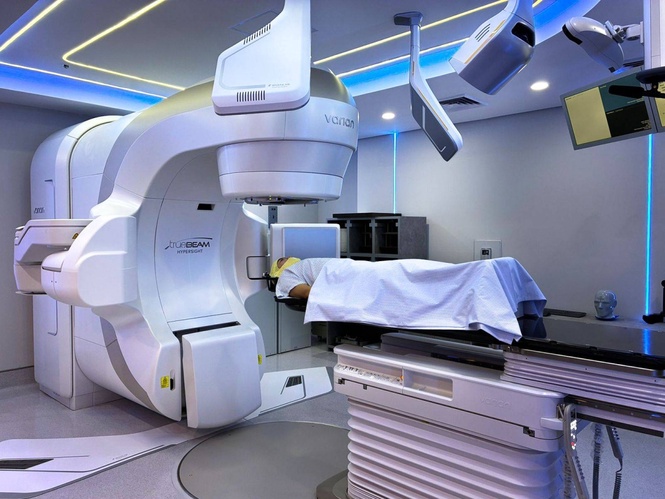
MANILA, Philippines — St. Luke’s Medical Center–Global City has launched its newest TrueBeam® Linear Accelerator system to enhance localized precision and patient comfort during radiation therapy.
Equipped with technologies such as HyperSight, RapidArc Dynamic, ExacTrac Dynamic, and HyperArc, the updated platform allows radiation oncologists to deliver targeted high-dose treatments directly to tumors while reducing radiation exposure to surrounding healthy tissues by up to 50 percent.
“This new technology allows us to better target tumors with greater accuracy and greater efficiency,” said Dr. Angela Camacho, Head of Radiation Oncology at St. Luke’s–Global City. “It’s much safer for the patient and better in terms of total protection.”
The new TrueBeam system introduces high-contrast 3D imaging via HyperSight, which cuts image acquisition time by half compared to previous systems, minimizing image blur caused by patient movement.
It also incorporates HyperArc technology for brain tumor care, replacing uncomfortable bolted head frames with a thermoplastic mask. The technology reduces treatment sessions for patients with multiple brain lesions from three to four hours down to 10 to 15 minutes.
Additionally, the system features ExacTrac Dynamic, a first in the country, which uses thermal surface and X-ray tracking to monitor sub-millimeter bodily movements, including breathing. The radiation beam automatically pauses if a shift occurs until alignment is restored.
The hospital also introduced RapidArc Dynamic, another country first, which combines dynamic collimator rotation with Volumetric Modulated Arc Therapy (VMAT) and Intensity-Modulated Radiation Therapy (IMRT) to adjust beam intensity and shape around complex tumors.
“In our previous machines, we were limited by technology,” Dr. Camacho noted. “With this new software and hardware working together, we can go beyond what used to limit us. The treatments are streamlined, much faster, and significantly more comfortable.”
According to St. Luke's, the platform adapts to routine and complex cases involving brain, breast, lung, abdominal, and pelvic tumors, with sessions averaging 10 to 15 minutes.