

A potential Tatooine-like planet from Star Wars of Earth’s size in a nearby binary star system can hold liquid water and support life, according to a new study that could expand the search for such habitable planets.
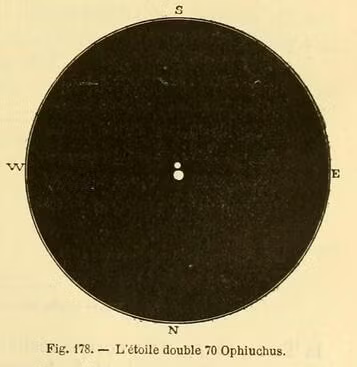
The two-star system called 70 Ophiuchi is trillions of miles from Earth, but is considered relatively nearby in cosmic terms.
For decades, scientists have studied this binary star system, with two stars slightly smaller and cooler than our Sun, orbiting each other.
However, there are no confirmed planets orbiting either star.
Using this star system as a reference, researchers modelled whether an Earth-sized planet could maintain a stable orbit in the larger star’s habitable zone.
This is the area around the star where a planet is just warm enough to maintain liquid water on its surface.
Researchers found that stable planet orbits are possible in the habitable zone of the primary star.
“This is also one of the nearest star systems to us. It’s been known since antiquity, but what hasn’t been known nearly as well is precisely how the two stars orbit each other,” said astrophysicist Stephen Kane, an author of the study published in the Astrophysical Journal.
In the study, scientists simulated gravitational interactions among multiple bodies, from objects as large as stars to objects as small as planets, around the stars.
They then placed an Earth-mass planet at different distances from the primary star and assessed what happened to it.
“An unstable planet’s orbit can become increasingly elongated until eventually the planet is essentially flung away from the system. By repeating the simulation at different locations, we can identify regions where an Earth-sized planet could remain stable,” Skylar D’Angiolillo, a study author from the University of California, Riverside, said.
“When people think about finding another Earth, they often picture something that looks like our own solar system. But if we’ve learned anything from the past few decades of exoplanet discoveries, it’s that other planetary systems can look nothing like ours,” Dr Kane said.
“Having a second sun may sound exotic, but we need to consider worlds that could be habitable without necessarily looking like Earth’s neighbourhood,” he said.
Such binary stars with stellar companions are common in the universe.
Our solar system, with only one star, is actually one of the rare kinds, researchers say.
Yet, of the 6,000 exoplanets confirmed to date, only 14 have been observed to orbit binary stars.
The latest study can help find more such planets, especially those with the potential to harbour life around binary stars.
“There are many other binary systems that could benefit from this type of analysis as scientists begin considering possible targets,” Dr Kane said.
“We also have more work to do on this particular system. There are no confirmed planets there yet, but now we know an Earth-sized planet could potentially maintain a stable orbit in the habitable zone,” he added.
Strange hole found on moon could lead to future astronaut shelter
Mars’s strangest cloud is even weirder than we thought, scientists say
There might be alien life on a nearby moon, scientists say
The solar system could be destroyed much sooner than we thought, scientists say
A Soviet satellite just broke apart and is threatening other spacecraft
Scientists trace radio burst to a 10 billion-year-old distant galaxy