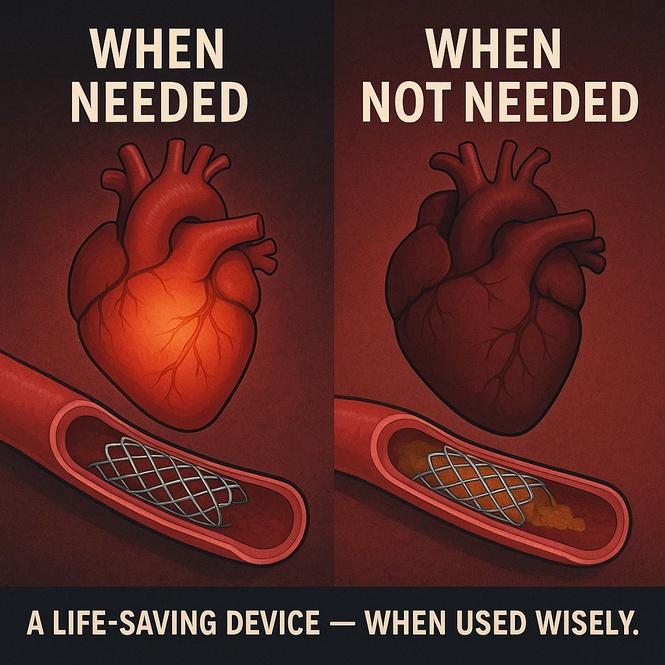
One of the hardest working organs in the human body, is the heart, which works continuously from about 30 days after we are conceived in our mother’s womb until the day we die. To work, the heart muscle needs a good supply of blood to provide it with nutrients and oxygen. This blood supply is provided by blood vessels called coronary arteries. Heart muscles needs more blood supply during exercise compared to rest. Over time due to various causes, these coronary arteries become diseased resulting in narrowings (called coronary stenosis or plaques) which impede blood supply to heart muscles. These coronary plaques are made up of cholesterol particles, several types of cells and in some cases calcium deposits. The affected person may then experience chest pain while working or exercising because these narrowings will prevent the increase in supply of blood needed by the heart muscle during the increased work brought about by exercise.
A major revolution in treating coronary stenosis started in 1977 when tiny balloons were treaded into coronary arteries to widen the narrowings. A few years later, these balloons were developed to carry small tubular wire meshes, called stents and these were implanted in the area of the stenosis to keep the artery open. The use of coronary stents to treat coronary stenosis has increased rapidly and exponentially all over the world. Just as stents can save lives if used appropriately, they can also cause damage to the heart when used inappropriately. Stents are very expensive.
The purpose of this article is mainly to inform the public about the appropriate use of stents. In the past I have penned 2 articles to address this : “To Stent or not to Stent” – the Malay Mail 30th May 2018 and “Do you really need a stent” – The STAR 15th December 2019. I write again because several of my like-minded colleagues are concerned about the continued abuse of coronary stents all over the world including Malaysia.
Let me begin by emphasizing that, when used appropriately, stents can save lives. I say this because, in the past, some of my articles have been accused of alarming the public—leading a few readers to refuse stent implantation even in situations where it could have improved their chances of survival.
So the question is : When are stents needed or be beneficial ?
Before we address this, we have elucidate the issue of chest pain. Though most people are worried about the heart when chest pain occurs, it has to be clarified that chest pain can also arise from the muscle, bone, lungs and nerves which also share the same space as the heart in the chest. Loosely, these conditions are sometimes described as “non cardiac chest pains”. It is vital to separate pain that arises from these structures from that arising from the heart because the treatment is vastly different and also because the implant of stents should never be done and will not be beneficial in these non cardiac conditions. The diagnosis of chest pain arising from the heart is not within the scope of this article but very briefly in classical presentations, it is described as having a heavy, compressing sensation in the chest, usually brought on by exertion and could be accompanied by perspiration and breathlessness. Often the pain will result in ECG changes (electrical tracings made from the heart) and elevation of specific blood enzymes. Sometimes the diagnosis can be vexing for even the most experienced of doctors but there are many tools available today to help establish the diagnosis. It is most important that it be established unequivocally that the cause of the chest pain is due to significant narrowing of the coronary artery before a stent is implanted.
There is very strong evidence based on rigorously performed scientific studies that in patients presenting with chest pain due to “acute coronary syndromes” the implant of stents will save lives. Again, it is beyond the scope of this article to delve into the diagnosis of acute coronary syndromes but it would suffice to say that a patient who presents with a “heart attack” which in most instances, is due to a sudden obstruction of a coronary artery, belongs to this group of patients.
Will everyone with a narrowing of a coronary artery, benefit from the implant of a stent ? The answer is a rigorous “definitely not”!. Most authorities (Ref.: 1) will agree that stents may benefit patients who have more than 70% narrowing of their coronary arteries. Even in this group, the astute reader will note some restrain in my advice. This is because the benefit accrued will be dependent on several factors including whether or not the person has chest pain due to the heart. We have several studies now to provide scientific proof that patients who have heart artery narrowings but no chest pains will do well with just drugs and that stents will bring no benefit. There are also studies to provide evidence that in some patients who have chest pains due to heart artery narrowings, classified as “stable coronary artery disease” drug therapy alone without stents will be equally if not more beneficial (Ref. : 2 and 3). Your cardiologist will be the best person to help make the distinction.
The diagnosis of the degree of narrowing in a coronary artery can be controversial. Some months back, a patient came to see me for a second opinion. He had gone to another hospital complaining of chest pains which to me, sounded to be that due to muscular pains. A coronary angiogram had been advised which he consented to. A coronary artery narrowing was diagnosed during the angiogram and the implant of a stent immediately, had been advised. He also consented to this. However, following the stent implant, his chest pains had persisted – I was not surprised by this, as I had concluded after listening to his story soon after he walked into my consultation room, that his chest pains were not due to his heart. I reviewed the angiograms that he brought along. I could not see any coronary artery narrowing before the stent was implanted. He subsequently saw three other cardiologists - two of them agreed with me that there had been no coronary artery narrowing needing the implant of a stent, while the third cardiologist felt that there was about a 30% narrowing which he certainly would not treat with a stent. In my lectures to the general public and in the articles that I have written, I have always advised, that, except in the event of an emergency like a heart attack, especially if you have no symptoms, consider requesting for a second and if necessary a third opinion before consenting to having a stent implanted in your heart artery.
As I mentioned at the beginning of this article, the inappropriate implant of coronary stents is universal. The Times of India reported on the 11th of May 2024 that 2 cardiologists and several officials in a hospital in India had been arrested for the overuse of stents in patients Ref.; 4). The LOWN Institute Hospital Index in the United States reported in 2021 that a study conducted between 2019 to 2021 revealed that in the USA, during that period, over 229.000 stents were unnecessarily implanted in patients! (Ref. : 5)
Are there disadvantages to having a stent implanted in your heart artery? Yes there are. Narrowing can recur within stents after they are implanted and these can be very difficult to treat. You will need to take lifelong medications after the implant of a stent, which if stopped can cause the development of a clot within the stent, causing you to suffer a heart attack and in the worst case scenario, result in death. The medications you need to take after the implant of a stent can cause bleeding and if this occurs in the stomach or brain can result in death. So due diligence must be exercised and much thought must go into the decision to implant a stent into a coronary artery.
How can the public ensure the appropriate use of coronary stents to treat their illness? Due diligence, monitoring and audits conducted by the Ministry of Health and the top management of hospitals will be important. My friends and I also believe that an informed public who will ask searching questions before consenting, will also be an important deterrent. When in doubt, and if it is not an emergency do not hesitate to request that the procedure be postponed until you get another opinion.
References :
Ref 1 : National Heart Association Malaysia. Clinical Practice Guidelines : Appropriate Use Criteria for Investigations and revascularization in CAD 2015
Ref 2 : Medical therapy versus percutaneous coronary intervention or coronary artery bypass graft in stable coronary artery disease; a systematic review and meta-analysis of randomized clinical trials ARYA Atheroscler. 2022 May;18(3):1–12. doi: 10.48305/arya.2022.24252
Ref 3 : Optimal Medical Therapy with or without PCI for Stable Coronary Disease N Engl J Med 2007;356:1503-1516
DOI: 10.1056/NEJMoa070829
Ref 4 : The Times of India : Why Overuse of Stents in Cardiac patients Needs to be Arrested : 1th May 2024
Ref 5 : Lown Institute Hospital Index : Avoiding Overuse: Coronary Stents. How professional inertia harms patients and wastes billions of dollars : October 31, 2023
Disclaimer: This article is intended for informational purposes only and does not constitute medical advice. Readers are encouraged to consult a qualified healthcare professional for diagnosis and treatment of any medical condition.
Dr. Kannan Pasam is a content creator under the Newswav Creator programme, where you get to express yourself, be a citizen journalist, and at the same time monetize your content & reach millions of users on Newswav. Log in to creator.newswav.com and become a Newswav Creator now!
The User Content (as defined on Newswav Terms of Use) above including the views expressed and media (pictures, videos, citations etc) were submitted & posted by the author. Newswav is solely an aggregation platform that hosts the User Content. If you have any questions about the content, copyright or other issues of the work, please contact creator@newswav.com.