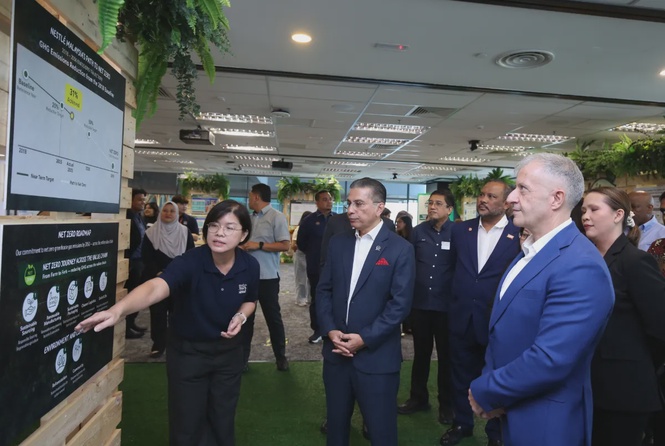
PETALING JAYA: Malaysia cannot meet its climate commitments without businesses stepping up, as the country’s transition to a low-carbon economy requires collective action from industry, businesses and communities alongside government policies, Deputy Natural Resources and Environmental Sustainability Minister Syed Ibrahim Syed Noh said.
Speaking at Nestle Malaysia Bhd’s Net Zero Milestone event today, Syed Ibrahim said while the government could provide the policy framework, incentives and an enabling environment for decarbonisation, achieving the country’s climate goals ultimately depends on action across the private sector and society.
“The government can set the direction, we can introduce the right policies and create an enabling environment, but the transition ultimately has to happen on the ground. It has to happen across our industries, businesses and, of course, communities,” he added.
Syed Ibrahim said Malaysia’s Third Nationally Determined Contribution (NDC 3.0), submitted to the United Nations Framework Convention on Climate Change in October 2025, commits the country to an absolute reduction of between 15 million and 30 million tonnes of greenhouse gas emissions by 2035 from its projected peak emissions level.
“Malaysia was also among the first five Asean countries to submit its third NDC,” he added.
The transition to a low-carbon economy was not only an environmental necessity but also an economic opportunity that would enhance Malaysia’s competitiveness and strengthen the position of Malaysian companies in meeting the evolving expectations of consumers, investors and global markets, Syed Ibrahim said.
“We need more companies like Nestle willing to invest for the long term, collaborate across sectors and be transparent about both their achievements and the work that remains ahead,” he added.
Congratulating Nestle Malaysia on reducing its greenhouse gas emissions by 31% in 2025 against its 2018 baseline, surpassing its initial target of 20%, Syed Ibrahim said, the achievement demonstrated that effective climate action could be pursued alongside business growth and long-term value creation.
“This achievement not only reflects the company’s continued commitment and investment in advancing its sustainability agenda, but also demonstrates that effective climate action can be pursued alongside business growth and the creation of long-term value,” he added.
The achievement, the deputy minister said, showed sustainability and business growth need not be competing priorities and expressed hope that the milestone would encourage the company to continue advancing its decarbonisation efforts.
Syed Ibrahim said Nestle Malaysia’s transition to renewable electricity across its operations aligns with the National Energy Transition Roadmap, under which Malaysia is working towards renewable energy accounting for 70% of installed electricity generation capacity by 2050.
However, he stressed that corporate sustainability must extend beyond reducing emissions within manufacturing facilities.
“But sustainability cannot stop at the factory gate, right? As such, I am also pleased to see the wider scope of efforts showcased today, from reducing packaging impact and strengthening community recycling, to restoring our natural ecosystems and encouraging environmental awareness among young Malaysians,” Syed Ibrahim said.
He emphasised that building a circular economy requires not only recycling infrastructure but also sustained public education and behavioural change.
“We can talk about emissions, we can talk about circular economy, climate targets, but ultimately these efforts must translate into actions that people can understand and practise.”
Syed Ibrahim also highlighted the importance of protecting and restoring natural ecosystems, saying such efforts strengthen biodiversity and climate resilience while reflecting the Islamic principle of Mizan, or balance, between economic development and environmental stewardship.
“Whether through reducing emissions, improving recycling or restoring nature, these efforts are interconnected and contribute to the wider transformation towards a more sustainable future,” he said.
Sustainability is ultimately a shared responsibility and urged all stakeholders to build on the momentum of corporate climate action, Syed Ibrahim said,. “The transition we speak about is not something waiting for us in the future. It is already happening, and all of us have a role in deciding how far and how fast we want to move.”