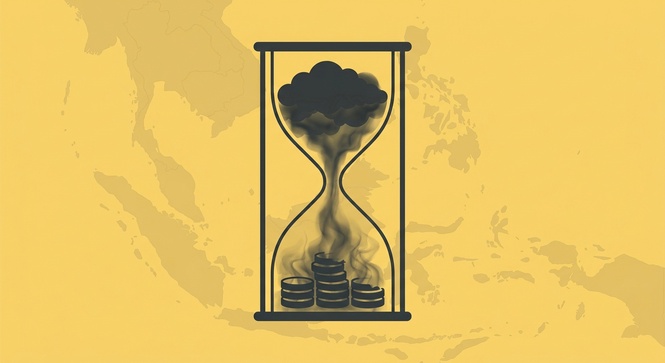
Transboundary haze is often treated as an inconvenience—schools close, flights are delayed, and people stay indoors. But the economic and human costs are far larger.
In Malaysia alone, according to The Star, experts estimate that prolonged haze is costing the country RM20 million to RM50 million every day, with losses potentially reaching RM600 million to RM1.5 billion a month if the crisis continues.
A Recurring Regional Crisis
Southeast Asian haze usually begins with land and forest fires, especially in Indonesia’s carbon-rich peatlands. Smoke then crosses borders, affecting Indonesia, Malaysia, Singapore, and sometimes Brunei and parts of Thailand.
The 2015 episode was among the most severe in recent memory, fires burned more than 20,000 square kilometres of land, and the resulting haze sickened hundreds of thousands of people in Indonesia before spreading to Malaysia and Singapore.
“Prolonged haze is costing the country RM20 million to RM50 million every day, with losses potentially reaching RM600 million to RM1.5 billion a month if the crisis continues”
The problem is not merely environmental.
It disrupts work, travel, healthcare, agriculture, tourism, and public confidence. Because the pollution crosses borders, no single country can solve it alone—yet every country pays part of the price.
Malaysia’s Daily Bill
Malaysia’s current haze-related losses are driven by disrupted business activity, higher healthcare spending, and reduced worker productivity. Sunway University economics professor Dr Yeah Kim Leng estimates the daily cost at RM20–50 million, a figure that can compound rapidly as the haze continues.
At the upper end, that implies a monthly burden of up to RM1.5 billion. This is not a hypothetical worst case; it reflects the cumulative effect of lost output, medical treatment, absenteeism, supply-chain disruption, and lower consumer activity.
Tourism is especially exposed. Air pollution could reduce visitor arrivals by up to 8%, with estimated GDP losses of up to RM1.5 billion, according to Dr Yeah. Aviation is also vulnerable, as poor visibility and health concerns disrupt flights, airport operations, and travel demand.
Agriculture faces a slower but serious impact. Vegetable and fruit production can decline, while palm oil may experience delayed effects lasting six to 12 months.
Meanwhile, healthcare systems bear higher treatment costs as respiratory illness increases, and outdoor workers face lower productivity and greater absenteeism.
Health Costs Are Rising
The health burden is one of the clearest indicators that haze is becoming more expensive. Nationally, the cost of illness linked to haze rose from about RM21 million during the 1997 haze to RM410 million in 2013.
That increase reflects both more frequent or severe pollution episodes and the growing cost of treating respiratory and cardiovascular conditions.
Haze does not only cause coughing and eye irritation; fine particulate matter can worsen asthma, chronic obstructive pulmonary disease, heart disease, and other conditions.
The true cost is likely higher than recorded medical spending because lost productivity, long-term illness, and premature deaths are harder to measure.
Southeast Asia’s Larger Losses
Malaysia’s losses are part of a much larger regional bill. During the 2015 crisis, the World Bank estimated that Indonesia lost at least US$16.1 billion, or about RM72.12 billion, because of the fires and haze. That was more than double the estimated cost of rebuilding after the Aceh tsunami.
Singapore also bore a substantial cost. The 2015 haze was estimated to have cost the city-state S$1.83 billion, or about RM5.91 billion.
These figures show that haze is not simply an Indonesian fire-management issue. It is a regional economic shock, with costs distributed across neighbouring economies through tourism losses, health spending, disrupted transport, and reduced productivity.
The Human Toll
The most serious cost cannot be fully captured in ringgit. Research covering 2004–2015 estimates that haze contributed to 40,000 to 100,000 additional deaths in Indonesia, Malaysia, and Singapore.
This range should be understood as a research-based estimate of excess deaths attributable to haze-related health impacts, rather than a precise count of individual fatalities.
Even at the lower end, it represents a major public-health failure, preventable pollution exposure leading to avoidable illness and death.
Why Prevention is Cheaper
The economics strongly favour prevention. Once fires spread across peatlands, firefighting becomes difficult and expensive; poor visibility can ground aircraft, while smouldering peat can burn underground for long periods.
Malaysia has also noted that haze is not currently classified as a natural disaster under existing ASEAN mechanisms, even though it produces disaster-scale consequences.
A stronger regional response would require rapid fire detection and cross-border data sharing, investment in peatland restoration and fire prevention, clear accountability for companies and land managers that use burning, health-system preparedness in neighbouring countries, and regional financing so that prevention is not treated as one country’s burden alone.
Haze is Not a Temporary Problem
Haze is not a temporary weather problem. It is a recurring economic shock and public-health emergency that costs Malaysia millions of ringgit each day and imposes billions in losses across Southeast Asia.
The 2015 experience showed that Indonesia can lose over US$16 billion, Singapore can lose S$1.83 billion, and tens of thousands of lives may be affected across the region.
For Malaysia, the current estimates—up to RM1.5 billion a month—make the case clear: investing in regional prevention, enforcement, and early response is far less costly than repeatedly absorbing the damage after the smoke arrives.
The post Suffocating Southeast Asia and Malaysia: The Unseen Health and Economic Costs of Haze first appeared on PP Health Malaysia (PPHM) | 10POINTS Evidence-Based Health News.