
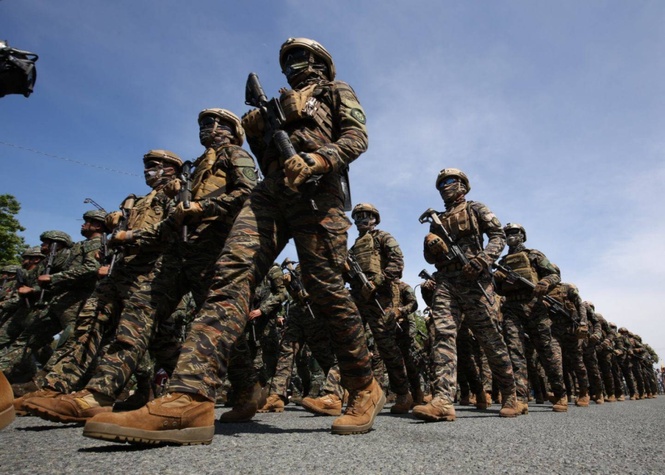
THE Armed Forces of the Philippines (AFP) will test its territorial defense capabilities along the country’s eastern seaboard through joint military and interagency exercises, including a counter-landing live-fire drill, maritime air-strike operations and coastal defense maneuvers in Surigao Strait and nearby areas.
Exercise Surigao Sentinel 2026, scheduled from Oct. 22 to 25, will bring together Army, Navy and Air Force units, civilian agencies and local governments to simulate responses to external security threats and test coordination across land, sea, air and other operational domains.
Spearheaded by the AFP’s Eastern Mindanao Command (EastMinCom), the exercise will be conducted under the theme “Beyond the Strait: Converging Historical Legacy and Multi-Domain Security.” EastMinCom said the drills are part of the military’s transition toward external defense operations under the Comprehensive Archipelagic Defense Concept, which calls for integrated capabilities to protect Philippine territory and maritime approaches.
The command said the exercise would strengthen operational readiness amid increasingly complex security challenges by testing procedures, identifying capability gaps and improving interoperability among military units, government agencies and other stakeholders.
The maneuver is described by EastMinCom as a pioneering territorial defense exercise along the country’s eastern seaboard and the first of its kind in the Caraga region.
The exercise comes as the Philippines seeks to strengthen its ability to defend its maritime domain beyond the West Philippine Sea, which has been the focus of much of the country’s recent maritime security activity.
“This exercise aims to test the capabilities of the AFP and other members of the security sector in times of external security threats,” Lt. Col. Gerard John Saldo, representing EastMinCom, said.
More than 600 military personnel are expected to participate, with Army, Navy and Air Force units joined by reserve forces and personnel from the Philippine Coast Guard (PCG), Philippine National Police and Bureau of Fire Protection.
The joint activities will include maritime domain awareness and intelligence, surveillance and reconnaissance; surface exercises; counter-landing live-fire drills; maritime air-strike operations; maritime interdiction; and visit, board, search and seizure operations.
Coastal defense and indirect-fire exercises will also be conducted, while water search and rescue, and noncombatant evacuation operations will test coordination between military and civilian authorities during emergencies and humanitarian contingencies.
A counter-landing live-fire exercise is intended to test the forces’ ability to respond to a simulated attempt by hostile forces to establish a foothold along the coast. The maritime and air components will test surveillance, interdiction and coordinated engagement capabilities.
The PCG will help secure designated waters during the live-fire phase. Under Notice to Mariners CGSDI-0926-001 issued by Coast Guard Station Dinagat Islands, fishing, sailing and navigation will be restricted within specified coordinates to protect the public and passing vessels.
EastMinCom has advised residents not to be alarmed by the movement of troops and military equipment, saying these are part of the scheduled exercise.
The Dinagat Islands provincial government has ordered the suspension of classes during the exercise period to ensure the safety of students, teachers and the public. It has also allocated P1 million in counterpart funding for the military activity.
The exercise is being conducted in partnership with the Surigao City government, the Dinagat Islands provincial government, and other government agencies and stakeholders.
AFP chief of staff Gen. Antonio Nafarrete and other senior defense officials are expected to attend frontline activities in Surigao City on Oct. 23.
The four-day exercise will culminate on Oct. 25, coinciding with the 82nd anniversary of the Battle of Surigao Strait, fought on Oct. 25, 1944, during World War II.
The battle was a decisive engagement between American and Japanese naval forces during the larger Battle of Leyte Gulf. It is widely regarded as the last battleship-to-battleship engagement in naval history.
EastMinCom said the commemoration links the historical defense of the strait with the AFP’s present responsibility to protect national sovereignty, safeguard communities and prepare for emerging security threats.