
On the 14th of September 2026, at two in the morning, I turned on SVT- Sveriges Television, Sweden's national public television broadcaster and news website - as they performed what can only be described as an Eurovision-styled exit poll reveal of the Riksdag elections. The first shock of the night was when the far-right Sverigedemokraterna came in third place. In contrast, the centre-right Moderaterna secured second place, and the Socialdemokraterna came in first - as usual. Now that the dust has almost settled as of my writing this article, let's conduct some analysis of the government talks that might usher in a new government in Sweden.
Background
The political prelude to an election starts with the incumbent Government going into the election - and it was a centre-right Government, a government that the Swedes (and Scandinavians at large) would coin as "bourgeois" or "non-socialist". As a result of the 2022 elections, the incumbent government is led by Ulf Kristersson and his liberal-conservative Moderaterna (M) party, with the Christian Democratic Kristdemokraterna (KD) and the right-wing liberal Liberalerna (L), with confidence and supply from the national-conservative Sverigedemokraterna (SD) in accordance with the Tidöavtalet or the Tidö Agreement, signed by leaders of the respective parties.
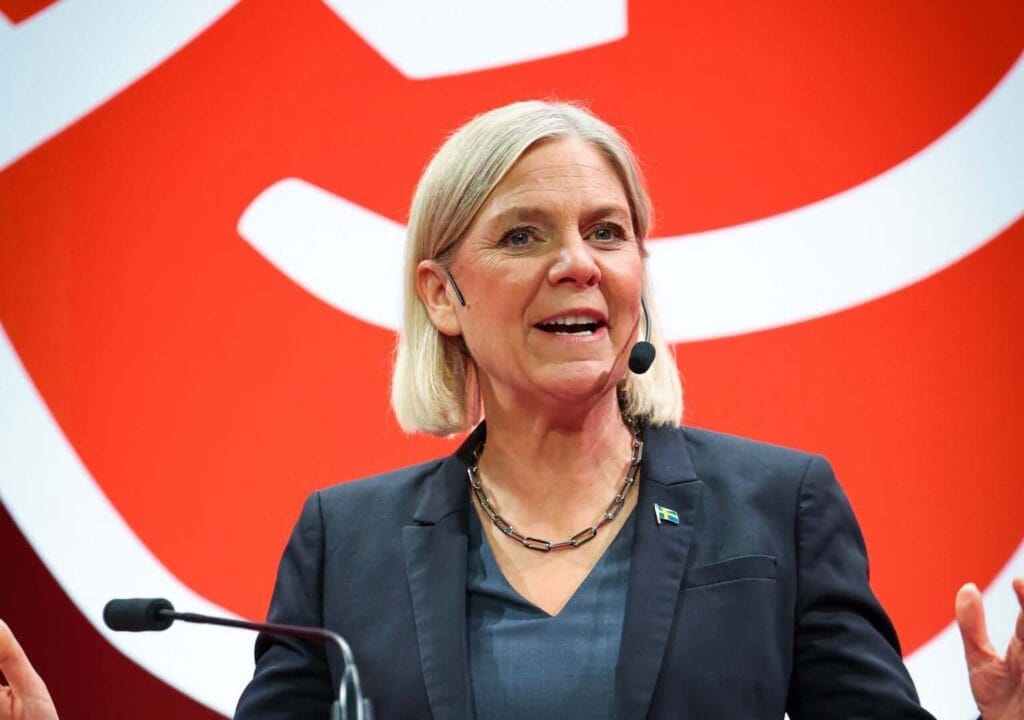
The Opposition is the "red-green" bloc, led by the social democratic Socialdemokraterna (S) party, led by former Prime Minister Magdalena Andersson, after taking over from Stefan Löfven in November 2021, before being ousted by the Tidöavtalet parties after 2022. The environmental party, Miljöpartiet de Gröna (MP), gives the green to the "red-green" bloc, while the socialist Vänsterpartiet (V) rounds off the bloc. The last party that rounds off the opposition, which is not part of the bloc, is the agrarian Centerpartiet (C), which started moving towards the left after the bourgeois parties decided to work with the far right. They were so outraged that former leader Annie Lööf mentioned that she and her party were ready to sit in a Social Democratic-led government - a policy that has remained in place going into the elections 4 years later, despite the political instability within the Centerpartiet.
Narratives
There were three overarching narratives going into the elections. The formation of a Government with SD, L not clearing the 4% threshold and the weakness of S.
The first was the expectation that SD was going to grow or retain second place in the polls. Ever since achieving their first seats in 2010, SD has been growing amidst growing anti-immigration sentiment and general discontent over law and order - one of their pillars on their website - with some undertones of welfare chauvinism sprinkled in there. However, going into the election, SD leader Jimmie Åkesson wanted to be formally part of the Government - with ministerial positions - after claiming that they had won the arguments. This would mark a seismic shift since there was an active cordon sanitaire with SD before the Tidö Agreement - and would allow a party with Neo-Nazi roots to get a foothold in Sweden since the establishment of democracy there.
The second was the worry that L would not clear the 4% electoral threshold. Sweden's electoral system runs on proportional representation - which means that, roughly speaking, the percentage of votes a party gets will be directly proportional to the percentage of seats they will obtain in the next Riksdag, but there is a catch. In order to get into the Riksdag, a party must either clear a 4% national threshold or get 12% of the vote in a certain region. In the 2022 election, L got 4.61% of the vote, which translated to 16 seats. However, the party had polled well below the 4% electoral threshold for years in the lead-up to the 2026 election - due to voter dissatisfaction with cooperation with the far-right - a feat that they had previously rejected unequivocally, until polls just a week before the election showed that they had cleared the threshold. This was a significant unknown for one main reason: without L, there was no chance that the parties that signed the Tidö Agreement would retain power, so many political analysts and armchair political analysts (like myself) waited with bated breath to see if L would get into the Riksdag or not.
The third and last narrative was the weakness in Magdalena Andersson's S, and the problem was with the campaign itself. A poll came out via SVT that mapped out voters' most important issues, which the first three, in order, were: Sjukvården [Healthcare], Skola och utbildning [Education and Training] and Svenska ekonomin [Swedish Economy]. With these three fundamental issues being that high, the opposition should have easily secured a win - but polls going into the election showed that S was going to hit historic lows in support, recorded by Reuters, as some polls showed Sweden's natural governing party slumping to only 25%, and it has got to come down to poor campaigning. A Friedrich Ebert Stiftung paper written in 2023 proved to be highly prophetic in this regard, in which there were signs that S could beat the Tidö Government. Still, they were going to struggle without concrete proposals - which turned out to be what Andersson offered in a presentation. She also framed it as a referendum on the participation of SD in Government, with ministers - which Verian Group is noted to have said: "The party [V] has positioned itself as the guarantee that the Social Democrats [S] will not make a right turn after the election. Perhaps this has influenced some red-green voters." This implies that by focusing on the SD question, voters of the red-green bloc indicated their willingness to vote for V [which showed an increase in support] in order to hedge the policy direction of S - ensuring simultaneously the collapse of the Tidö Agreement and the push for S to go in a certain way.
Results & Government Formation
The results, as of writing, according to SVT, are as follows - with the rounded brackets denoting the seat change from the 2022 election and the square brackets denoting the change in vote share from the 2022 election:
Socialdemokraterna "S" - 100 seats (-7) with 28.1% [-2.3%]
Moderaterna "M" - 70 seats (+2) with 19.9% [+0.8%]
Sverigedemokraterna "SD" - 62 seats (-11) with 17.5% [-3%]
Vänsterpartiet "V"- 29 seats (+5) with 8.3% [+1.5%]
Centerpartiet "C" - 25 seats (+1) with 7.1% [+0.3%]
Kristdemokraterna "KD" - 22 seats (+3) with 6.2% [+0.9%]
Miljöpartiet "MP" - 22 seats (+4) with 6.1% [+1%]
Liberalerna "L" - 19 seats (+3) with 5.4% [+0.8%]
"Red-Green" Bloc: S-V-MP-C: 176 seats
Tidö Government Bloc: M-SD-KD-L: 173 seats
Result: The Tidö Government has been defeated
It is expected that a left-wing coalition will take power in Sweden. Still, coalition talks must ensue - especially a compromise between V and C. C has previously mentioned that they are unwilling to give V ministries when C leader Elisabeth Thand Ringqvist was asked on SVT, despite V wanting to sit in Government - which leaves Magdalena Andersson with a complex problem to solve. Still, there might be light at the end of the tunnel. According to Swedish political analyst Nasreddin, who works for Europe Elects, mentioned in his Twitter post: "All my Centerpartiet sources are hyping up a minority government S+C+MP taking support from V. The question is: what price will V ask for abandoning their demand of getting ministers in an Andersson government?" Reportedly, one concession that C and V can agree on is the banning of profit-taking in schools, which Aftonbladet, a Swedish daily newspaper, published shortly after the election. This is a remarkable turnaround for C, since they have historically - even up til the 2026 election - defended the right of friskolor or the "free-school" system, to make profits. What other concessions will be made to make this coalition succeed is yet to be seen, but it sure seems that C is in a conciliatory tone and is flexible for such arrangements.
Writer's Closing Thoughts
The fall of S to its lowest point in a century must be studied. The natural governing party of Sweden dropped to its lowest support in a century, just shy of 30%. This shows that a concrete plan for social democrats across the world is needed in the modern political environment we find ourselves in. Vague directions are not able to inspire a population when election tensions run high in the face of the far right. Social Democrats and Democratic Socialists across the world must take note of the Friedrich-Ebert-Stiftung paper released in 2023 to analyse and modify their political efforts going forward to convince people that the extreme right is not the way forward to a better nation - but the left is the best bet for a stronger way forward.
Timothy (timothytanyeantim@gmail.com) is a content creator under the Newswav Creator programme, where you get to express yourself, be a citizen journalist, and at the same time monetize your content & reach millions of users on Newswav. Log in to creator.newswav.com and become a Newswav Creator now!
The User Content (as defined on Newswav Terms of Use) above including the views expressed and media (pictures, videos, citations etc) were submitted & posted by the author. Newswav is solely an aggregation platform that hosts the User Content. If you have any questions about the content, copyright or other issues of the work, please contact creator@newswav.com.