
M.Krishnamoorthy
A media coach, adjunct professor and author
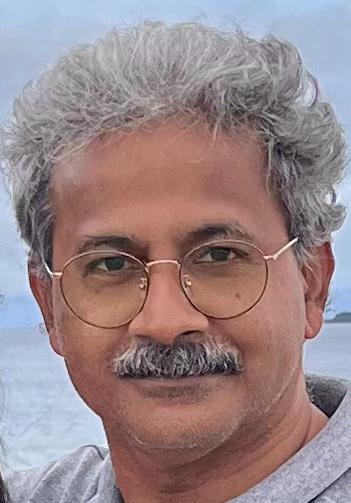
Gobinathan Raman, 59, was born in a family of 13 children. His father was a rubber tapper in Kirby Estate, Jalan Labu in Seremban.
“Our family lived a simple and carefree life. Being away from the eyes of the civilised world, nestled in Labu, we didn't have any pressure to live up to certain standards or expectations of people back in the 70s and 80s. My family had very few possessions – a small table, a few chairs, some wooden shelves to stack clothes and plates, and of course, the benches for sleeping – that was about it.”
“The house was very basic with just a cement floor, so not a lot of cleaning was required. Before school-going age, and if not old enough to be sent to the creche, we roamed around the house and even outside in shorts minus the tops.”
“For us brothers and sisters, life was all about having the basic meals and enjoying playtime throughout the day. We had loads of fun and laughter playing cartwheel, wheelbarrow, and hide and seek. Minor cuts on the hands and legs were quite common,” Gobi, who is a civil engineer, narrated in his first book My Story: Musings of an Estate Boy.
In a storytelling manner, he often reminisced his childhood memories that he eventually penned during the COVID-19 pandemic in 2020.
Time can never erase sweet memories for Gobi. “While we age as the years roll on, the memories of sweet family life, beloved people, places and precious experiences remain fresh, enthralling our hearts and minds, with each dear reminiscence. From time to time, cherished memories give rise to deep yearnings to relive the past of our loving family life, impossible though it may be. Yet, they keep springing forth as a fountain of unmistakable warmth radiating with hope and joy.”
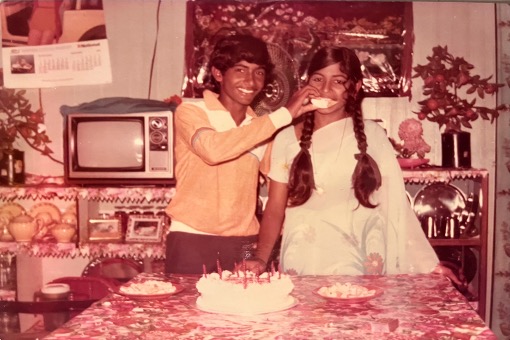
In this account of his childhood in the book and growing up in a loving family, Gobi fondly recalls events and experiences of growing up in a rubber plantation. Born into a large family, with his parents working as rubber tappers and labourers, his early days were marked by poverty. Yet, in an unassuming way, he learned to enjoy and savour every single one of those days. Simplicity and gratitude coloured the lenses through which he viewed his world then. And he is no different today.
Gobi grew up in Negeri Sembilan in Kirby Estate, which is located along the trunk road connecting Seremban and Nilai. He received his education at Kirby Tamil School and St. Paul’s Institution. He graduated from the University of Malaya in civil engineering and spent a large part of his work life with an MNC. Gobi is currently semi-retired and engages himself in minor entrepreneurial interests, in addition to participating in community-related activities and giving back to society.
“Our family lived in poverty, and our meals were very basic. Meat and fish were rare, and often our meals comprised just rice mixed with yellow lentil curry and some vegetables like spinach, gourds, cucumber, and the like, that were mainly grown in the backyard. We often found wild spinach and mushrooms to supplement our meals. Tapioca was abundantly available, either in our backyard or courtesy of the neighbour's garden. There was not a time when we went hungry, and I’m grateful for that. Stories of our parents and others going hungry during World War II, living on tapioca for days, still linger on in my memory.”
Dinner was a lot more fun than lunch for the family. “I still fondly remember my mother mixing rice, curry, and vegetables in a small pot, making rice balls and feeding us young ones sitting in a circle. Food eaten that way always seemed tastier. On other occasions, either my mother or one of the older sisters would take us on a dinner stroll along the main dirt road, even when we were between five and six years old. The absence of vehicles afforded us the freedom to walk along the road, engage in childish splashing with our mates and get fed with rice balls in between. The pleasant and fun distraction always ended in us finishing our dinner without any coercion. These instances of simple joy and freedom are some things most kids of today rarely get to enjoy. Of course, this meant dinner was early, before 6 pm, as the study session with my father started soon after that.
“Money was hard to come by and we were given 10 cents a month on the day my father received his first pay of the month. Under the British system, the workers were paid twice a month – on the 6th of the month (the salary) and the 20th (the advance). As soon as the 10 cents coin landed on our palms, we would rush to the grocery store operated by our night-class teacher’s father, about 100 yards away from the house, and return with two types of sweets or sour plum or even gamble it on the ‘Tikam’ (lottery) game which promised a special gift for the lucky tickets, but more often than not we left empty-handed. And we had to wait for the following month. Father’s second pay or ‘advance’ was insufficient to afford us another 10 cents as my father had to balance the income with all the family commitments.
“I also remember a ‘no’ answer whenever the Chinese peddler came around at night selling ‘pow’. The hot, fluffy steamed buns with chicken or black bean stuffing were irresistible but always out of reach. I rarely remember eating them. But I must never forget the special allowance my father made for either chicken prawn or crab once a month. While individual cravings were not entertained, and justifiably so, the common interest of the family got the nod whenever our finances permitted. We did rear chickens, but they were either kept for their eggs or escaped the knife out of sheer sentimentality; pets are not for slaughtering.”
In school, he and his twin sister Sumathi excelled, often being 1st and 2nd in class. His father’s push proved to be the stepping stone. And though the constant push for excellence ended with his father’s passing, Gobi’s determination continued to grow. As the teacher’s pet, he was always expected to participate in extracurricular activities like drama, reading, essay writing, storytelling, elocution and the like.
Gobi recalls the house had only 1 bathroom-cum-toilet. Due to the sheer numbers, finding a slot for a bath was simply difficult during ‘peak’ hours. As a 6 to 8-year-old, bathing stark naked at the back of the house was a very common thing for Gobi and his younger brothers.
One of the memories of getting ready for school in the dimly lit house was a ‘painful’ one for Gobi. When the yellow filament light was turned on around 5 am, it attracted the bees which were ever ready with their stingers when accidentally stepped on. His greatest experience of watching a movie then was something that would probably never repeat itself in Malaysia, certainly not in this generation. Gobi had the privilege of enjoying a movie lying down on a mat, under the stars, in the open-air field. And for free - nothing could ever beat that. The movies were shown once a month, and the family enjoyed watching it with all the other estate folks and the Malay and Chinese communities from nearby towns and villages. Movies turned out to be a real family bonding time, with much laughter, especially over the antics of Indian comedians in Tamil movies.
Those were the days of Gobi’s unique experiences, and unforgettable memories. “Looking back now, after five decades, I realise that the estate life experience was something very special, and difficult to replicate. To a large extent, it had to do with the close-knit family, communal living, self-containment, absence of external attractions and distractions, co-dependency, and simplicity of life. I suppose it may be the same for others from small towns and villages.”
Some of these experiences recounted here are rather unique to estates while others are more common, but was memorable, nevertheless, by the closely-knit family environment, the people, and the setting.
Freelance Writer M. Krishnamoorthy (www.imkrishna.net) is a media coach, adjunct professor and undercover journalist. He has freelanced with Bernama, NST, The Star, and Malaysiakini. He also freelances as a fixer/coordinator for CNN, BBC, German and Australian Television networks and the New York Times. As an undercover journalist, he has highlighted society's concerns.

Submit any #Family-related content for a chance to win prizes worth up to RM5,500! T&C apply. Find out how you can participate here.
M. Krishnamoorthy is a content creator under the Newswav Creator programme, where you get to express yourself, be a citizen journalist, and at the same time monetize your content & reach millions of users on Newswav. Log in to creator.newswav.com and become a Newswav Creator now!
The User Content (as defined on Newswav Terms of Use) above including the views expressed and media (pictures, videos, citations etc) were submitted & posted by the author. Newswav is solely an aggregation platform that hosts the User Content. If you have any questions about the content, copyright or other issues of the work, please contact Newswav.
