
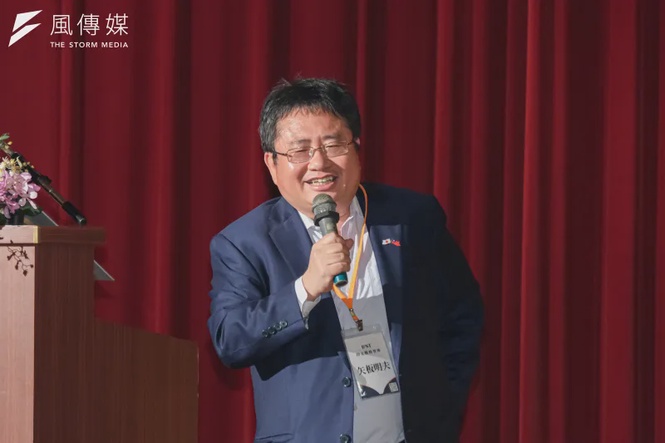
Prosecutors in Taiwan have concluded that the July assault on commentator Akio Yaita (矢板明夫) in Taichung was not a case of mistaken identity or a random act of anger, but a paid, organized cross-border attack meant to frighten critics of Beijing into silence. The Taichung District Prosecutors Office on October 6 indicted Liao Gangfa (廖港發), the Hong Kong triad member who threw the punch, and asked the court to impose the maximum sentence of five years in prison.
"This time the fist landed on my face, but what it really wanted to knock out was everyone's courage to speak," Yaita said in a statement after the indictment. "I will not fall silent because of this punch."
What Prosecutors Found
Liao, 33, a Chinese national who entered Taiwan on Hong Kong travel documents, was described by prosecutors as an operations team leader in the Hong Kong triad Wo Shing Wo (和勝和). He was indicted on charges including assault, public insult, intimidation of the public and participation in a criminal organization, according to CTWANT. Prosecutors asked that he remain in detention during the trial.
Four alleged accomplices, a man surnamed Wu who organized the group and three others surnamed Kwong, Fung and Wong, are wanted. Prosecutors said the attack was bankrolled by a man calling himself "Chan Wai-ho" (陳偉豪), whose true identity remains unknown. He was unhappy that Yaita frequently commented in public on cross-strait affairs and politics, prosecutors said, and paid a cross-border gang to assault him in public to intimidate free speech and achieve transnational repression, the Liberty Times reported.
Prosecutors said the plot was designed to use cross-border violence and the media attention it would draw to create a "kill one to warn a hundred" effect, spreading fear and a chilling effect across society.
How The Attack Was Planned
According to the indictment, the group entered Taiwan in batches between July 1 and July 4 and spent July 4 and 5 scouting the Tempus Hotel in Taichung, where Yaita was scheduled to speak, and the surrounding area. Wu directed the operation and assigned tasks, Liao handled reconnaissance and on site coordination, Kwong was originally meant to carry out the attack, and Fung and Wong were to act as lookouts.
The original plan called for Kwong to hit Yaita over the head with a glass bottle. But Kwong and Fung backed out, worried about being identified, and flew out of Taiwan on July 5. Liao stepped in and, at about 11:38 a.m. on July 6, punched Yaita in the face as he left the hotel. He was ultimately paid HK$100,000, or about NT$400,000, Newtalk reported. Police arrested him at Taichung International Airport that afternoon as he tried to leave for Busan.
Yaita said a poster may have saved him from worse. The event organizer, the Spring Rain Foundation, had listed seven speakers for July 5 and 6 with his name first, because the schedule had not been finalized. The attackers assumed he would speak on July 5 and arrived for that day, when in fact he spoke on July 6. "If the poster had been clearer, they might have caught me," he told reporters, agreeing that a glass bottle could have caused far more serious injuries.
A Pattern Of Transnational Repression
Yaita said the findings disproved both early claims that the attacker had targeted the wrong man and Beijing's description of the case. China's Taiwan Affairs Office had dismissed the assault as an ordinary public order incident carried out out of personal outrage.
He placed the attack alongside a string of recent incidents in democracies. In the United States, a woman was charged with surveilling President Lai Ching-te's family on behalf of the Chinese government. In South Korea, four Chinese men broke into and damaged a Chinese restaurant named "Xi Jinping" before quickly returning to China. In Taipei, Live Comedy Club Taipei, where a performer had publicly mocked Xi, was pelted with a mixture of white paint and excrement. And this week, Taiwanese prosecutors also said two men from Hong Kong paid private investigators to keep Taipei mayoral candidate Puma Shen and his family under round the clock surveillance.
"Chinese style transnational repression is moving from online intimidation to property damage and hired violence, from individuals to their families, and from Taiwan and Hong Kong to democracies such as the United States and South Korea," Yaita said. The surveillance of Lai's family struck him as especially chilling, because the president's relatives are not public figures and have never criticized China or taken part in politics.
Why Yaita Says Current Laws Fall Short
Asked about the Mainland Affairs Council's plan to amend the law to counter such attacks, Yaita said the case could be prosecuted this time only because the attacker was caught and investigators found extensive evidence on his phone. Without that, he said, such cases are usually treated as ordinary public order offenses, and under current law the cost of committing them is very low.
"The chilling effect they want to create is truly sinister, a serious challenge to Taiwan's democracy and freedom of speech," he said, arguing that the law should be amended to deal with cross-border, organized and politically motivated violence. He also urged Taiwan to tighten border controls, noting that most of those who came to attack him were gang members who currently face few obstacles entering the country, and that criminals could come not only from Hong Kong but from Japan, Europe or the United States.
Beyond Taiwan, he called for democracies including the United States, Japan and South Korea to build a common line of defense against what he described as China's authoritarian government exporting violence and fear.
The Toll Of The Attack
Yaita said his injuries have largely healed. For more than a month after the assault, he had difficulty eating; a dentist later found nine loose teeth, mostly in his upper jaw. Psychologically, he said, he now pays more attention to his safety and reacts more sensitively when strangers approach him. He thanked police across Taiwan for deploying officers to keep order at his public events and seminars.
But he said the attackers' real target was not him. "They sent so many people and spent so much money not to teach me a lesson, but to knock out the courage of Taiwanese people to speak and silence criticism of China," he said. "If we stop speaking now, they win. The more they do this, the more bravely we should stand up."
He said living a normal life was the most effective form of resistance, and that he would keep speaking out for Taiwan and for freedom, including at a Taiwan and Japan technology forum he is hosting on October 11.
YP