

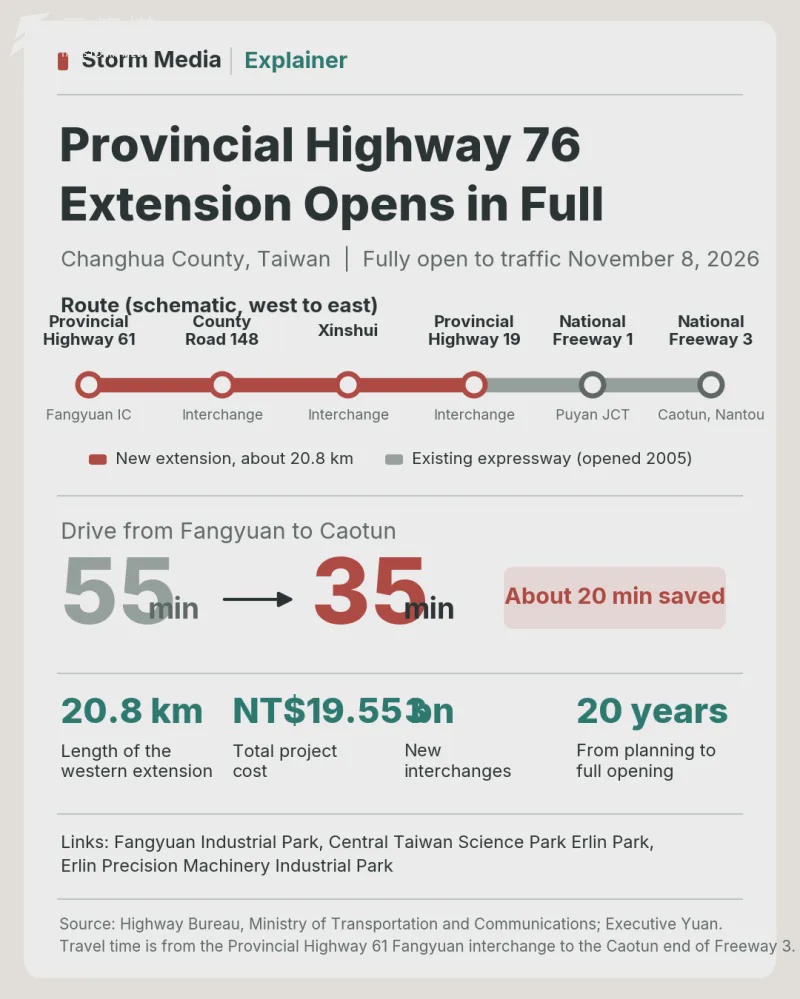
After two decades of planning and construction, the western extension of Provincial Highway 76 in central Taiwan's Changhua County opened in full on November 8, 2026, finally linking the county's rural southwest coast to the island's two main north-south freeways.
The 20.8-kilometer expressway runs from the Fangyuan interchange on the coastal Provincial Highway 61 east through Erlin and Puyan, where it joins the existing Highway 76. The drive from Fangyuan to the Caotun end of National Freeway 3 in neighboring Nantou County drops from about 55 minutes to 35, a saving of roughly 20 minutes, according to the Highway Bureau.
Premier Cho Jung-tai Opens The NT$19.55 Billion Extension
The Highway Bureau under the Ministry of Transportation and Communications held the opening ceremony on November 7, attended by Premier Cho Jung-tai, Transportation Minister Chen Shih-kai, Changhua County Magistrate Wang Hui-mei, and local lawmakers. The final elevated section opened to traffic at noon the following day.
The project cost about NT$19.55 billion and was built in four construction contracts. Along the way, it adds three interchanges, at County Road 148, Xinshui, and Provincial Highway 19. The at-grade western sections opened in stages earlier, while the elevated stretches to the east were the last to be completed.
With the extension in place, Highway 76 now ties together Provincial Highway 61, Provincial Highway 19, National Freeway 1, and National Freeway 3. Officials say it will also draw traffic off County Road 148 and Provincial Highway 19, two local roads that carried most of the area's through traffic.
Residents Of Southwest Changhua Gain Faster Trips
Magistrate Wang said the extension was a project local residents had pushed for over many years. Cutting the Fangyuan to Caotun trip to about 35 minutes makes it easier for people to commute, travel for work, and return home to visit family, she said.
Premier Cho said the road fills a gap in Changhua's east-west network and completes the connections between the coastal expressway and the two freeways, improving transport efficiency across central Taiwan.

Industrial Parks In Erlin And Fangyuan Get A Direct Route
The road is also meant to serve industry. It connects the Fangyuan Industrial Park, the Erlin campus of the Central Taiwan Science Park, and the Erlin Precision Machinery Industrial Park, as well as the Changhua Coastal Industrial Park, shortening freight times and improving logistics in the region.
Cho said Changhua has been designated a "new core for precision and smart industries in central Taiwan" under the government's regional development plan, and that a complete road network will help industrial sites in the area grow. Wang said opening the route will give the three parks in southwest Changhua a boost and lift the local economy.
Faster Hospital Transfers And Disaster Response
Officials also highlighted the road's role in emergencies. Fangyuan and Dacheng, on Changhua's low-lying southwest coast, have long been far from major hospitals. Cho said the expressway will give residents quicker access to Changhua Christian Hospital, Show Chwan Memorial Hospital, and Yuanlin Christian Hospital, cutting transfer times for critically ill patients and speeding up disaster response.
The project was designed as a "sponge road" that helps hold and store rainwater, with landscaping along the route. Space under the elevated sections has been turned into bike paths, rest areas, and public art, part of a people-oriented design meant to fit the road into the communities around it.
A Plan First Drawn Up In 1991
Highway 76 dates back to Taiwan's 1991 Six-Year National Development Plan, which called for 12 east-west expressways. Part of the route opened in 2005 but stopped at Puyan, leaving the western end unbuilt for years as local officials lobbied for funding.
In 2018, Lai Ching-te, then premier and now Taiwan's president, approved the plan and budget for the extension west of Puyan. After years of coordination and construction by central and local governments, the full 20.8-kilometer route is now open. Highway Bureau Director-General Lin Fu-shan briefed guests on the project at the ceremony, which ended with a blessing rite and a ribbon cutting.