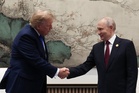
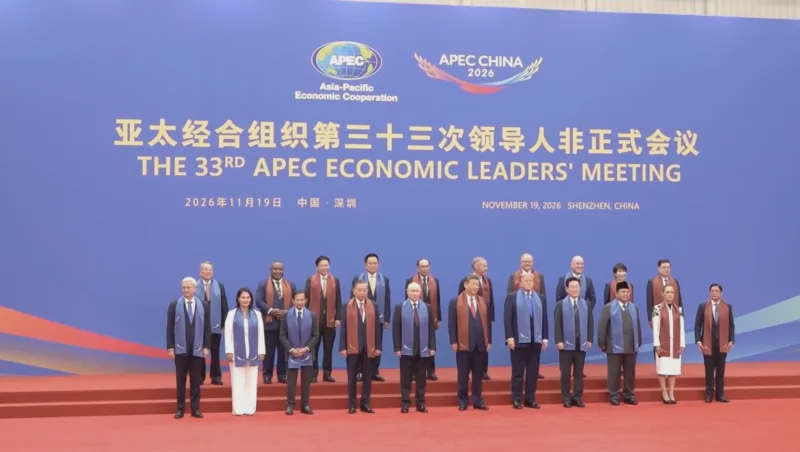
Taiwan's envoy to the APEC leaders' summit in Shenzhen, China, shook hands with US President Donald Trump and Russian President Vladimir Putin on November 19, even though he was again placed in the far corner of the back row for the leaders' group photo.
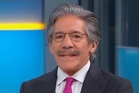
Stan Shih, the 81-year-old founder of Acer, attended the 33rd APEC Economic Leaders' Meeting on behalf of President Lai Ching-te. Taiwan is a full member of the Asia-Pacific Economic Cooperation (APEC) forum under the name "Chinese Taipei," but Beijing's objections keep its presidents from attending in person. Footage released by Taiwan's Ministry of Foreign Affairs shows Shih also shook hands with Chinese President Xi Jinping, the summit's host, as he entered the venue, his second handshake with Xi in two days.
Shih Holds Out His Hand As Trump Reaches Across
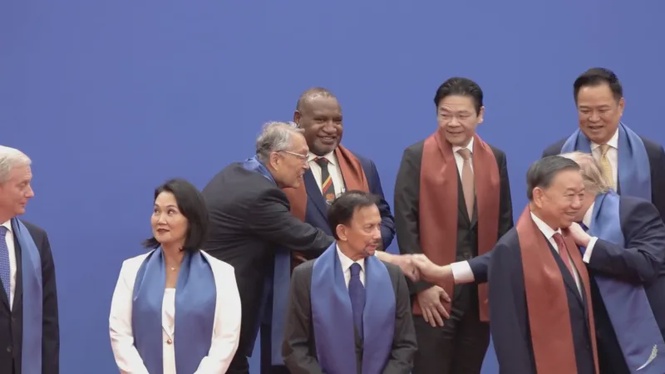
Leaders lined up for the group photo late in the morning. As at the welcome dinner the night before, Shih was put at the far left end of the back row. Before the photo, he shook hands in turn with Canadian Prime Minister Mark Carney, Peruvian President Keiko Fujimori, and Vietnamese President To Lam.
Once Trump reached his spot, he began shaking hands with the leaders standing behind him. Shih turned early and held out his hand. Trump rested one hand on the shoulder of To Lam, who stood in the front row, and stretched across with the other to shake Shih's hand. The two exchanged a brief greeting before turning back to face the cameras.
For Taiwan, which has no formal diplomatic ties with Washington and is routinely sidelined at multilateral events, even a few seconds of contact with the US president at a summit hosted by Beijing carries symbolic weight.
A Parting Handshake With Putin, A Missed Moment With Takaichi
When the photo session ended and leaders began filing out, Shih did not leave right away. The foreign ministry's footage shows him waiting until he could shake hands with Putin as the Russian leader walked off.
He appeared to look for a chance to greet Japanese Prime Minister Sanae Takaichi as well, but she stayed close beside Trump, and no opening came.
Not every encounter was warm. Chilean President José Antonio Kast, who stood directly in front of Shih in the photo, shook hands with Papua New Guinea Prime Minister James Marape when he took his place, but only waved and nodded at Shih.
US Cabinet Members Sought Out Taiwan's Back Table
The handshakes followed a busy night of contact at the leaders' welcome dinner on November 18. When Shih arrived with his wife, Acer co-founder Carolyn Yeh, Xi and China's first lady, Peng Liyuan, offered their hands to the couple.
Taiwan's delegation was seated at a round table in the last row of the banquet hall. Taiwanese journalists at the scene saw US Treasury Secretary Scott Bessent and Singapore Foreign Minister Vivian Balakrishnan walk over to the table to chat with members of the delegation, including Wu Cheng-wen, a minister without portfolio who heads Taiwan's National Science and Technology Council.
Vincent Chao, deputy secretary-general of Taiwan's National Security Council, also approached US Secretary of State Marco Rubio and US Commerce Secretary Howard Lutnick to strike up conversations. According to accounts relayed by the delegation, Shih interacted with leaders of 13 economies over the course of the dinner.
From An Empty Corner To A Seat Beside Singapore
Shih's place at the table also improved overnight. At the dinner, his seat sat at a corner with no one to his left. At the summit's round table on November 19, as Xi and other leaders delivered remarks, he was seated between Thai Prime Minister Anutin Charnvirakul and Singapore Prime Minister Lawrence Wong, an arrangement that appeared to follow alphabetical order under the letter T. Images from the session show Shih chatting and laughing with Wong.
Xi Pledges US$20 Million And A New Shenzhen Research Center
Xi, who chaired the meeting, used his remarks to press Beijing's vision of an "Asia-Pacific community." In the full text released by Xinhua, China's state news agency, he said "momentous changes not seen in a century are accelerating across the globe," and that innovation was booming across science, technology, and industry. Regional cooperation, he argued, had to adapt to new realities and take new strides.
He called for a community "characterized by solidarity and mutual assistance, openness and integration," as well as innovation and inclusive development. "China is an advocate, promoter and forerunner of Asia-Pacific economic cooperation," Xi said, adding that Beijing wanted to work with all parties to build four pillars of that community: economy and trade, connectivity, innovation, and development.
Xi announced that China would provide US$20 million to fund practical APEC cooperation and would set up a Center for Asia-Pacific Community Studies in Shenzhen to support policy research and exchanges. China also plans to create cooperation bodies covering digital technology, cross-border data flows, clean energy, and the development of small and medium-sized enterprises.