
The U.S. Commerce Department has stationed a second export control officer in Taiwan, according to people in the island's unmanned vehicle supply chain, as Washington tightens its watch over American technology moving through Taiwanese factories that now build drones and sea drones as well as chips and AI servers.
The officer would join the regional export control officer the department's Bureau of Industry and Security (BIS) first placed at the Taipei office of the American Institute in Taiwan (AIT), Washington's de facto embassy, in mid-2023. Storm Media's reporting on the second posting is based on industry sources.
The move comes as Nvidia CEO Jensen Huang's admitted affair with Alice Huang, a Megaspeed executive whom U.S. intelligence has identified as a Chinese intelligence asset, puts Beijing's espionage against American tech companies and the wider U.S.-China technology race back in the headlines.
Drone Partnerships Widen The Export Control Net
Cooperation between Taiwanese and American companies has spread from semiconductors and server supply chains into dual-use fields such as aerial drones and unmanned surface vessels, and defense industry ties between the two sides keep deepening. Taiwan's suppliers have won a reputation for reliable delivery and high quality, drawing a string of foreign drone and sea drone makers that mostly source components locally, on top of contracts from Taiwan's own Ministry of National Defense.
That growth is what drew a second officer, according to people in the industry. Some of the work American firms want to do with Taiwanese suppliers may involve items covered by U.S. export controls, which makes the unmanned vehicle sector a priority for enforcing Commerce Department rules on the island. The aim is to make sure no sensitive U.S. technology leaks into the "red supply chain," the term used in Taiwan for China-linked suppliers.
Taiwan's First Officer Also Covers Japan And South Korea
AIT announced in October 2024 that Ariel Leinwand had become the first regional export control officer stationed at AIT, with a remit that extends beyond Taiwan to Japan and South Korea. It was the first BIS export control post in Taiwan, which is one of a handful of overseas locations where the Commerce Department keeps such officers.
Before the posting, Leinwand served as a senior policy adviser at the headquarters of the department's Office of Export Enforcement (OEE), handling enforcement policy related to Russia and Belarus with a focus on aviation and finance. From March 2021 to April 2023, he was special agent in charge of OEE's Miami office, overseeing investigations and special agents across Georgia, Alabama, Mississippi, Florida, the U.S. Virgin Islands, and Puerto Rico.
According to AIT, he speaks Mandarin and Hebrew and served four years in the U.S. Army, working in military intelligence.
End Use Checks Put Officers Inside Buyers' Premises
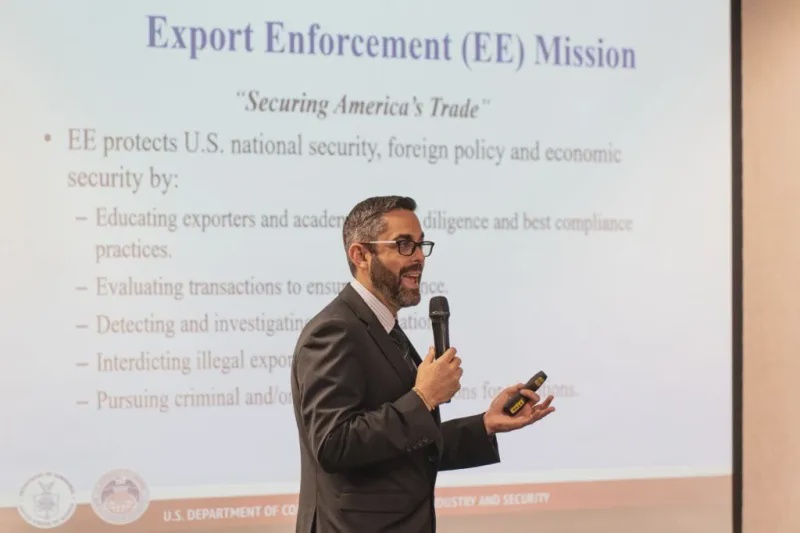
Export control officers are there to make sure the Export Administration Regulations (EAR) are followed outside the United States and to stop controlled technology from being diverted to unauthorized uses or destinations, according to AIT's website. Stationing them abroad effectively extends U.S. export rules into major overseas trading hubs.
BIS has 11 export control officers worldwide, the website says. Besides Taiwan, they are based in Hong Kong, China, Singapore, India, Germany, Finland, the United Arab Emirates, and Turkey, and the bureau also has an export compliance analyst in Canada.
Their core task is the end use check. An officer, or an authorized representative, visits the premises of an overseas buyer, consignee, or end user to verify that U.S.-origin or EAR-controlled items are being used for the declared purpose and by the declared party.
Taiwan Firms Urged To Track Who Uses Their Computing Power
Chen-Tso (Wesley) Chu, secretary-general of the International AI and Law Research Foundation, laid out what this means for Taiwanese companies in a speech on how U.S. export controls affect Taiwan's industries, delivered at the foundation's ninth international conference on artificial intelligence and law on November 7.
Under what he called "export controls 2.0," Washington is shifting from controlling goods to controlling computing power, Chu said. He pointed to this year's export control controversy involving Supermicro, the U.S. server maker, as proof that shipping products to a third country does not put them beyond the reach of U.S. rules. Even if the buyer sits in Singapore or Malaysia, products that are transshipped or resold and end up with restricted companies or users can still fall under the EAR.
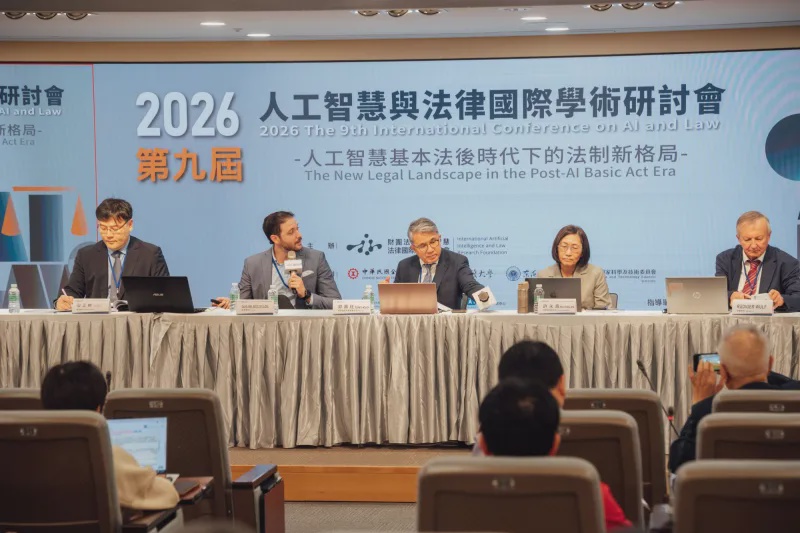
"For Taiwanese companies, traditional 'know your customer' (KYC) is no longer enough," Chu said. Firms should build a compliance mindset of "know your end user" and "know your compute user," he said, tracking where their products finally end up, where they are actually deployed, who controls the computing power and what it is used for, while sharpening their ability to spot third-country transshipment risks and tightening due diligence and ongoing monitoring of transactions.
With a second U.S. officer reportedly on the ground and Taiwan's drone makers courting American partners, that advice now applies as much to the island's unmanned vehicle industry as to the chip and server makers at the center of the U.S.-China technology contest.