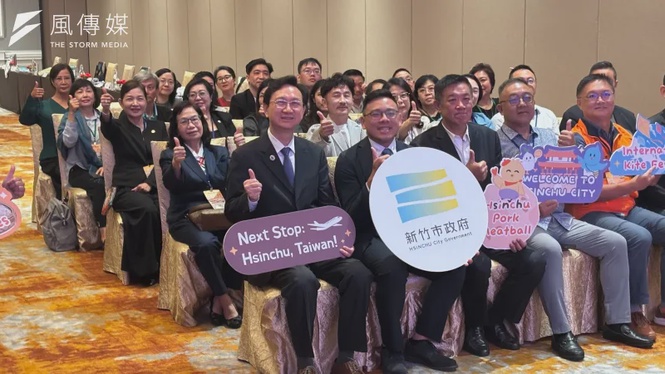
Hsinchu City Government took its tourism pitch to Singapore last week for the first time, sending more than 20 local industry representatives to court Southeast Asian travel partners.
The group joined NATAS Holidays 2026, Singapore's largest annual travel fair, from August 21 to 23, then hosted a B2B networking session on August 24 that drew 52 local travel agencies. It was the first time Hsinchu's hoteliers, travel agents, and tour guides had collectively promoted the city overseas, under the new "Hsinchu Way" (玩味新竹) brand.
Why Singapore Was the Natural First Stop
Lin Yu-zhi, director of Hsinchu's City Marketing Division, told Storm Media at the event that the choice of Singapore rested on three factors: linguistic proximity, shared food culture, and a solid base of Taiwan-bound visitors. Singapore sends roughly 300,000 to 400,000 tourists to Taiwan each year, and they tend to favor independent itineraries, a style that suits Hsinchu's compact scale.
"We're not greedy," Lin said. "We hope that when people visit Taipei or Taichung, they'll set aside a day or two to come to Hsinchu." He called Hsinchu a "just-right destination": 104 square kilometers, with every major attraction within 30 minutes of the city center.
Aero Chiang, chairman of the Hsinchu-Miaoli Area Association for Regional Tourism Taiwan's Tourism Administration, agreed. "Singaporean visitors mostly come in small groups or travel independently," he said. "Hsinchu should keep going outward, targeting the Singapore, Malaysia, and Thailand markets, while catering to the needs of different age groups so that international visitors feel genuinely satisfied."
Beyond the science parks, the city counts 17 kilometers of coastline, Qingcao Lake, Nanliou Fishing Port, Shisheajian Mountain, and Taiwan's oldest municipal zoo. Lin also dismissed the notion that Hsinchu lacks good food, pointing to two consecutive years in the Michelin Guide, including a Bib Gourmand designation.
The pitch targets visitors already in Taiwan for business or passing through Taipei and Taichung, converting stopovers into stays with half-day or full-day options in Hsinchu's old city quarter, the City God Temple district, and its street food scene.
Hotel operators were eager to signal their readiness. "We are extremely grateful to the City Marketing Division and Mayor Ko for bringing us here to Singapore for the very first time," said Yang Ting-yu, general manager of the hotel division at Shin Yuan Group, referring to Hsinchu Mayor Ko Hung-an. "What we want to convey is that Hsinchu is not only about the tech industry; our culture is worth sharing with the world. The hospitality sector is ready."
Kite Festival Timing Emerges as a Scheduling Problem
The B2B sessions also surfaced a concrete problem. Singaporean agencies showed strong interest in Hsinchu's International Kite Festival but pointed to a mismatch: Singapore's main holidays begin in September, while the festival typically runs in late August.
The city is considering expanding next year's festival to two weeks, bridging late August and early September to fit Southeast Asian school calendars. Hotel operators on the delegation also used the sessions to negotiate directly with Singaporean agencies, with some preliminary agreements already in place.
A Five-Stage Roadmap from Awareness to Bookings
City officials outlined a five-stage commercial path: raising awareness, brokering partnerships, co-designing itineraries, listing products on travel platforms, and converting interest into bookings.
A bundled "lazy combo ticket" combining transportation, accommodation, and experiences is set to launch in October, giving independent travelers a one-stop option. It will come with a digital tourism map offering audio guides in Chinese, English, Japanese, and Korean, with AI-assisted translation for other languages.
The goal, officials said, is to move beyond single trade shows and bring Hsinchu from visibility to actual visitation across Southeast Asia.