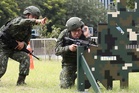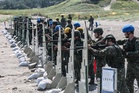
TAIPEI — Through its military drills this year, Taiwan has chosen to emphasize the flexibility and resilience of its army and society, as opposed to primarily putting advanced weapons on display. Experts say the exercises’ structure indicates closer ties with the United States military in the face of Chinese threats to the island.
The annual “Han Kuang” exercises were taking place from Aug. 5 to 14 at various locations around the island. The live-fire exercises test the Taiwanese army’s ability to sustain 24-hour defense operations, as well as counter China’s “gray zone” tactics, which stop just short of open warfare.
China claims the self-ruled democratic island as its own territory, and has not renounced the use of force to bring it under its control. Taiwan dismisses Beijing’s claims and insists it is a sovereign state.
The US, while not recognizing Taiwan as a country, sees all threats to the island as a matter of great concern. Washington is bound by its own laws to provide Taipei with the means to defend itself.
Closer ties with US military
While there has long been speculation that the US military has been quietly training Taiwanese troops, the collaboration between the two sides has been more visible in recent weeks. A key component of the Han Kuang drills, for example, is the practice of a US-inspired military communications method called “backbriefing,” where subordinates explain to commanders how they plan to carry out assigned missions.
The communication drills are intended to encourage first-line fighters to be more self-reliant and effective in battle, experts say.
“The most important new development in this year’s Han Kuang is the incorporation of American-style military training methods, which are aimed at enhancing the coordination and combat readiness of the Taiwanese military,” said William Yang, a senior Northeast Asia analyst for the International Crisis Group.
The drills thus “stay away from the mostly performative tasks of firepower display” of past years and instead focus on building real combat capabilities, he added.
Emphasis on reservists, urban resilience
Another focus of this year’s drills is mobilizing one of the largest numbers yet of reservists: around 20,000 personnel, according to local media. Taiwan’s Defense Ministry did not say how many of them were participating.
The emphasis on reserves illustrates Taiwan’s efforts to address the military power asymmetry between itself and China, Yang said. China maintains the world’s largest army, which has more than 2 million active-duty personnel — almost nine times the size of Taiwan’s active-duty armed forces.
Another focus of the exercises is urban resilience drills, reflecting Taiwan’s long-standing emphasis on civil defense. These were taking place on different days in the major cities of Kaohsiung, Taichung and the capital Taipei. During the drills, mobile internet speeds were reduced for about 30 minutes to simulate telecommunications interference in case of an attack.
The emphasis on combat readiness and civilian preparedness reflect Taiwanese leader Lai Ching-te’s priorities amid political constraints, said Lev Nachman, a political science professor at National Taiwan University.
Lai has sought to pass a $40-billion special defense budget for US arms purchases and local defense manufacturing. A much smaller version of the budget — $24.8 billion — was eventually approved by the opposition-controlled parliament.
“Given that Lai has been constrained on his ability to pass a budget that could even supply the kinds of weapons he would want to test, he has had to look to what he is able to do given the domestic political gridlock,” Nachman said.
US arms sales to Taiwan remain in question
Despite closer informal ties between the US and Taiwanese militaries, questions remain around a massive $14-billion arms sales package to Taiwan that US President Donald Trump has yet to approve. After traveling to China in May, Trump described arms sales to Taiwan as a “very good negotiating chip” with Beijing, raising anxieties on the island about continued American support.
Trump also said after his summit with Chinese leader Xi Jinping that he does not want to “travel 9,500 miles (15,300 kilometers) to fight a war” over Taiwan.
In that context, seeing the US influence on Taiwan’s military drills offers a “silver lining” in terms of Washington’s commitment to Taiwan, Nachman said.
“Even though Trump and those close to him have flip-flopped on supporting Taiwan, the connection between the two militaries remains strong, enough to at least ensure that Taiwan is still able to learn at a high level from the US,” he said.