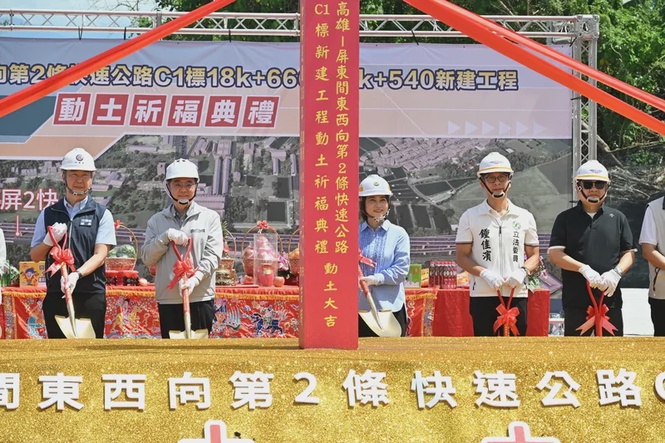
Taiwan has started building a 22.6-kilometer expressway between the southern cities of Kaohsiung and Pingtung that is expected to cut the drive from Pingtung City to the high-speed rail station in Kaohsiung's Zuoying district roughly in half, to about 24 minutes, once the full route opens in 2032 or 2033.
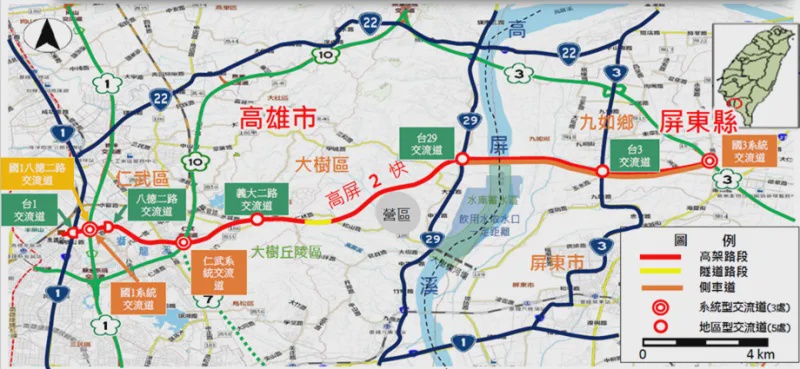
The Kaohsiung-Pingtung East-West 2nd Expressway will run from Zuoying in Kaohsiung across the Gaoping River to National Freeway 3 in Pingtung County. The project is budgeted at about NT$98.39 billion (around US$3 billion) and will be built in seven sections, the first of which broke ground on September 28.
Today the trip from central Pingtung to Taiwan High Speed Rail (THSR) Zuoying Station takes about 45 minutes. Premier Cho Jung-tai said the new road would bring it down to 24 minutes, putting Pingtung within a 30-minute "living circle" of the high-speed rail network, according to the Executive Yuan, Taiwan's Cabinet.
A 22.6 Kilometer Route Across The Gaoping River
The expressway's western end starts near THSR Zuoying Station, where ramps will carry traffic over the existing high-speed rail line and Provincial Highway 1. From there it heads east through Kaohsiung's Renwu and Dashu districts, crosses the Gaoping River into Pingtung County, and ends at a new system interchange on National Freeway 3 in Jiuru Township.
Along the way it crosses National Freeway 1, National Freeway 10, Provincial Highway 29, and Provincial Highway 3, with three system interchanges linking it to other expressways and five local interchanges for surrounding roads. Most of the route will be elevated: about 20.7 kilometers will be built as bridges, with a 0.8-kilometer tunnel and a 22.8-meter-wide roadway, United Daily News reported, citing a Highway Bureau briefing.
Premier Cho Breaks Ground On The First Section
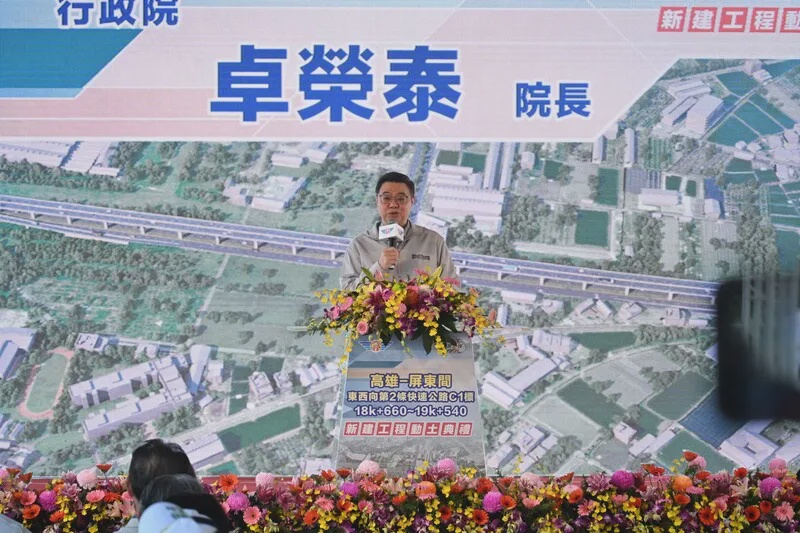
Cho led the groundbreaking for the first section, known as C1, in Jiuru Township on September 28, joined by Transportation Minister Chen Shih-kai and Pingtung County Magistrate Chou Chun-mi, the Central News Agency reported. It was the first section of the expressway to start construction, marking the project's move from planning into building.
The C1 section is about 0.88 kilometers long and sits at the Pingtung end, where an elevated bridge will cross Provincial Highway 3. It includes parallel westbound entry and eastbound exit ramps and frontage roads beneath the bridge. The section costs about NT$3.48 billion and is due to be finished in 2029, the Liberty Times reported. The remaining six sections will follow, with the whole expressway targeted for completion between 2032 and 2033.
Two Busy Highways Carry Most Traffic Today
The new road is meant to ease a squeeze that has built up as Kaohsiung's metropolitan area has grown. More people now cross the Gaoping River every day to work, study, see a doctor, or go out, and traffic over the river keeps rising.
East-west travel between the two areas relies mainly on Provincial Highway 1 and the Provincial Highway 88 expressway. National Freeway 3 serves north-south traffic near Pingtung City, but east-west expressway capacity is limited, and some stretches regularly jam at rush hour.
The idea of an east-west expressway linking National Freeway 7 and National Freeway 3 first came up in a transport network feasibility study commissioned by the Pingtung City Office, and local officials lobbied the central government for it for years. The project cleared an environmental impact review in December 2024, and the Executive Yuan approved the construction plan in September 2025.
Pingtung Gets Within 24 Minutes Of High Speed Rail
Cho described the expressway as serving three purposes: an industrial corridor, an everyday commuter road, and a resilient backup route.
For commuters, the biggest change is access to the high-speed rail. Many Pingtung residents travel to Kaohsiung for work or school, or to catch trains north from Zuoying. Once the expressway opens, the drive from Jiuru Township to Zuoying Station should take only about 20 minutes, and the trip from neighboring Changzhi Township should fall from about 50 minutes to about 30, the Liberty Times reported.
A Second River Crossing For Typhoon Season
The expressway will also give the region a second fast crossing of the Gaoping River, taking pressure off Provincial Highways 1 and 88 at peak hours.
That matters when typhoons, torrential rain, or accidents cut or restrict existing roads. The Executive Yuan said the new route would serve as a resilience corridor, giving traffic and emergency services an alternative way across the river.
Linking Southern Taiwan's Chip And Farm Parks
The route is also designed to tie together science parks, industrial parks, and agricultural parks on both sides of the river, including the Renwu Industrial Park, the Pingtung Agricultural Biotechnology Park, and the Tropical Agriculture Industrial Park, the Liberty Times reported.
It forms part of the transport network for the Greater Southern New Silicon Valley Promotion Plan, which the Cabinet approved in January 2025 to build an "S-shaped" semiconductor and AI corridor across Chiayi, Tainan, Kaohsiung, and Pingtung, the Taipei Times reported. The government has earmarked about NT$509.1 billion for transport infrastructure supporting the plan, the Executive Yuan said.
The expressway has been years in the making. When it is finished, it is expected to bring Kaohsiung and Pingtung closer together for commuting, daily life, and business alike.
You've read it. Now join the conversation — follow us on X, Facebook and IG. Editor: Penny Wang