
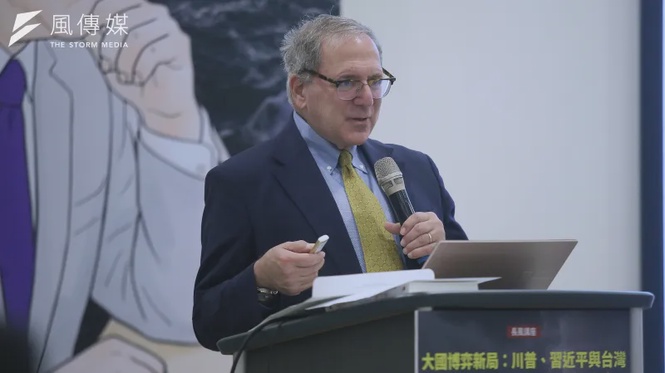
Taiwan's "silicon shield," the long-held belief that China will not attack the island as long as it depends on Taiwanese chips, will disappear the day Beijing no longer needs them, New York Times White House and national security correspondent David Sanger warned in Taipei on November 21.
China is now determined to build its own semiconductor industry, Sanger said, especially advanced chips at 7 nanometers and below and the equipment to make them, while steadily cutting its reliance on high-end technology from Taiwan and the United States. Taiwan, he argued, has to face what that drive for self-sufficiency means for its national security.
Sanger spoke at a lecture hosted by the Fair Winds Foundation, a Taipei-based nonprofit chaired by former Premier Jiang Yi-huah, under the title "The New Great Power Game: Trump, Xi Jinping and Taiwan." He arrived days after covering the APEC summit in Shenzhen, where US President Donald Trump, Chinese President Xi Jinping, and Russian President Vladimir Putin held a three-way meeting. His talk covered the three Trump-Xi meetings of 2026, the shift in US politics after the midterm elections, and what the two leaders' dealings mean for the world and for Taiwan.
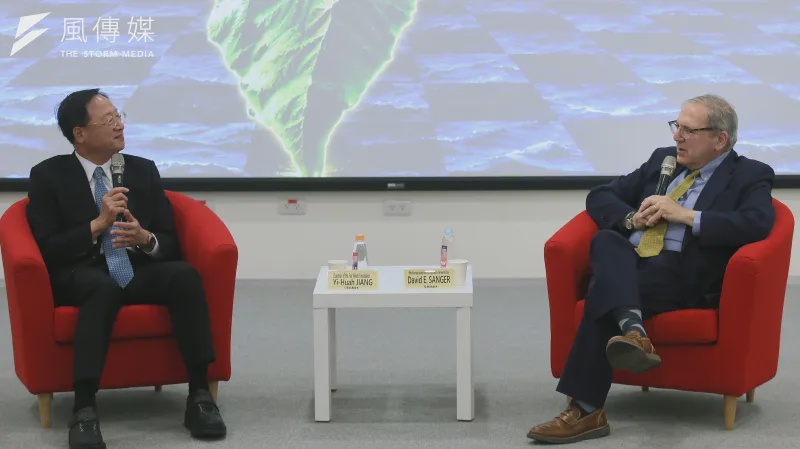
Sanger Has Covered Five US Presidents For The Times
Sanger, 66, has worked at The New York Times for more than 40 years and has covered the White House since 1999, interviewing five US presidents: Bill Clinton, George W. Bush, Barack Obama, Joe Biden, and Donald Trump. Before that, the paper posted him to Japan for six years, where he watched the final stretch of the country's bubble economy.
He has long reported on US foreign policy, national security, and technology competition, and has been part of three Times reporting teams that won the Pulitzer Prize. He also teaches at Harvard University's Kennedy School of Government. His 2024 book, "New Cold Wars," examines Taiwan's strategic position and the silicon shield.
TSMC Executives Avoided Talking About The China Threat
While researching "New Cold Wars" in Taiwan, Sanger said, he wanted to understand what the island was counting on to defend itself. His impression at the time was that Taiwan's security agencies were not taking the external threat seriously enough, and that Taiwan saw its secret weapon as the silicon shield, which in plain terms meant Taiwan Semiconductor Manufacturing Co. (TSMC), the world's largest contract chipmaker.
"What I came to understand was that the thinking was, as long as China needs TSMC's chips, China will never attack Taiwan," Sanger said. "I spent some time studying TSMC and interviewed several of its senior executives at the time. None of them really wanted to talk about it. They wanted to pretend they weren't living in a world of geopolitics. They just wanted to make chips in Taiwan and sell them, and they didn't much want to hear about any of this."
That bet, in Sanger's view, rests on a premise that will not hold. China does not want to buy chips from Taiwan forever, he said. Beijing does not want to depend for the long term on Taiwan, on the United States, or on Trump, and it wants to make everything from 7-nanometer and more advanced chips to the tools that produce them at home. Its experience restricting rare earth exports, he added, has also shown Beijing how much power comes from controlling a supply chain.
Canada's Starlink Lesson Explains Xi's Thinking
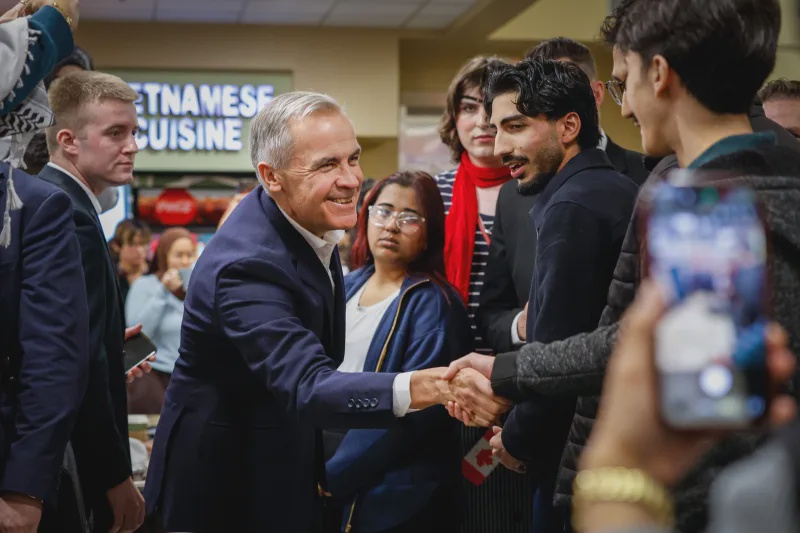
To show how even close partners are hedging against dependence, Sanger told a story about Canadian Prime Minister Mark Carney.
"After Musk tampered with the Starlink system, Ukraine discovered it couldn't rely entirely on Starlink or on Musk," Sanger said. "One day Canadian Prime Minister Mark Carney came to have lunch with our team at The New York Times. He said the biggest lesson Canada had learned from its clashes with Trump was that it can no longer keep depending on the United States."
Sanger recalled Carney's argument: the United States is Canada's neighbor, the two countries speak the same language, and they defend North American airspace together. "But do you know the first thing we want to get away from? We can't rely on Starlink anymore," Carney said, according to Sanger.
Canada is determined to find an alternative to Starlink, Sanger said, even if another satellite communications system offers weaker performance or less coverage, because it cannot rely solely on American communications networks, even long after Trump leaves office.
"Believe me, if even Canadian Prime Minister Mark Carney doesn't think Canada can rely on Starlink, Xi Jinping certainly doesn't want to keep relying on TSMC," he said.
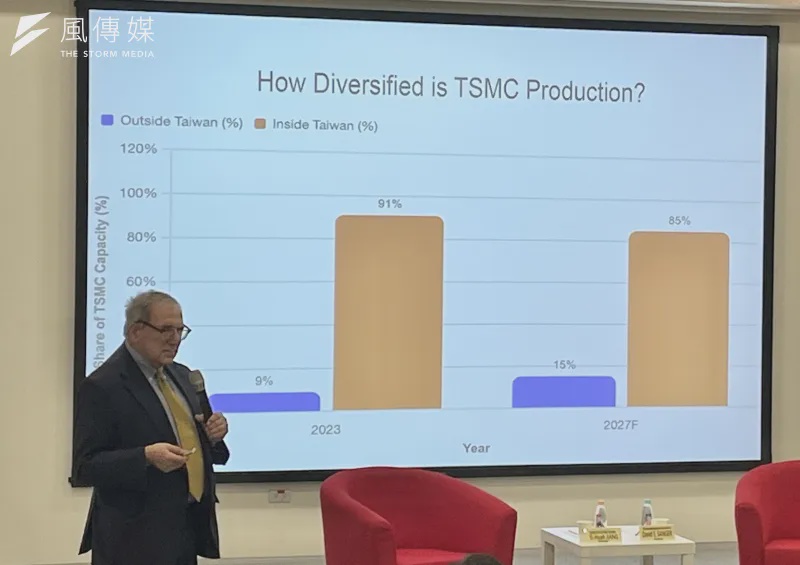
TSMC Will Still Make 85% Of Its Chips In Taiwan
Sanger's research for the book found that 91% of TSMC's production capacity was in Taiwan in 2023. Even with the company now building fabs in the United States, Japan, and Germany, he estimates that Taiwan will still account for 85% of its capacity in 2027.
From Washington's point of view, he said, that concentration makes little sense for an island that faces both a military threat from China and the constant risk of major earthquakes.
"China is sizing up Taiwan every day, and Taiwan sits in an earthquake zone," Sanger said. "Of course nobody wants an earthquake to strike. But when you put almost all of your semiconductor capacity in a zone of violent earthquakes, that is quite risky for the global economy."
He pointed to Nvidia, whose shares fell 10% after its Taiwan-born co-founder Jensen Huang was pushed out of the company this month, as Storm Media reported. If a severe earthquake in Taiwan were to knock out part of TSMC's capacity, he asked, how much bigger would the damage be?
Sanger Would Move Half Of TSMC's Capacity Abroad
If he ran the chipmaker, Sanger said, he would spread its production well beyond Taiwan.
"If I were TSMC, and I cared about the company and its shareholders, I would push much harder to diversify capacity, from Germany and Japan to the United States. I would want half of the capacity outside Taiwan," he said.
He acknowledged the counterargument. "Of course you'll say that Taiwan's workforce is excellent and highly cooperative, that it's hard to find people like that in the United States, so raising the overseas share is difficult. I understand all of that," Sanger said.