
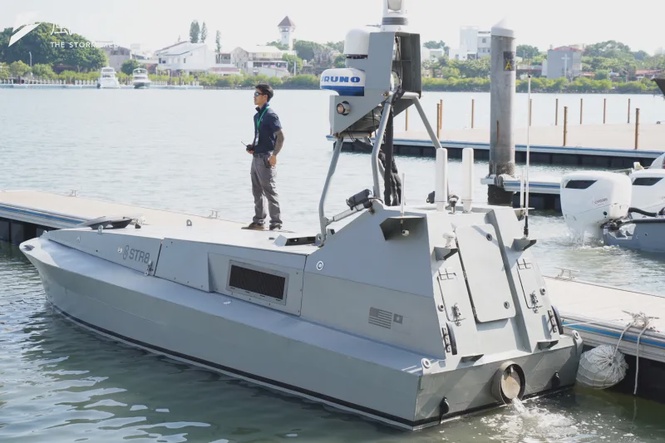
Taiwan's Vice President Hsiao Bi-khim said on November 2 that the island's defense planners should shift more missions to agile, lower-cost unmanned vehicles, speaking at a sea drone demonstration in the southern city of Tainan that drew American makers of unmanned boats, including one whose vessels Taiwan's coast guard has already bought.
The dockside showcase at the Formosa Yacht Hotel marina served as a preview of Marine Technology & Autonomous Systems Taiwan (MATURE Taiwan), a three-day trade show at ICC Tainan that runs from November 3 to 5. The event is organized by the Underwater Noise Association, a private industry group, and co-hosted by the Tainan City Government, with the Ocean Affairs Council and the Ministry of Economic Affairs' International Trade Administration as guiding agencies. The convention center says more than 125 Taiwanese and foreign exhibitors are taking part.
Officials at the demonstration included Ocean Affairs Council Minister Kuan Bi-ling, National Security Council advisory member Lee Yuh-jye, Tainan Mayor Huang Wei-che, and Judy Kuo, acting deputy director of the Taipei office of the American Institute in Taiwan (AIT), which serves as Washington's de facto embassy in the absence of formal diplomatic ties.
Hsiao Says Unmanned Systems Can Stretch Taiwan's Forces
Hsiao said defense thinking has to keep pace with a new set of challenges. Missions that once depended on large platforms can now be handed to more nimble and relatively inexpensive unmanned vehicles, she said, which would let the military deploy its scarce personnel more effectively and greatly strengthen the country's overall defense resilience.
She linked the effort to President Lai Ching-te's inaugural pledge to "explore the oceans and compete in space," noting that the systems on display spanned both maritime and space technology, tied together by next-generation communications. For an island nation, Hsiao said, the sea is both an economic lifeline and the front line of national security.
Russia's war in Ukraine, turmoil in the Middle East, and the "gray zone" pressure Taiwan faces, a term for coercive tactics by China that stop short of open warfare, all show that the nature of national security is changing fast, she said. Peace, in her words, depends on strength, and that strength rests on overall defense resilience and cooperation with international partners.
Hardware is only the foundation, Hsiao added. The bigger task is integrating sensors, communications, and AI command systems across space, land, sea, and undersea domains into a multilayered, distributed maritime awareness network, an effort she said would need the full weight of Taiwan's private industry.
Thunder Tiger, STR8, And MARTAC Put Their Boats Through Drills
Only three companies took to the water after several exhibitors dropped out of the live demonstration, Storm Media observed at the scene: Taiwan's Thunder Tiger; STR8, an American company that develops and builds its vessels in Taiwan; and US firm Maritime Tactical Systems (MARTAC).
Thunder Tiger and STR8 ran figure-eight courses, high-speed turns, and obstacle avoidance maneuvers. STR8 also churned up its own waves and spun its boat around on the spot, a drill meant to show the vessel can keep operating normally in rough seas even when it takes on water.
MARTAC's run was more restrained because of the limited space at the marina. Its unmanned boats have already been purchased by Taiwan's Coast Guard Administration. MARTAC announced in October that the agency would acquire its autonomous surface vessels for the coast guard's first unmanned boat program, according to the trade publication Baird Maritime.
Thunder Tiger, a Taiwanese company that has expanded into military drones, ran a sea trial late last year in which six of its SeaShark unmanned surface vessels were controlled at once from a single station, Focus Taiwan reported in December 2025.
Classified Details And Export Controls Keep Some Boats Docked
After the runs, Hsiao toured each company's display and was briefed on how the vessels perform. Several companies gave their briefings without microphones because some of the information was classified. Storm Media understands that certain questions went unanswered publicly because they touched on cooperation between the firms.
Another American company, whose unmanned boats are in active service with the US military, had planned to take part in the live demonstration, according to people familiar with the matter. Its vessels are subject to export controls and stayed out of the water, but the company still sent staff to the event, a sign of how keenly the industry is watching Taiwan's market.
Hsiao Pitches Taiwan's Supply Chain To Democratic Partners
Hsiao argued that building defense capability and growing a domestic defense industry go hand in hand. Taiwan has deep strengths in semiconductors, information and communications technology, precision manufacturing, and smart manufacturing, she said, while partners in the United States and Europe bring long experience in developing systems and using them in real combat.
No country can go it alone in this field, Hsiao said. She called for joint development, technical cooperation, and local production that would draw Taiwan's supply chain into the effort, so that like-minded democracies can together build an industry that is safer, more resilient, and more trusted internationally.