
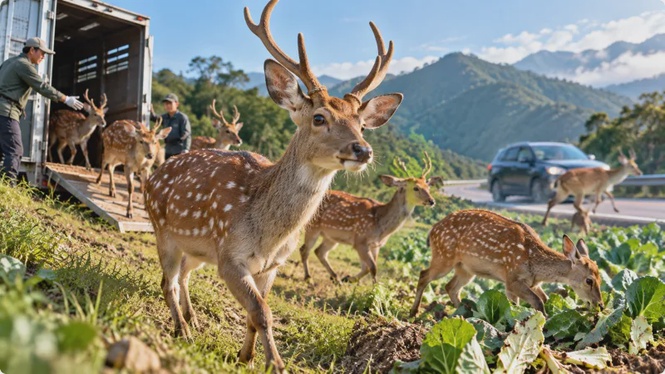
Taiwan's sika deer vanished from the wild more than half a century ago. Four decades after a reintroduction program began in Kenting National Park, at the island's southern tip, there are now so many that they are stripping young trees from protected forest, raiding farms, and running into traffic.
A 2024 survey commissioned by Kenting National Park Headquarters estimated that more than 3,600 Formosan sika deer live in and around the park. In parts of the Hengchun Peninsula, deer densities are now high enough that authorities are weighing fences, contraceptive vaccines, and capture to bring the herd under control.
Hunting And Farmland Wiped Out Taiwan's Wild Deer
The Formosan sika deer, a subspecies found only in Taiwan, once roamed plains and rolling hills across the island's low and middle elevations. Kenting was never its only home. According to the Taipei Zoo, a Qing dynasty travel account of Taiwan, the Taihai Shicha Lu, described deer herds flourishing on the island, and the animals were a valuable economic resource.
Their hides were what doomed them. Under Dutch rule in the 17th century, Taiwan exported deerskins in huge numbers, and historical records show the annual haul reached 150,000 hides in 1638. The trade carried on for generations, while expanding farms and settlements turned deer habitat into fields and towns.
Kenting National Park Headquarters says that after a 1973 survey of Taiwan, the American wildlife scientist Dale McCullough estimated that wild sika deer may have disappeared as early as 1969. Some captive animals survived in zoos and private deer farms, and those animals later became the seed stock for bringing the species back.
From 22 Zoo Deer To A Herd Of Thousands
Kenting National Park Headquarters launched the reintroduction program in 1984, moving step by step through captive breeding, acclimatization, and tracking after release. According to the Taipei Zoo, the zoo, then still located at Yuanshan in Taipei, supplied five stags and 17 does in 1986. Those 22 deer became the founding herd.
Researchers first let the deer adjust to their surroundings in the Sheding reintroduction area, monitoring how they fed, moved, and bred. Releases into the wild began only in 1994, followed by further releases at Sheding, Longluan Lake, Jiupeng, and Chuhuo. Over the years the deer formed a self-sustaining wild population and spread from the release areas across the Hengchun Peninsula.
CHART / 01 OF 02How Taiwan's Sika Deer Returned to the WildFive key years, from extinction in the wild to a rebuilt population1969(estimate)Wild deer believed extinctYears of hunting and habitat loss1984Kenting launches reintroduction programWork begins to rebuild the population198622 captive deer arrive in KentingFive stags and 17 does from the Taipei Zoo1994First releases into the wildAt Sheding, Longluan Lake and other sites2024More than 3,600 in and around KentingA survey estimate of the wild population, not a head countSources: Kenting National Park Headquarters; Taipei Zoo. Note: 1969 is an estimated date of extinction in the wild; the 2024 figure is a survey estimate.The 2024 survey found that the deer's range had kept growing since 2021. Deer south of County Road 200 have pushed as far south as Eluanbi and Longkeng, near the peninsula's tip, and some have appeared east of the road as well.
Deer Have Cut Some Forest Saplings By 70% To 90%
Sika deer eat plants, browsing on tender leaves, seedlings, and other vegetation, and stags rub their antlers against tree trunks. When large herds concentrate in one area and keep eating seedlings and bark, the forest can struggle to regenerate.
A 2021 study by the Taiwan Forestry Research Institute found that the deer clearly favor certain tree species, and that the more a species is preferred, the steeper the decline in its young saplings, a statistically significant link.
A June 2026 special report by Taiwan's Public Television Service (PTS) found that in Kenting's uplifted coral reef forest, saplings of some tree species favored by the deer had fallen by about 70% to 90%. With food running short, dense herds had also begun stripping bark, and about 20% of the Pisonia umbellifera trees in the area showed ring-shaped bark damage, known as girdling. Researchers worry that if young trees cannot grow, the forest's mix of species could change over time, affecting other plants and animals that depend on it.
Farmers And Drivers Feel The Pressure
The growing herd is also changing daily life for residents. Kenting National Park Headquarters has found that deer enter farmland and eat crops, causing losses for farmers. Deer that are foraging, or being chased by dogs, can also dart across roads and cause collisions. The Chuanfanshi, or Sail Rock, section of Provincial Highway 26 is a hotspot for crashes involving deer.
How many deer can the area support? A study commissioned by the park in 2024 estimated about 2,864 deer south of County Road 200 alone, above the range the researchers recommended for managing the population, which was 1,006 to 2,414 animals.
CHART / 02 OF 02Why a Conservation Success Became an Ecological Problem2024 | Sika deer survey of the area south of County Road 200Estimated wild population2,864 deerManagement range recommended by researchers1,006 to 2,414 deer01,0002,0003,000■ Recommended range ● 2024 estimateNote: Covers only the area south of County Road 200; the recommended range is not an absolute ceiling for all of Kenting. Source: Kenting National Park Headquarters, 2024 sika deer population survey.Capture Trials Halted, Fences And Contraception Under Review
In January 2026, Kenting National Park Headquarters held its first training course for hunters, with plans to catch deer using snares and move them back into enclosures at the reintroduction area. But PTS reported in June that the capture trials had been suspended. Catching the deer proved difficult, frightened animals could suffer severe stress reactions, and the plan drew criticism over animal welfare.
The park is also still weighing fences and contraceptive vaccines. Fencing can keep deer out of specific areas and cut crop losses and road accidents, but it does nothing to reduce their numbers.
Researchers have tested a contraceptive vaccine on captive deer, and early results show it can suppress breeding. As of June 2026, however, cost and the difficulty of vaccinating free-ranging animals meant it had not been used on wild herds.
Taiwan worked for decades to bring the sika deer back to its forests. The challenge now is finding a way to protect the deer, the forest, and the people of Kenting at the same time.
Sources
- Kenting National Park Headquarters: Formosan sika deer reintroduction; 2024 survey of the wild Formosan sika deer population in Kenting National Park and assessment of a suitable population size.
- Taipei Zoo: background on the Formosan sika deer.
- Taiwan Forestry Research Institute, Ministry of Agriculture: study on sika deer feeding preference, antler rubbing, and sapling population changes in Kenting forests.
- Central News Agency report, January 20, 2026.
- Public Television Service News Network, 2026 special report on the sika deer's return from extinction to overpopulation.