
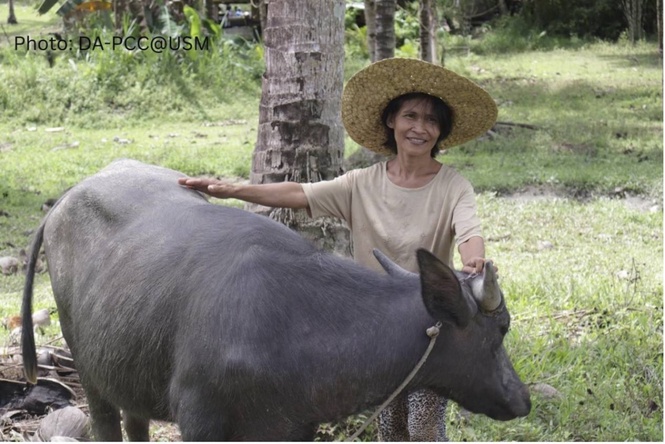
TENDING carabaos is no easy feat, particularly for a woman trying to balance her responsibilities between caring for her family and earning a living.
Jocelyn Ortiga, 51, a resident of Barangay Canahay, Surallah, South Cotabato, exemplifies an empowered woman who works hard to make ends meet, even if it means taking on responsibilities typically associated with men.
Before becoming a dairy farmer, Ortiga spent most of her time being a housewife and growing various crops.
In 2022, she became a beneficiary of the Carabao-based Enterprise Development program of the Department of Agriculture–Philippine Carabao Center (DA-PCC).
Under the program, rural farmers are empowered through technical training and a range of support services to enhance enterprise development and marketing integration.
This initiative aims to transform carabao raising into profitable dairy and meat businesses.
Initially, Ortiga faced challenges in raising a carabao, including caring for a sick one, which nearly led her to give up on her journey as a dairy farmer.
“Sa pamamagitan ng mga workshop at seminar, natutunan ko ang tamang pagpapakain gamit ang napier, ipil-ipil, at saging, pati na rin ang epektibong paraan ng paggagatas (Through workshops and seminars, I learned about proper methods in feeding carabaos and the most effective techniques for milking them),” she said.
With this, Ortiga gradually built a more productive and sustainable small business. At times, she considered surrendering the carabao to PCC because she struggled to balance her time between working on the farm and caring for her family. However, her perseverance and commitment to helping her husband provide for their family while ensuring their children received an education led Ortiga to discover an effective strategy.
Last year, she collected 1,402.54 liters of milk from one of her carabaos, earning her P83,403.20 from this single source.
“Tatlo ang college ko ngayon. Dati, hindi ko alam kung paano ko sila mapapaaral, pero ngayon, dahil sa kita sa gatas ng kalabaw, nakakabili na ako ng gamit nila sa eskwela; hindi na ako humihingi sa asawa ko (I currently have three children in college. Previously, I was uncertain about how I would afford their education. But now, thanks to the income from selling carabao milk, I can buy their school supplies without needing to ask my husband for assistance),” she emphasized.
Ortiga demonstrated that farming is not limited by gender, challenging the traditional belief that it is solely a male domain.
She is a living testament that with determination, positive attitude, technical knowledge and additional support, women can achieve what men can.
Meanwhile, DA-PCC at USM Center Director Geoffray Atok emphasized the agency’s commitment to promoting equality, particularly for women, in the implementation of its programs.
“Bilang katuwang ng mga magsasaka at komunidad, patuloy na sinusuportahan ng DA-Philippine Carabao Center at USM ang pagkakapantay-pantay ng kasarian at ang pagbibigay ng mas maraming oportunidad para sa kababaihan, lalo na sa sektor ng paggagatas at pag-aalaga ng kalabaw (As partners of farmers and the community, the DA-Philippine Carabao Center and USM continue to support gender equality and to provide more opportunities for women, particularly in dairy farming),” Atok highlighted.
The milky way: Carabao-based enterprise development and the rural renaissance
FOR decades, the water buffalo, or carabao, was viewed solely as the “beast of burden” — the silent partner of the Filipino farmer tilling the soil under the grueling heat of the sun.
However, through the Philippine Carabao Center (PCC), an attached agency of the Department of Agriculture, the humble carabao has been reimagined. Today, it is the centerpiece of a burgeoning Carabao-Based Enterprise Development (CBED) program that is transforming rural economies from subsistence farming to high-value dairy production.
The strategic shift began with a focus on genetic improvement. By crossing the native swamp buffalo with larger, high-yielding dairy breeds like the Italian Mediterranean and Bulgarian Murrah, the DA has produced “socialized” crossbreds.
These animals retain the resilience of the local carabao while producing significantly higher milk volumes — up to 8 to 10 liters a day compared to the measly 1 to 2 liters from native breeds.
This genetic leap served as the foundation for the CBED.
The program operates on a “value chain” approach, ensuring that the farmer is not just a producer of raw milk but a key player in a larger commercial ecosystem.
Strength in numbers The DA’s strategy relies heavily on the DA-PCC’s Dairy Herd Management System and the formation of village-based cooperatives.
By clustering small farmers into cooperatives, the agency provides them with collective bargaining power and access to centralized facilities.
Under the CBED, cooperatives are provided with: milk collection centers that are equipped with cooling tanks to maintain milk quality and prevent spoilage, processing facilities where raw milk is transformed into high-value products like pasteurized milk, chocolate milk, white cheese (kesong puti), and even gourmet gelato and market linkages connecting farmers directly to the national school-based feeding program, ensuring a guaranteed market for their produce while addressing child malnutrition.
The impact of carabao-based enterprises is measurable in the “daily cash flow” it provides to rural households.
Unlike traditional crops like rice or corn, which offer a payout only twice a year during harvest, dairy provides a steady, daily income. For a farmer with five milking carabaos, the daily earnings from milk sales can far exceed the minimum wage, providing a cushion against inflation and climate shocks.
Moreover, the CBED promotes a “circular economy.” The waste from the carabaos is processed into organic fertilizers, while the forage requirements encourage the planting of high-protein grasses and legumes, improving local biodiversity and soil health.
As the Philippines strives for food sovereignty, the Carabao-Based Enterprise Development Program stands as a trailblazing model.
It proves that by applying science, cooperative management and market integration to a traditional asset, the government can turn a cultural icon into a modern economic engine.
For the Filipino farmer, the “beast of burden” has truly become the “beast of fortune,” paving a milky way toward a more resilient and prosperous countryside.