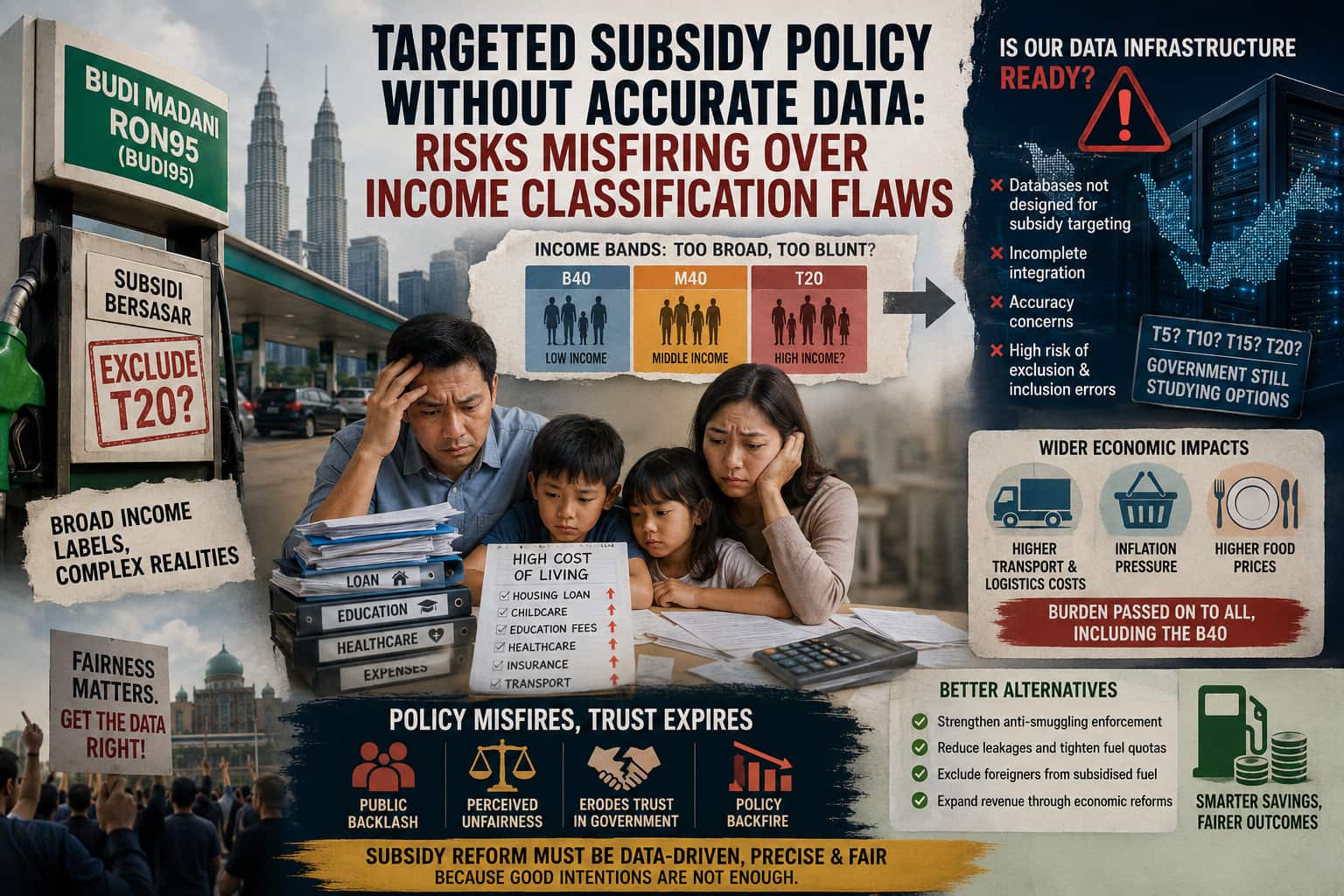
Malaysia’s push to reform fuel subsidies may be economically necessary, but the proposed exclusion of the T20 group from the Budi Madani RON95 (Budi95) subsidy scheme risks becoming a policy that appears efficient on paper while creating wider economic, administrative and political complications in reality.
At the heart of the issue lies a fundamental question: Can broad income categories such as B40, M40 and T20 truly reflect the financial realities faced by Malaysians today?
The answer is increasingly uncertain.
For years, these classifications have served as rough economic benchmarks rather than precise indicators of affordability or wealth. Yet policymakers now appear prepared to use them as the main basis for determining who deserves fuel subsidies and who does not. That approach risks oversimplifying the increasingly complex financial pressures faced by many households.
A person categorised under the T20 bracket may appear financially comfortable based on declared income, but that label often ignores real-world commitments and living costs. In major urban centres such as Kuala Lumpur, Penang and Johor Bahru, many middle- and upper-middle-income households are burdened with high housing loans, rising childcare expenses, elderly healthcare costs, insurance commitments and mounting education fees.
Being classified as “high income” does not automatically translate into financial security.
This is why subsidy targeting based purely on broad income bands could create significant exclusion errors - where genuinely struggling households are denied assistance simply because they fall into an arbitrary category. Such mistakes could deepen resentment among the middle class, especially among taxpayers who already shoulder a larger share of the national tax burden.
Even more concerning is whether Malaysia’s current data infrastructure is truly ready for such fine-targeting.
The government itself appears uncertain. Putrajaya is still refining eligibility mechanisms under the National Economic Action Council task force, while debates continue over whether subsidy cuts should target the T5, T10, T15 or T20 categories. That uncertainty alone reflects the difficulty of accurately identifying affordability using existing databases.
As Universiti Teknologi Petronas adjunct professor Samirul Ariff Othman reportedly noted, income bands should not be treated as perfect indicators of affordability. His observation highlights a deeper structural issue: none of Malaysia’s existing databases were originally designed for precision subsidy targeting.
Without accurate and integrated data systems, the risk of both exclusion and inclusion errors becomes inevitable.
Beyond the technical concerns, there are also broader economic implications. Removing subsidies too aggressively from a large segment of consumers could contribute to inflationary pressures, particularly in transportation, logistics and food prices. Businesses facing higher operating costs may eventually pass those costs on to ordinary consumers, indirectly affecting even lower-income households.
More importantly, there are alternative strategies available to the government that may achieve savings without creating widespread domestic dissatisfaction.
Strengthening anti-smuggling enforcement, reducing leakages, tightening subsidised fuel quotas based on actual usage patterns and ensuring foreigners do not benefit from subsidised fuel could produce meaningful fiscal savings while minimising the burden on Malaysians.
The government could also focus on expanding revenue streams through broader economic reforms instead of relying heavily on cutting subsidies from segments already contributing significantly through taxation.
Subsidy reform is undoubtedly necessary. Malaysia cannot sustain blanket subsidies forever. However, reforms built on overly broad classifications rather than precise and reliable data risk creating more problems than they solve.
Fiscal discipline is important, but so is public trust.
If Malaysians begin to perceive the system as unfair, inaccurate or disconnected from economic realities, the political and social backlash could outweigh any short-term savings achieved through subsidy cuts.
In the end, successful subsidy reform depends not just on reducing government spending, but on ensuring the policy is credible, fair and backed by accurate data. Without that foundation, even well-intentioned reforms may struggle to gain public acceptance.
By: Kpost
Information Source:
Kpost (ckhorsk@gmail.com) is a content creator under the Newswav Creator programme, where you get to express yourself, be a citizen journalist, and at the same time monetize your content & reach millions of users on Newswav. Log in to creator.newswav.com and become a Newswav Creator now!
The User Content (as defined on Newswav Terms of Use) above including the views expressed and media (pictures, videos, citations etc) were submitted & posted by the author. Newswav is solely an aggregation platform that hosts the User Content. If you have any questions about the content, copyright or other issues of the work, please contact creator@newswav.com.