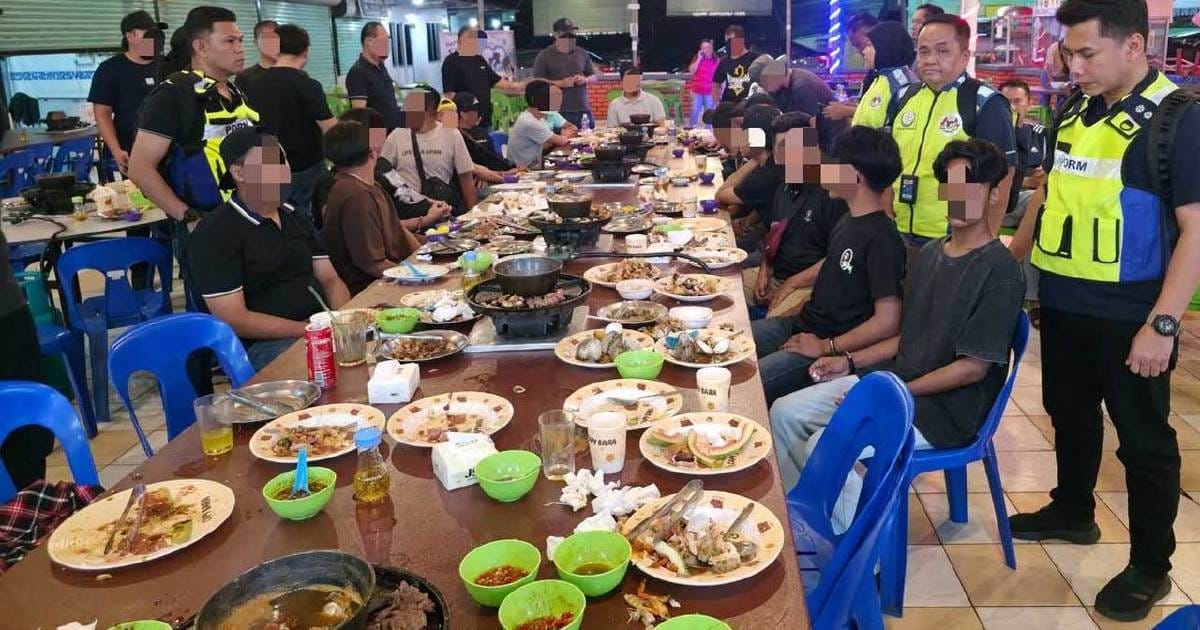
It was supposed to be a night of ritualistic celebration a gathering of brothers bound not by blood, but by blood oaths. On June 2026, inside a seemingly unassuming local eatery along Jalan Masjid in the heart of Keningau, Sabah, a celebratory feast was underway. Laughter echoed, glasses clinked, and shared secrets were passed across the table as members of the outlawed gang Kappa Rho Kappa publicly masked under the enigmatic title Knight’s Of The Right Keeper’s (KRKK) convened to mark their annual anniversary. But just as the nostalgia of their forbidden fraternity reached its peak around 9:00 PM, the door shattered open. The celebratory atmosphere instantly evaporated into a chilly realization of entrapment.
In a lightning-fast swoop codenamed Op Cantas Bersepadu (Gangsterisme), tactical operators from the D7 Secret Societies, Gambling, and Vice Division of the Royal Malaysia Police (PDRM) Sabah Contingent HQ, acting in tandem with the Registrar of Societies (ROS), swarmed the premises. The sting net hauled in 19 male suspects. What began as a defiant milestone for an underground network ended as a sobering police log, offering a window into a shadow world that many Malaysians mistakenly believe belongs only to history books or cinema screens.
This raid is not merely an isolated local police success; it serves as a stark reflection of a broader, systemic socio-cultural issue quietly fermenting beneath the surface of modern Malaysia. The Keningau bust exposes an unsettling reality: despite aggressive state crackdowns, rapid urbanization, and a highly digitalized economy, the raw, visceral appeal of the outlawed secret society remains deeply entrenched among vulnerable demographics.
The Demographics of Despair: Age and Lawlessness
When Keningau District Police Chief, Superintendent Yampil Anak Garai, broke down the details of the raid to the press, one specific metric sent shockwaves through social commentators: the age bracket of the detainees. The suspects ranged from full-grown adults down to children specifically spanning ages 14 to 59. Among those handcuffed were five adolescents, teenagers whose lives should theoretically revolve around secondary school examinations, sports, or digital hobbies, rather than back-alley brotherhoods.
This multi-generational spectrum indicates that gangsterism in Malaysia is not a dying historical artifact; it is an active, self-perpetuating pipeline. Sociological analysis suggests that when a single criminal organization successfully attracts both a 59-year-old veteran and a 14-year-old minor, it possesses an effective mechanisms for cultural transmission. The older generation provides structural continuity, perceived prestige, and mythical lore, while the youth offer a renewable source of cheap, impressionable, and fiercely loyal labor.
Physical evidence collected during the raid further underscored the deep level of psychological commitment embedded within this group. Investigators discovered that five of the individuals bore distinct group tattoos carved into their skin permanent biological markers signifying lifelong, unbreakable loyalty to the Kappa Rho Kappa banner. Furthermore, two individuals were caught carrying physical KRKK membership cards. In an era where even legal corporate memberships have transitioned entirely to digital apps, this gang maintained a physical, bureaucratic paper trail of illegal affiliation. This institutionalization reveals a calculated attempt by illicit groups to mimic legitimate structures, offering disenfranchised individuals a formalized sense of identity and order that they feel the mainstream socio-economic system denies them.
The Ghost of 2015: The Institutional Battle Against Shadow Societies
To fully understand the gravity of the Keningau arrests, one must look backward into Malaysia's legislative and security history. Kappa Rho Kappa is not a new upstart phenomenon. The group was officially gazetted as an illegal, banned organization by the Ministry of Home Affairs (KDN) over a decade ago, on December 16, 2015.
Under the stringent framework of Section 43 of the Societies Act 1966, any person who scans as a member, attends meetings, or assists an unlawful society faces severe criminal prosecution. Yet, more than ten years after being legally declared dead by the state, KRKK continues to breathe, organize, and gather to celebrate its history. This resilience highlights a significant institutional challenge faced by law enforcement: you can outlaw a name, but you cannot easily erase a subculture once it takes root in the localized social fabric.
Compounding this security puzzle is the complex intersection of local gangsterism with wider immigration vulnerabilities. During the Keningau operation, police discovered that an overwhelming majority of the suspects 15 out of the 19 detained did not possess any valid identification documents. Only four individuals held verifiable credentials, which included a mix of MyKad, MyPR, MyKAS, and standard international passports.
Consequently, a large portion of the gang is currently being processed under Section 6(1)(c) of the Immigration Act 1959/63 for entering and staying in the country without a valid permit. Sociologists and regional security analysts assume that this lack of documentation creates a perfect storm for criminal exploitation. Undocumented individuals, existing completely outside the formal state safety nets, cannot secure legal employment, open bank accounts, or access public healthcare without extreme friction. Cut off from the formal economy, they become prime targets for secret societies that offer alternative protection networks, informal financial support, and a collective shield against both rival syndicates and state authorities.
Moving Forward: The Need for Holistic Intervention
The Keningau bust proves that relying solely on tactical police raids is akin to treating the surface symptoms of a deeply rooted systemic illness. While the swift action of the D7 division is commendable and necessary to preserve immediate public safety, long-term resolution demands a multi-agency, holistic intervention strategy.
Educational institutions, social welfare departments, and non-governmental organizations must work collaboratively to dismantle the recruitment pipelines that feed these gangs. For the youth, there must be viable, engaging alternatives skills training, community sports, mentorship programs, and economic pathways that offer genuine upward mobility. Furthermore, addressing the legal status of undocumented or marginalized communities within the state is crucial; as long as a sizable parallel population exists without legal identity, criminal syndicates will always have an abundant pool of desperate recruits ready to sign away their futures for a sense of security.
What Do You Think? I’d Love to Hear Your Opinion In The Comments Section.
The story of nineteen men and boys arrested mid-toast on a Tuesday night in Keningau is more than a standard headline on a newsfeed; it is a mirror reflecting the hidden fractures within our shared social landscape. It forces us to confront uncomfortable questions about who we are leaving behind in our race toward modernity. When a fourteen-year-old child decides that his best path forward involves permanently tattooing the insignia of an outlawed syndicate onto his skin, it represents a collective failure of the community structures that should have protected and guided him. Security is not merely built on iron bars and handcuffs; it is nurtured through inclusion, opportunity, and the strength of our social safety nets. True safety is achieved when our youth no longer feel the need to seek sanctuary in the shadows of an illegal brotherhood.
AM World (tameer.work88@gmail.com) is a content creator under the Newswav Creator programme, where you get to express yourself, be a citizen journalist, and at the same time monetize your content & reach millions of users on Newswav. Log in to creator.newswav.com and become a Newswav Creator now!
The User Content (as defined on Newswav Terms of Use) above including the views expressed and media (pictures, videos, citations etc) were submitted & posted by the author. Newswav is solely an aggregation platform that hosts the User Content. If you have any questions about the content, copyright or other issues of the work, please contact creator@newswav.com.