
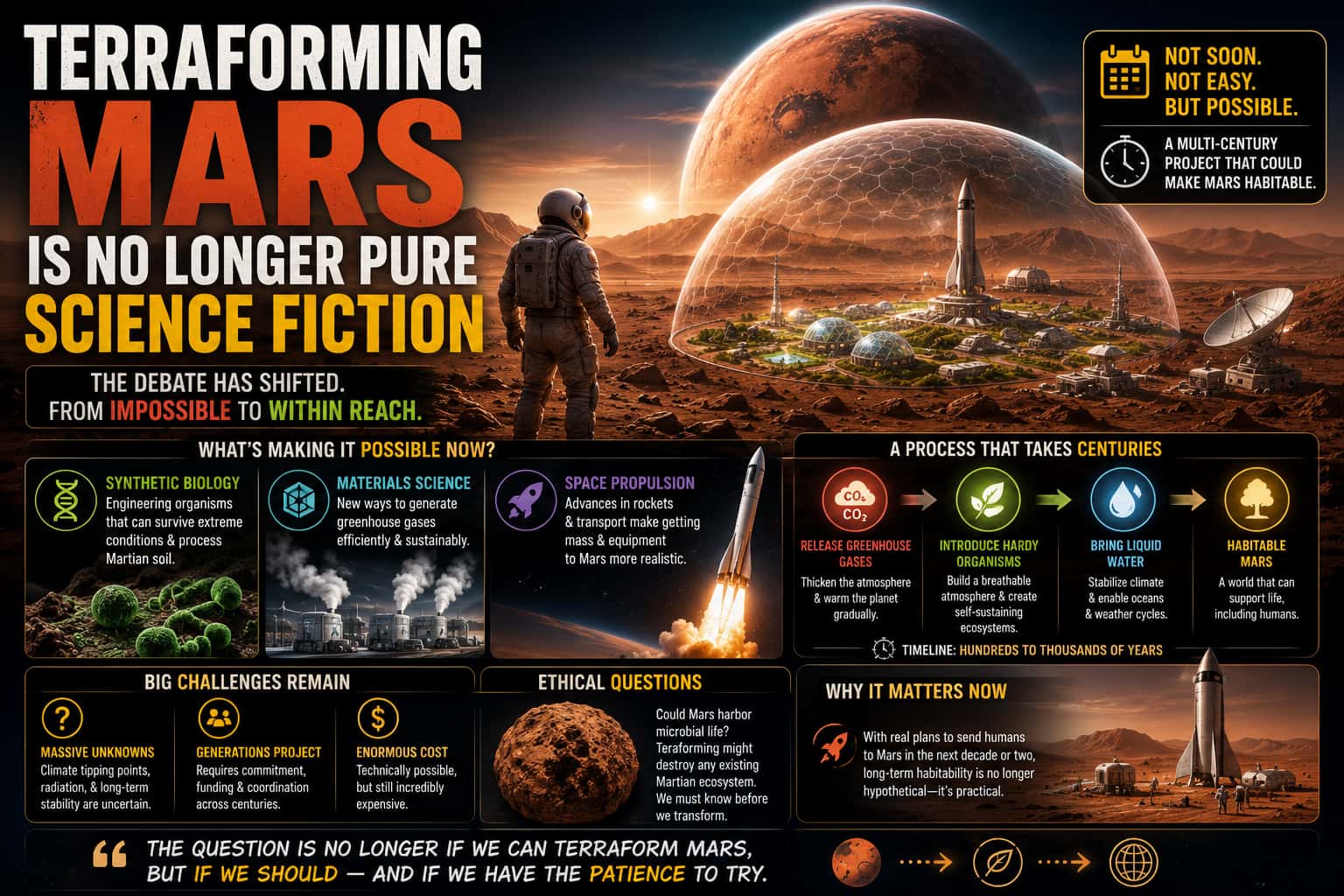
For decades, the idea of making Mars habitable belonged firmly in the category of science fiction. The planet is cold, dry, and has almost no atmosphere. Its surface is bombarded by radiation. Nothing grows there. Talking seriously about terraforming it would get you polite smiles at most academic conferences.
That is starting to change. New technologies have reopened the debate among researchers over whether Mars could someday be transformed into a world that supports life. The conversation has shifted from "this is impossible" to "this is extremely difficult but theoretically within reach."
The basic challenge of terraforming Mars has always been the atmosphere. Mars has one, but it is almost entirely carbon dioxide and far too thin to trap heat or block radiation. To make the planet liveable, you would need to thicken the atmosphere dramatically, warm the surface, and somehow introduce water in liquid form.
Recent advances in several fields are what make the conversation more serious now. Synthetic biology has produced organisms that can survive extreme conditions and potentially process Martian soil. Advances in materials science offer new approaches to generating greenhouse gases efficiently. And improvements in space propulsion mean that getting the necessary equipment to Mars is becoming more realistic, if still expensive.
Nobody is suggesting this will happen soon. Even the most optimistic researchers frame terraforming as a multi-century project. The first step would likely involve releasing greenhouse gases to warm the planet gradually, a process that could take hundreds of years. After that, introducing hardy organisms to begin building a breathable atmosphere could take centuries more.
But the point is that the conversation has moved from fantasy to engineering problem. Scientists are now publishing serious research on the specific mechanisms, timelines, and technologies that would be required. There are still enormous unknowns, including whether humanity could sustain a project that spans generations without losing interest or funding. But the physics, at least in principle, appears to work.
This shift in thinking is partly driven by the broader push toward Mars exploration. NASA, SpaceX, and several other organisations have concrete plans to send humans to Mars within the next decade or two. Once people are on the surface, even in small habitats, the question of long-term habitability becomes practical rather than hypothetical.
There are ethical questions too. Mars might harbour microbial life, either on the surface or underground. Terraforming would almost certainly destroy any existing Martian ecosystem. Researchers have argued that we need to answer the question of Martian life definitively before we start reshaping the planet.
The debate is no longer about whether terraforming is possible. It is about whether it is wise, and whether humanity has the patience and coordination to attempt something that would take longer than any project in human history.
Do you think humanity could ever commit to a project that takes centuries to complete?
Ronny M (ronny76netstuff@gmail.com) is a content creator under the Newswav Creator programme, where you get to express yourself, be a citizen journalist, and at the same time monetize your content & reach millions of users on Newswav. Log in to creator.newswav.com and become a Newswav Creator now!
The User Content (as defined on Newswav Terms of Use) above including the views expressed and media (pictures, videos, citations etc) were submitted & posted by the author. Newswav is solely an aggregation platform that hosts the User Content. If you have any questions about the content, copyright or other issues of the work, please contact creator@newswav.com.