
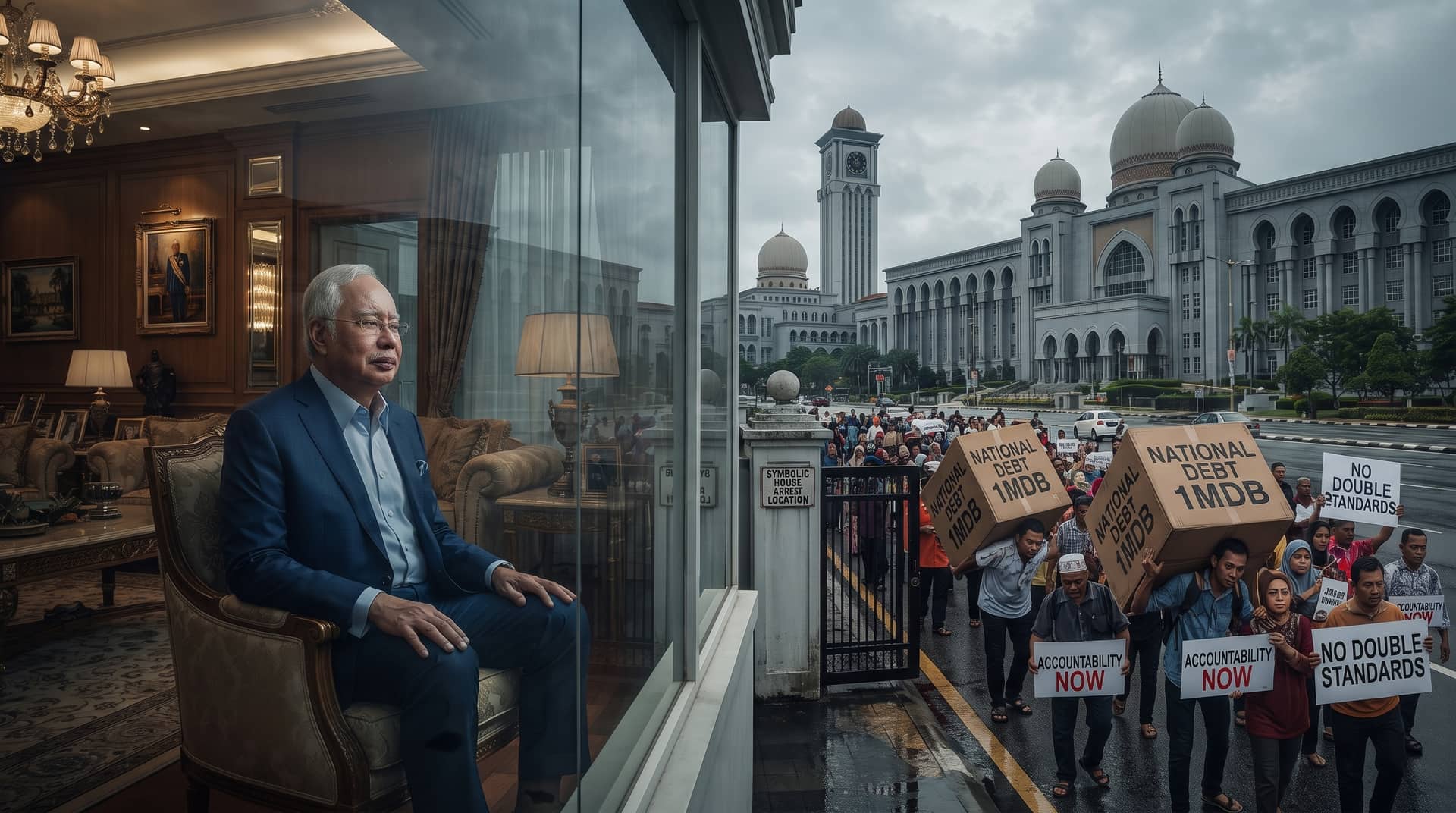
The recurring spectacle of high-profile clemency petitions does more than test the fragile resilience of a ruling coalition; it holds up an unsparing mirror to the nation’s ethical baseline. When political survival is routinely pitted against the unbending demands of institutional accountability, the resulting friction exposes a profound national malaise. We find ourselves trapped in a perpetual political loop where the architects of monumental fiscal damage are recast as martyrs, while ordinary citizens are left to service the staggering public debts they leave behind.
At the heart of this recurring drama is a striking dissonance regarding responsibility and consequence. While political factions bargain for early releases, house arrest concessions, and symbolic rehabilitation, they ignore the harsh reality etched into the public ledger. Grand corruption is never a victimless clerical error or a harmless administrative oversight. It is structural theft that compromises national development, weakens public infrastructure, and burdens generations of taxpayers with liabilities they had no hand in creating. When institutional leniency is contemplated for figures convicted of monumental financial crimes, it sends an unambiguous, corrosive signal to society: that the law is an elastic boundary for the powerful, yet an iron cage for everyone else.
The institutional fallout for the ruling administration is equally precarious. Navigating these turbulent waters requires an unflinching commitment to the rule of law, yet coalition politics often demands pragmatic compromises that erode public trust. If governance is reduced to a cold calculation of appeasing party warlords to avert immediate political collapse, the administration forfeits its moral mandate. True reform cannot be conditional on political convenience. Allowing the calculus of coalition survival to dictate the boundaries of justice transforms the legal system into a theater of impunity, alienating an electorate that expects integrity to supersede expedience.
When political entities scramble to frame judicial outcomes through self-serving narratives, they reveal a cynical disregard for public intelligence. Supporters may rally behind old loyalties, glossing over massive institutional deficits under the banner of past contributions, but the arithmetic of national debt remains unforgiving. Billions siphoned from sovereign funds do not simply vanish; they manifest as constrained public services, heavier tax burdens, and stunted economic futures for the young. To campaign for the rehabilitation of those who orchestrated such burdens while preaching reform is an exercise in political schizophrenia that ultimately exhausts the patience of the electorate.
The political landscape is further strained by the friction between coalition partners, where divergent agendas threaten to tear the administration apart. On one side, reform-minded factions face intense pressure from grassroots supporters who demand that convicted offenders serve their sentences in full. On the other side, traditionalist parties lean heavily into historical loyalty, pushing for clemency and special accommodations under the guise of unity. This tug-of-war places immense pressure on the architecture of governance, forcing leaders to choose between appeasing coalition partners and maintaining whatever moral authority they have left.
As executive bodies convene under royal prerogative to weigh these high-stakes petitions whether deciding on full pardons or house arrest concessions the outcome presents the administration with an existential paradox. Granting leniency risks alienating reformist allies who built their credibility on anti-corruption mandates, while upholding the sentence threatens to sever ties with traditionalist partners whose support keeps the government afloat. If choices are dictated merely by the threat of coalition fallout or broken electoral promises, the administration reduces governance to a transactional gamble, forcing parties to either swallow their principles or fracture the government.
Ultimately, a nation cannot build a sustainable economic future while remaining anchored to a culture of patronage and selective amnesia. Progress demands that accountability be applied universally, regardless of political lineage or past office. Until the political class learns to prioritize the collective welfare of the public over the rehabilitation of disgraced elites, public trust will remain elusive, and the foundational promise of equitable justice will remain unfulfilled. True stability is never achieved by bending the law to accommodate power; it is secured only when power is forced to bow before the law.
Justice loses its meaning the moment it becomes negotiable for the powerful. - Annan Vaithegi
Annan Vaithegi (annanvaithegi@icloud.com) is a content creator under the Newswav Creator programme, where you get to express yourself, be a citizen journalist, and at the same time monetize your content & reach millions of users on Newswav. Log in to creator.newswav.com and become a Newswav Creator now!
The User Content (as defined on Newswav Terms of Use) above including the views expressed and media (pictures, videos, citations etc) were submitted & posted by the author. Newswav is solely an aggregation platform that hosts the User Content. If you have any questions about the content, copyright or other issues of the work, please contact creator@newswav.com.