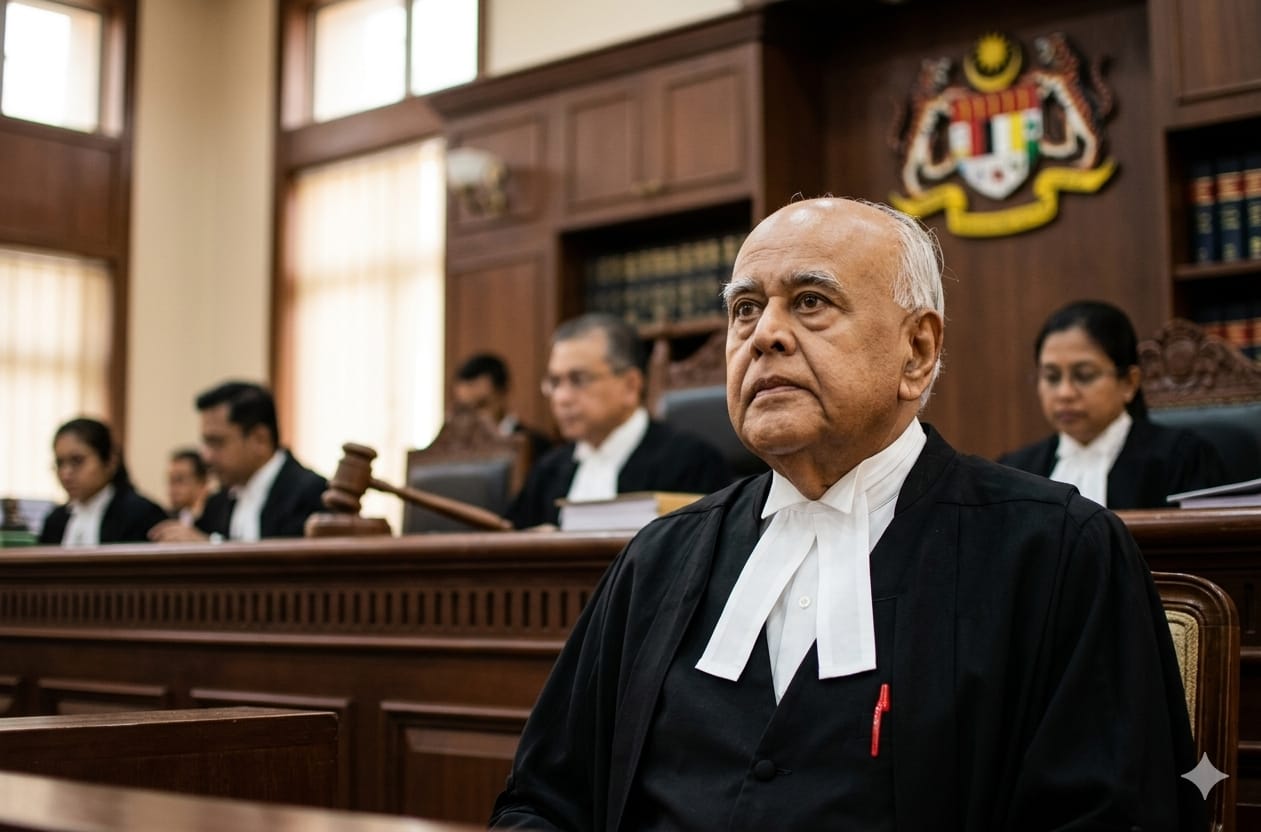
The passing of Datuk Seri Gopal Sri Ram marked the official end of the "Old School Gladiator" era for the Malaysian bar and bench. In a rare, delightfully unhinged recording on Advocates the Podcast, the late jurist left behind a masterclass in legal history, courtroom warfare, and the raw philosophy of what it truly means to be a "paid gladiator" of the law. Sri Ram’s reflections remind us of a golden era when the law was less about over-specialized corporate billings and more about the rigorous, holistic mastery of common law principles and a healthy dose of courtroom swagger.
The Accidental Mathematical Advocate
To truly understand Sri Ram’s razor-sharp precision in the courtroom, you have to look at his first love: mathematics. By his own admission, he was an "accidental lawyer." Left to his own devices, he would have been perfectly content living out his days as a happy mathematics teacher. The only reason he stepped foot into Lincoln's Inn was because his mother flatly refused to pay for a mathematics degree. “No way am I paying for you to become a math teacher,” she told him.
Yet, that mathematical mindset became his greatest weapon. He simply viewed complex legal briefs as structural equations, always seeking the shortest, most elegant route to a logical conclusion. In fact, he carried this obsession straight to the bar table. When bored out of his mind listening to tedious cross-examinations or unnecessary courtroom drama, he wouldn't doodle he would sit there calculating circle theorems in his head to stay sane.
Transforming Courtroom Culture: Defeating the "Ambush"
Modern Malaysian litigators take the mutual exchange of bundles of authorities for granted. We upload them smoothly on e-Review and call it a day. Few realize that we owe this sanity to Sri Ram’s early frustration with the time-honored Malaysian tradition of the "courtroom ambush."
Coming into practice as only number 211 on the rolls of Malaya, he found the standard tactic of hiding your legal authorities until the very last second absolute "nonsense." To break the habit, he started serving his lists on opponents early, effectively using a psychological guilt trip to force them into reciprocity. This procedural rebellion caught the eye of Chief Justice Raja Azlan Shah, who basically said, "Since you cowboys are already doing this, let’s make it a rule." Thus, the modern bundle of authorities was born, saving generations of junior lawyers from instant cardiac arrest at the podium.
The Philosophy of the Bench: "Scratch It, Don't Open It"
Sri Ram’s commentary on judicial temperament serves as a timeless, highly entertaining guide for the modern judiciary. He drew a sharp line between judges recruited from the civil service and those elevated directly from the practicing bar. In his view, the finest judges of his era men like Hashim Yeop Sani and Harun Hashim possessed an unmatchable judicial temperament because they understood a very simple concept: a court's primary duty is to listen, not to badger.
For the judges who loved to talk over counsel, Sri Ram offered some classic, unfiltered advice: "If your mouth is itching, scratch it don't open it."
His advice to advocates was equally unyielding. He completely rejected the modern, overly polite colloquialism of "humbly submitting" to the court. "Advocates are never humble," Sri Ram declared. "Humility is not the hallmark of an advocate. They are arrogant, but they are respectful." To Sri Ram, true advocacy required the fierce, unbowed confidence to look a judge in the eye and stand your ground, balanced perfectly with absolute reverence for the robe.
A Legacy of Relentless Slogging
If there is a singular lesson to extract from Sri Ram’s final reflections, it is his blunt command to the younger generation: learn the law. He openly mocked the trap of youthful arrogance, laughing at how his own massive, weekend-long research sessions could be completely dismantled by a senior colleague like Robert Chelliah, who would casually open a tiny notebook and cite a single, definitive Privy Council decision that ended the entire argument.
Gopal Sri Ram was a self-proclaimed "slogger" who transformed himself into a giant. He proved that an "utterly hopeless, terrible student" in school could become the architect of Malaysia’s constitutional jurisprudence through pure, unadulterated dedication to the craft.
Saving the Nation One Judgment at a Time
To truly appreciate his patriotism, one must examine how his pen actively shielded the democratic foundations of Malaysia from executive overreach. He pioneered the "living document" approach to the Federal Constitution, ensuring it served as a dynamic shield for ordinary citizens rather than a weapon for the state.
Through the landmark Federal Court decision in Sivarasa Rasiah, Sri Ram introduced the "prismatic interpretation" of human rights. He established that constitutional liberties must be read as broadly as a prism reflects light, while state restrictions must be read micro-strictly. By declaring that any law curbing free expression or public assembly must be objectively reasonable and proportionate, he single-handedly stripped Parliament of the power to pass unchecked, oppressive statutes.
Furthermore, he fundamentally expanded Article 5’s "Right to Life" to include living with basic human dignity, employment, and unhindered access to justice. When corporate or political "ouster clauses" attempted to castrate the courts and block citizens from judicial remedies such as in the historic Danaharta Urus v. Kekatong dispute Sri Ram fiercely struck them down. He firmly held that the inherent power of judicial review was an untouchable, co-equal branch of the separation of powers.
The Twilight Crusade: Prosecuting the Unprosecutable
Sri Ram’s love for the law did not fade into a quiet retirement. When the nation was rocked by unprecedented institutional corruption, he returned to the trenches of practice and accepted a grueling appointment as a Senior Deputy Public Prosecutor.
As the legal spearhead in the complex 1MDB and corruption trials of former high-ranking state leaders, Sri Ram masterfully mapped out complex webs of financial graft. He carried the immense structural burden of holding the executive accountable. By refusing to let political status or elite immunity deter the course of justice, he sent an enduring, ironclad message to Putrajaya: no individual, no matter how powerful, sits above the rule of law.
An Indelible Mark on the Fabric of Justice
Ultimately, Datuk Seri Gopal Sri Ram’s true immortality lies within the pages of the Malayan Law Journal. As the first practitioner to be elevated directly to the Court of Appeal, he broke structural glass ceilings and completely rewrote the rules of judicial output. The sheer volume, depth, and analytical clarity of his judgments breathed new life into administrative and constitutional law, transforming abstract statutes into living protections for the common Malaysian.
He did not merely interpret the law; he sculpted it. Whether prosecuting high-profile cases with relentless focus or delivering landmark rulings from the bench, his footprint on our legal architecture is permanent. He remains an irreplaceable pillar of Malaysian justice a man whose booming voice and sharp wit will echo through our courtrooms for generations to come.
Annan Vaithegi: “A good law does not merely punish the guilty; it protects the innocent from being crushed by the machinery of justice.”
Annan Vaithegi (annanvaithegi@icloud.com) is a content creator under the Newswav Creator programme, where you get to express yourself, be a citizen journalist, and at the same time monetize your content & reach millions of users on Newswav. Log in to creator.newswav.com and become a Newswav Creator now!
The User Content (as defined on Newswav Terms of Use) above including the views expressed and media (pictures, videos, citations etc) were submitted & posted by the author. Newswav is solely an aggregation platform that hosts the User Content. If you have any questions about the content, copyright or other issues of the work, please contact creator@newswav.com.