
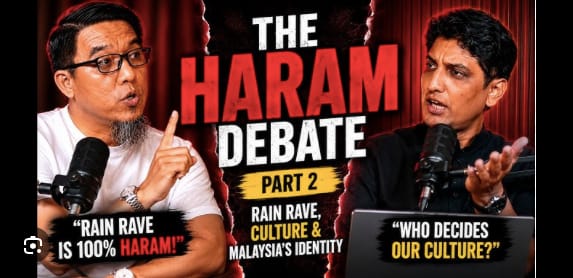
There was a moment deep into the now-viral podcast exchange between Vinoth and Firdaus Wong when the conversation simply stopped moving.
Across the three-part podcast dialogue between Vinoth and Firdaus Wong, a revealing stalemate slowly emerged: two men speaking fluently, yet increasingly unable to speak within the same moral framework.
The HARAM Debate (PART 1) | with Firdaus Wong
Rain Rave Is HARAM! (PART 2) | Firdaus Wong DOUBLES DOWN
Race, Religion & Privilege (PART 3) | with Firdaus Wong | The Final Showdown
Not because either man had run out of words.
But because they had run out of shared language.
One spoke in the language of legality. The other spoke in the language of humanity. One demanded proof, procedure, and constitutional boundaries. The other pleaded for sensitivity, dignity, and social restraint. Both insisted they were defending harmony. Yet by the end of the exchange, harmony itself had become the battlefield.
The stalemate was not accidental. It was structural.
And perhaps that is the most unsettling revelation of all.
The Battle Over “Kuil Haram”
No phrase captured the fracture more clearly than “kuil haram.”
For Firdaus Wong, the term was presented as an administrative and legal description. If a structure stood on land without legal authorization, then the issue in his view was fundamentally about legality, trespassing, and procedural correctness. To him, the outrage over the phrase represented emotional overreaction and what he repeatedly framed as “semantic infiltration”: an attempt to soften or sanitize wrongdoing through language.
For Vinoth, however, the issue was never merely linguistic.
The host repeatedly argued that words carry social weight beyond dictionary definitions. In a deeply religious and multicultural society like Malaysia, the term “haram” does not exist in a sterile legal vacuum. It carries theological gravity. It invokes moral condemnation. To apply such language to a non-Muslim house of worship, regardless of legal status, transforms a land dispute into a civilizational confrontation.
And this was the central divide.
Firdaus Wong viewed language as subordinate to factual legality.
Vinoth viewed language as inseparable from social consequence.
One side asked:
“Is the structure legal?”
The other asked:
“Even if it is illegal, must we speak this way?”
Neither question is inherently irrational.
But they belong to entirely different moral frameworks.
The Contradiction Between Openness and Defensiveness
One of the most fascinating tensions throughout the debate was the contradiction between Firdaus Wong’s stated openness to correction and the defensive structure of his communication style.
At multiple points, he emphasized that he was willing to learn, willing to engage, and willing to be corrected if proven legally wrong. He framed himself as someone open to public discourse and investigation, repeatedly insisting that criticism should be substantiated with evidence and proper procedure.
On the surface, this positioned him as intellectually receptive.
Yet the actual rhythm of the conversation often projected something very different.
Whenever Vinoth attempted to secure direct “yes” or “no” answers on emotionally sensitive ethical questions, the response frequently shifted away from moral clarity and back toward legal interpretation, definitional disputes, or personal religious frameworks.
This was not simply disagreement.
It was conversational repositioning.
Questions about emotional impact became debates about constitutional legality. Questions about dignity became debates about administrative procedure. Questions about communal sensitivity became discussions about factual correctness.
The result was a growing perception fair or otherwise that openness to correction existed primarily within narrow legal parameters rather than broader ethical ones.
And this is where the debate became psychologically revealing.
Because a refusal to provide direct answers in emotionally charged discussions can create the perception that the speaker is avoiding the wider social implications of a straightforward response.
That perception may not always be accurate.
But in public discourse, perception itself becomes part of the political reality.
The Manoeuvring of the Modern Debate
The debate became especially fascinating not because of what was said but because of how it was said.
Throughout the exchange, Firdaus Wong consistently avoided direct “yes” or “no” answers whenever the discussion approached emotionally explosive terrain. Instead, he employed a series of rhetorical manoeuvres that shifted the battleground away from ethics and back toward legality.
The first manoeuvre was the re-framing of the premise itself.
Whenever the discussion centered on whether the phrase “kuil haram” was insensitive or inflammatory, the conversation was redirected toward permits, land ownership, municipal procedures, and constitutional rights. What began as a debate about public decency was repeatedly repositioned as a debate about administrative legality.
This was not accidental.
It was strategic narrowing.
By reducing the discussion to procedural facts, the larger emotional and symbolic implications were effectively sidelined.
The second manoeuvre was anecdotal deflection.
When confronted with difficult ethical hypotheticals, Firdaus Wong frequently pivoted toward stories and examples designed to redirect emotional focus. The discussion surrounding the DBKL operation became a prime illustration. Instead of engaging directly with the question of whether language could inflame communal sensitivities, the conversation shifted toward stories about roadside shrines being removed peacefully and communities allegedly accepting enforcement without protest.
The anecdote served a rhetorical purpose.
It replaced abstraction with imagery.
And in doing so, it subtly repositioned the audience’s emotional sympathies.
The third manoeuvre was perhaps the most significant: the shifting of moral accountability onto the legal system itself.
Repeatedly, Firdaus Wong invoked a familiar line:
“If I am wrong, file a police report.”
At first glance, the statement appears reasonable. After all, societies governed by law require legal mechanisms.
But beneath the surface lies a more consequential implication.
It suggests that morality only becomes actionable once it crosses into illegality.
In other words, if no court convicts, no police investigation succeeds, and no law is technically broken, then the speaker bears no further obligation to confront the social consequences of his rhetoric.
This is legalism in its purest modern form.
Not necessarily unlawful.
But profoundly detached from the emotional architecture that holds plural societies together.
Vinoth’s Counterattack
To his credit, Vinoth recognized the manoeuvring almost immediately.
Again and again, the host attempted to drag the conversation back into the realm of ethics, social responsibility, and emotional intelligence.
He challenged the reduction of religious sensitivity into administrative terminology. He rejected what he saw as “semantic infiltration” from the opposite direction the transformation of deeply emotional disputes into cold bureaucratic exercises.
Most importantly, he persistently demanded direct answers.
Would a surau built illegally also be called “haram”?
Would the same terminology be applied consistently across religions?
Could something be legally correct yet socially irresponsible?
These were not merely argumentative traps.
They were attempts to expose whether the principles being articulated could survive moral consistency.
Yet what became increasingly visible throughout the discussion was Firdaus Wong’s refusal to engage with what Vinoth framed as ethical equivalence.
Whenever analogies emerged that threatened to blur rigid legal distinctions, the response was swift:
“That is apples and oranges.”
The effect was subtle but powerful.
By rejecting ethical hypotheticals outright, the debate remained confined within legal boundaries rather than moral ones.
And this is where the communication breakdown truly crystallized.
Vinoth was attempting to discuss how words affect societies.
Firdaus Wong was attempting to discuss whether rules had technically been broken.
Neither man fully entered the other’s framework.
So the conversation looped endlessly.
The Crisis of Modern Discourse
This stalemate extends far beyond a single podcast.
It reflects a broader crisis in modern public dialogue.
Increasingly, public figures defend themselves not by asking whether something is wise, compassionate, or socially constructive but by asking whether it is technically illegal.
The distinction matters.
Because legality establishes the minimum threshold of acceptable conduct.
But societies are not sustained by minimum thresholds alone.
They are sustained by restraint.
By grace.
By the understanding that in diverse societies, not every truthful statement must be weaponized at maximum volume.
At the same time, the opposite danger also exists.
A society cannot function if emotional offense becomes the sole measure of public speech.
Not every disagreement is hatred.
Not every criticism is oppression.
Not every uncomfortable statement is violence.
And that is precisely why this debate resonated so deeply.
Both men were defending legitimate anxieties.
One feared the erosion of law and consistency.
The other feared the erosion of humanity and coexistence.
Yet when legality and compassion cease speaking to each other, national discourse begins to fracture into parallel realities.
One side asks:
“Is it legal?”
The other asks:
“Is it decent?”
And somewhere in between, the country quietly loses the ability to answer both.
The Silence After the Debate
Perhaps the most haunting part of the exchange was not the arguments themselves.
It was the exhaustion that settled over the conversation.
The repeated interruptions.
The circular reasoning.
The inability to secure even a single shared premise.
By the end, both men were still talking.
But they were no longer truly communicating.
That may ultimately be the defining condition of modern discourse.
Not open hostility.
But sophisticated misunderstanding.
A society where legality replaces empathy.
Where sensitivity replaces clarity.
Where everyone insists they are defending harmony while simultaneously speaking past one another.
And in that widening gap between law and decency, between technical correctness and human wisdom, lies the true danger.
Not chaos.
But a nation slowly forgetting how to hear itself.
Annan Vaithegi writes socially conscious columns examining the tensions between legality, morality, and coexistence in modern society.
Annan Vaithegi (annanvaithegi@icloud.com) is a content creator under the Newswav Creator programme, where you get to express yourself, be a citizen journalist, and at the same time monetize your content & reach millions of users on Newswav. Log in to creator.newswav.com and become a Newswav Creator now!
The User Content (as defined on Newswav Terms of Use) above including the views expressed and media (pictures, videos, citations etc) were submitted & posted by the author. Newswav is solely an aggregation platform that hosts the User Content. If you have any questions about the content, copyright or other issues of the work, please contact creator@newswav.com.