.jpg)
By Mihar Dias October 2026
It was the best of times. And it was the worst of times. (Dickens).
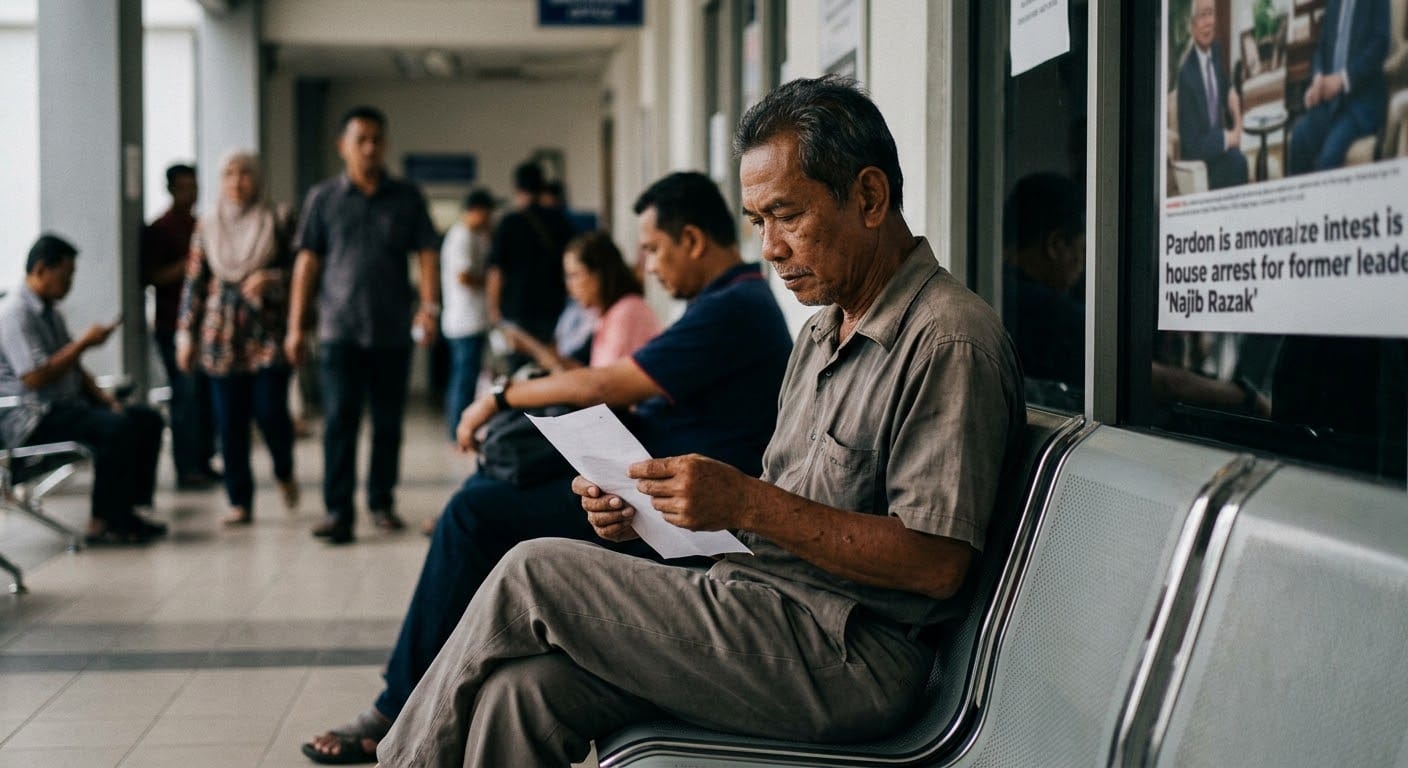
Actually, in Malaysia after almost 70 years of independence, it depends on which queue you are standing in.
If you are among the fortunate, the system can sometimes look remarkably flexible. If you are among the unfortunate, flexibility is something you see only when other people are being flexible.
Pasir Gudang MP Hassan Abdul Karim has now said aloud what many ordinary Malaysians have been quietly wondering: are we gradually becoming a country with two tracks of justice — one for ordinary rakyat and another for the political elite? https://www.thestar.com.my/news/nation/2026/09/19/najib039s-pardon-gives-pakatan-harapan-an-039advantage039-claims-pasir-gudang-mp
That is quite a question for a member of the ruling coalition to raise.
Hassan was commenting on the conditional pardon granted to former prime minister Najib Razak, which allows him to serve the remainder of his sentence under house arrest, subject to conditions including a RM50 million fine. He also questioned the political consequences for Umno and PAS, arguing that the development has created an opportunity for Pakatan Harapan to go on the offensive.https://www.thestar.com.my/news/nation/2026/09/19/najib039s-pardon-gives-pakatan-harapan-an-039advantage039-claims-pasir-gudang-mp
But let us leave the politics aside for a moment.
The more interesting question is what happens to the Malaysian citizen who does not have a political party, a fundraising machine, prominent friends, lawyers on speed dial or a national argument taking place over his predicament.
For him, justice is rather less negotiable.
He receives the letter. He reports to the court. He pays what he can. He serves what he must. But nobody starts a national fundraising campaign asking whether he should be allowed to serve his sentence from the comfort of his living room.
This is not about whether one particular individual deserves sympathy or punishment. That is for the courts, the law and the constitutional processes to determine.
It is about something more fundamental:
Does justice feel equal to the person standing at the bottom of the ladder?
Because equality before the law is a wonderfully comforting phrase.
The problem begins when people start comparing experiences. One Malaysian sees a prison sentence. Another sees house arrest.
One struggles to raise RM5,000. Another has supporters discussing RM50 million.
One defendant becomes yesterday's news. Another becomes tomorrow's election strategy.
And suddenly the citizen begins to wonder whether Malaysia has accidentally invented a new judicial principle:
Equal justice, different packaging.
Of course, nobody should be denied lawful remedies merely because he is rich, famous or politically important. That would be unfair.
But neither should ordinary Malaysians feel that the law becomes more accommodating as one's social altitude increases. That would be worse.
Because democracy is not merely about allowing people to vote every few years.
It is also about whether the citizen believes that the same rules apply when the voting is over.
Now, here lies the great Malaysian paradox.
We have become enormously successful at modernisation.We have skyscrapers.Highways.
Digital government.Artificial intelligence.
Cashless payments.Smartphones capable of doing almost everything except explaining Malaysian politics.
Yet somewhere underneath all this technological sophistication sits an ancient human suspicion:
Is the system really the same for everybody?
Hassan's intervention is therefore significant precisely because he comes from within the political system. He has not merely thrown stones from the opposition benches. He has questioned whether the public now sees a justice system divided into two levels.
That should make everyone uncomfortable.
Not because Hassan is necessarily right about every political implication. But because a democracy should be uncomfortable whenever its citizens begin to believe that justice has a VIP entrance.
The irony is almost too perfect for us to see.
For decades, Malaysians have been told that the country is progressing. Of course, it is.
The unfortunate part is that progress appears to have developed two speeds.
There is the Malaysia of the privileged — where lawyers negotiate, politicians strategise, supporters organise and public relations departments go into overdrive.
Then there is the Malaysia of everyone else — where the ordinary citizen stands patiently in line and hopes the photocopier at the government counter is working.
Perhaps this is simply how modern democracy works. Perhaps equality before the law means everybody is equal — but some people have considerably better resources for demonstrating their equality.
That is the cynical interpretation.
The optimistic interpretation is that Malaysia is still capable of correcting itself. And that is where Hassan's question becomes bigger than Najib, Umno, PAS, Pakatan Harapan or the next general election.
It becomes a question about the Malaysia we want after nearly seven decades of independence. A Malaysia where justice is blind.
Or a Malaysia where justice is perfectly capable of seeing who is standing in front of it.
Because if we are not careful, we may eventually discover that Dickens got Malaysia right after all:
It is the best of times. It is the worst of times.
Yes, depending on which queue you are standing in, it can be both at exactly the same time.
Mihar Dias (mihardias@gmail.com) is a content creator under the Newswav Creator programme, where you get to express yourself, be a citizen journalist, and at the same time monetize your content & reach millions of users on Newswav. Log in to creator.newswav.com and become a Newswav Creator now!
The User Content (as defined on Newswav Terms of Use) above including the views expressed and media (pictures, videos, citations etc) were submitted & posted by the author. Newswav is solely an aggregation platform that hosts the User Content. If you have any questions about the content, copyright or other issues of the work, please contact creator@newswav.com.