DATES do not decide a case.
But when allegations involve a government project, public funds and a later financial transaction cited as evidence of a possible connection, dates can tell us what questions still need to be answered.
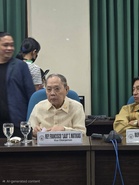
That is becoming important in the preliminary investigation involving Surigao del Norte Rep. Francisco “Lalo” Matugas and the Mahayhay-Tuburan Road project in Del Carmen.
The ombudsman is investigating allegations involving a road project that was reportedly fully paid but subsequently found during an inspection to be only partially accomplished.
Those allegations deserve to be investigated.
But Matugas has now filed a counter-affidavit, putting another set of facts and arguments before the ombudsman.
Among them is a chronology worth examining.
According to the complaint as quoted in the counter-affidavit, the contract for the road project was entered into on Feb. 22, 2022.
At the time, Matugas was governor of Surigao del Norte. His term ended on June 30, 2022.
From July 1, 2022 until June 30, 2025, Matugas occupied no elected or appointive public office.
That period matters because the complaint identifies payments to contractor Boometrix Development Corp. beginning in February 2022 and continuing until March 24, 2024.
Thus, while the project began during Matugas’ term as governor, payments continued well into the period when he was already a private citizen.
Then there is the financial transaction cited in the complaint.
The complaint refers to a real estate mortgage, or REM, involving Matugas and his wife in connection with a loan involving Boometrix.
According to the counter-affidavit, the REM was executed on May 1, 2025 — more than a year after the last project payment identified in the complaint, dated March 24, 2024.
At the time, Matugas was not holding public office. He would assume his present congressional post only on July 1, 2025.
Put those dates together.
The last project payment identified in the complaint: March 24, 2024.
The REM: May 1, 2025.
Matugas’ return to public office: July 1, 2025.
What does that chronology prove?
By itself, nothing conclusive.
Being a private citizen when the REM was executed does not make the transaction irrelevant to earlier events. Nor does the timing necessarily mean the mortgage and project could not be connected.
Investigators may have other evidence establishing such a connection.
But the reverse is equally important.
A later financial transaction does not, standing alone, establish its connection to an earlier government project. That connection has to be shown by evidence.
Matugas maintains that the REM was provided as security for a loan involving Boometrix. He says the mortgage document does not mention the Mahayhay-Tuburan Road project or give him any role in managing the contractor.
He also states that he did not sign any document relating to the road project or prepare, review or approve the project documents, disbursement vouchers, inspection reports or certifications being questioned.
These are defenses, not findings. They must be tested against the ombudsman’s evidence.
But that is precisely why the chronology matters.
If the May 2025 mortgage is being cited as evidence relevant to Matugas’ alleged participation in irregularities involving the road project, what establishes the connection?
Was the mortgage connected to project proceeds? Did Matugas receive project proceeds? Was there an earlier agreement explaining the later mortgage? Does other evidence connect the May 2025 transaction to decisions or payments made during the project?
Or was it a separate transaction?
Those are questions for evidence to answer.
The same principle applies to Matugas’ period outside public office.
Being a private citizen does not exclude someone from possible participation in wrongdoing involving government. But if such participation is alleged, the particular acts attributed to that person and the supporting evidence should be identified.
That is what preliminary investigation is for.
The complaint presents one side. The counter-affidavit presents the response. Neither should substitute for examination of the complete record.
The Mahayhay-Tuburan case involves serious allegations involving public money. It deserves serious scrutiny — of the allegations, the defenses and the evidence connecting each respondent to the acts being investigated.
Dates cannot decide guilt or innocence.
But they can establish the sequence of events.
And when one transaction is being used to help explain another that occurred more than a year earlier, chronology is not a minor detail.
It is part of the evidence that must be explained.
In this case, the dates matter.